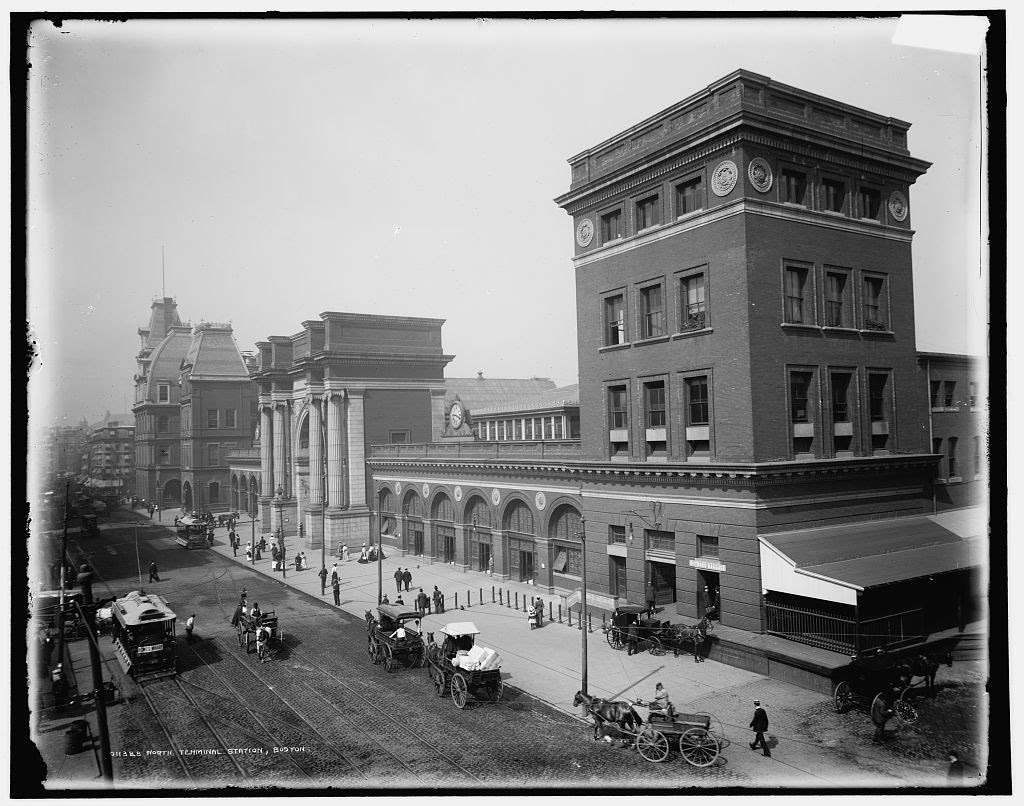
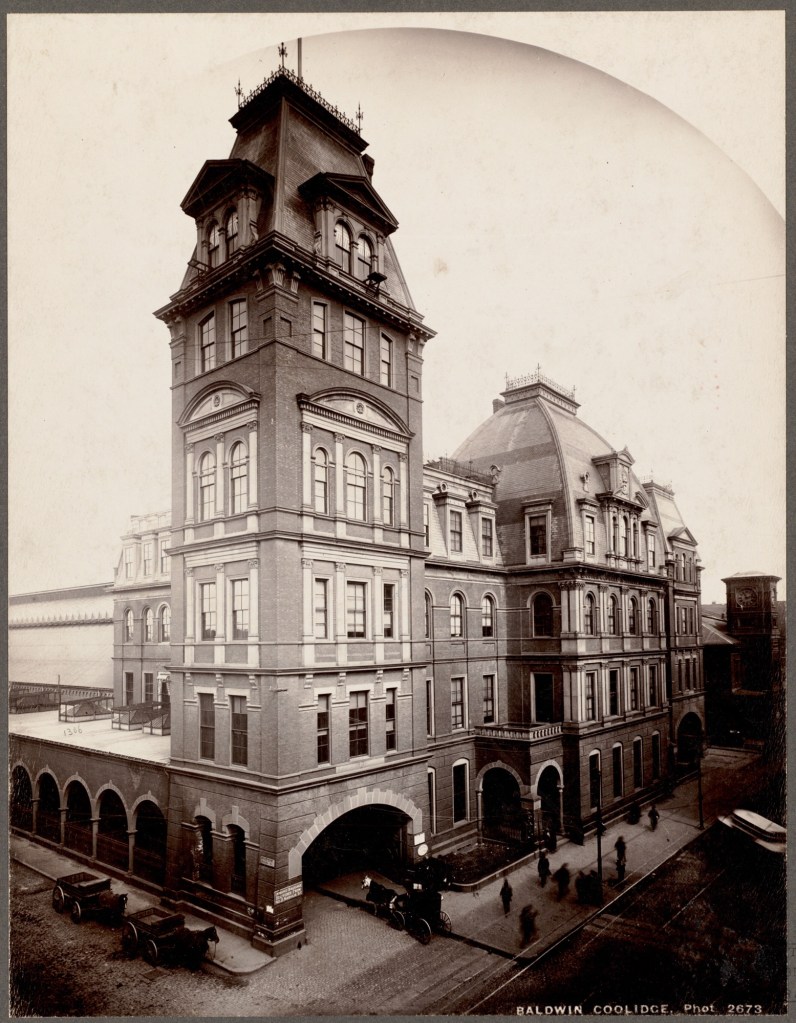
By the 1890s, many of the regional train lines in New England consolidated and as a result, union stations were built. All north-bound train lines including the Boston & Lowell and Boston & Maine railroads would consolidate into North Union Station with southbound trains consolidated into South Station. North Union Station, actually three adjoined buildings, was completed in 1893 and included the former Boston & Lowell Station, a Second Empire masterpiece which dated from 1873. The other sections of Union Station were designed by the firm, Shepley, Rutan & Coolidge, and comprised of an office tower at the rightmost section and a central building serving as the main entrance and concourse with waiting rooms and baggage holding. The central entrance exhibited an elaborate columned block of brick with stone trimmings. The station lasted until 1927 when the entire complex was razed for the new North Station (The Boston Garden), which itself was replaced. The demolition of the Old North Union Station was one of the biggest architectural losses in Boston’s history, a stain on its historical legacy only compounded by the sterile development we see there today.
 Buildings of New England