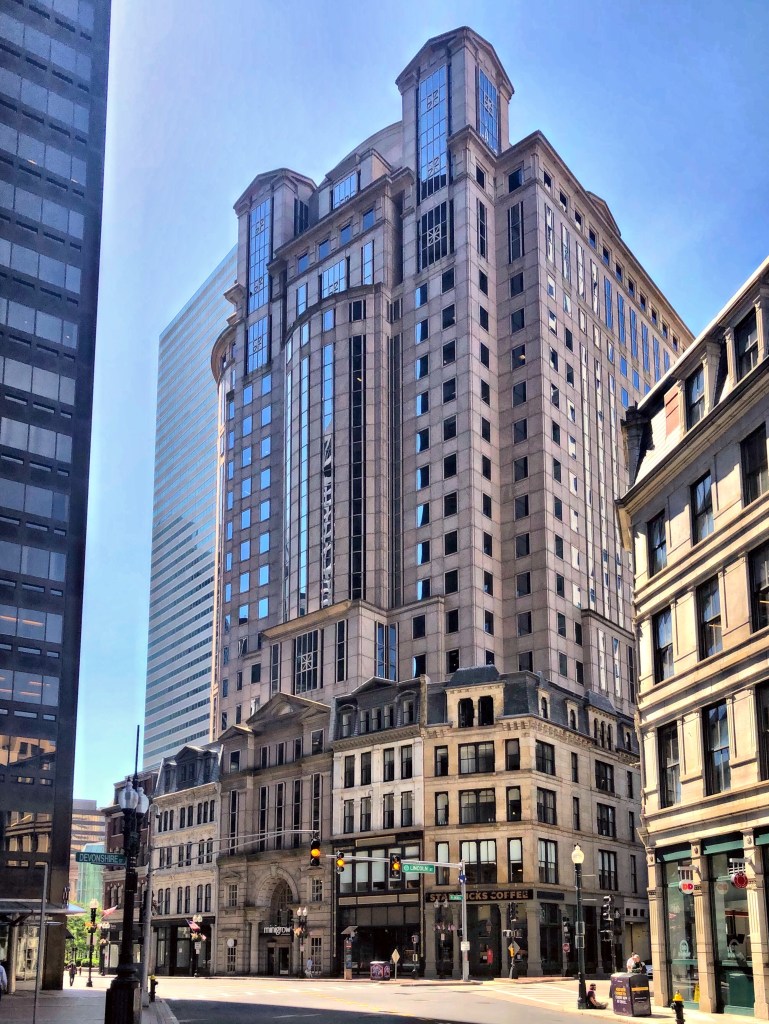
125 Summer Street // 1989

The late 1980s were a time of financial success for developers and banking companies all over the country. It seems that more skyscrapers were constructed in Boston this decade than any other of the 20th century, but working within the confines of the historic downtown of the city, left architects and developers to come up with creative ways to build here. The architectural firm of Kohn Pederson Fox was hired to construct a 20+ story office tower at the southern edge of the Financial District in Boston, while preserving the small-scale commercial buildings there. A row of four-story commercial blocks constructed after the Great Boston Fire of 1872 were retained with the tower seemingly growing out of them. The process here is known as “facadism” which is a valuable preservation tool to balance preservation with density in historic downtowns, though not always done right. This KPF design with its Post-Modern tower in concrete and granite fits well within the streetscape and maintains a walkable block downtown.

What do you think of this design?

Richards Building // 1859

One of my favorite buildings in Downtown Boston is the Richards Building on State Street for its rare and lavish cast-iron facade. Built in about 1859, the building was developed by Quincy A. Shaw and Gardiner H. Shaw (uncles of Robert Gould Shaw, who led the famed African American regiment that is the subject of St. Gaudens’ and Charles McKim’s Boston Common monument), merchants who then leased out commercial space in the building. The architect of the building is unknown; however, the sheet metal was supplied by E.B. Badger & Sons. The original design was a five-story, eight-bay cast iron front structure, in the Northern Italian mode of the Renaissance Revival style. The facade is only a screen attached to the front of the building. It is made of pieces of cast iron that were fabricated in Italy and bolted together in Boston. In 1889, the building was sold to Calvin A. Richards, a wealthy street railway tycoon and it is presumed that the two upper stories and corner oriels were added at that time. The building features one of a handful of extant cast-iron facades in Boston, which was restored in the 1980s.

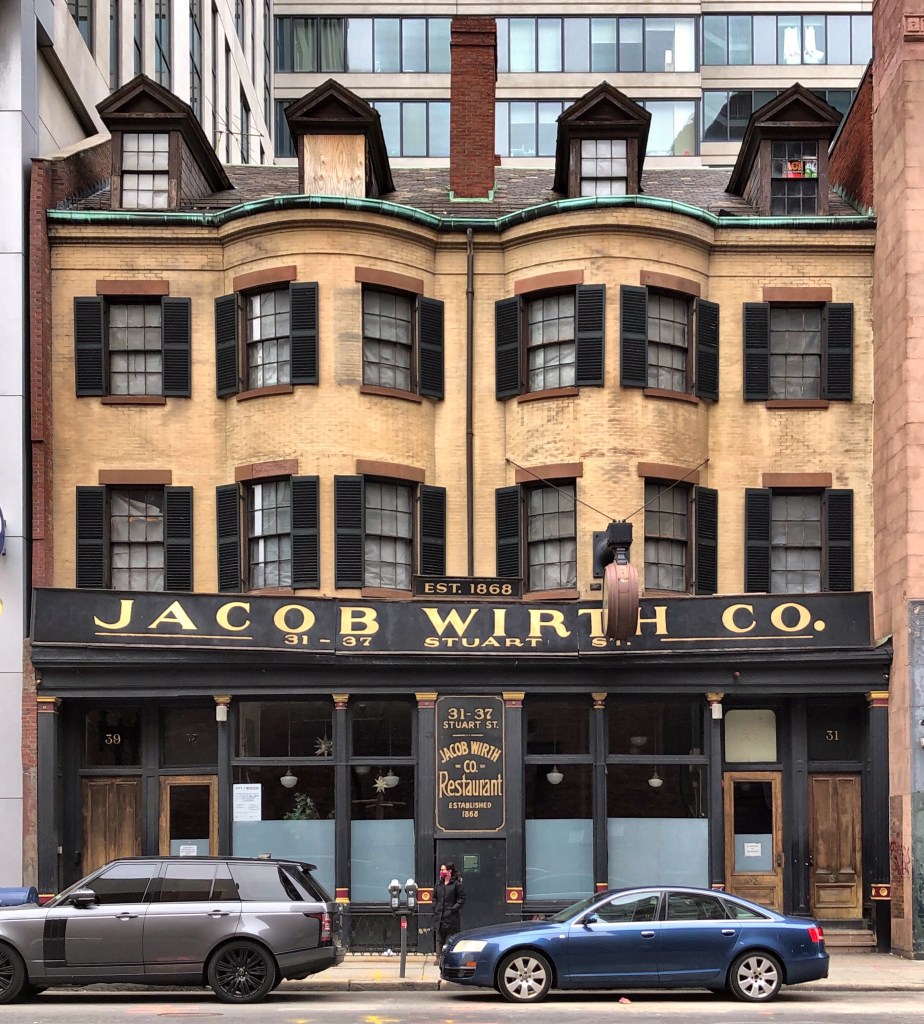
Jacob Wirth Building // 1844

Comprising twin bowfront Greek Revival rowhouses, the Jacob Wirth Restaurant buildings on Stuart Street are scarce survivors of a century of urban change in an area in which the building type once abounded. Built by developer housewrights quite active in the area, the twin houses were soon sold to “gentlemen” for rental purposes. Jacob Wirth, a German emigrated to Boston from Bingen, Germany, and began work as a baker before getting into the restaurant business. Wirth bought the left building seen here in 1878 as his dwelling above and ran his authentic German restaurant below. Due to the success of the restaurant, he purchased the adjacent home in 1889 and constructed the storefront that now unites them. Jacob Wirth ran the restaurant until his death in 1892, which was then managed by his son, Jacob Wirth Jr., who also managed it until his death in 1965! In 2018, Jacob Wirth’s, the second oldest continuously operated restaurant in Boston, closed its doors following a fire. The future is somewhat uncertain for the space, but as it is landmarked, there are protections (even at the interior) of the building.

Did you get a chance to eat at Jacob Wirth’s before it closed?