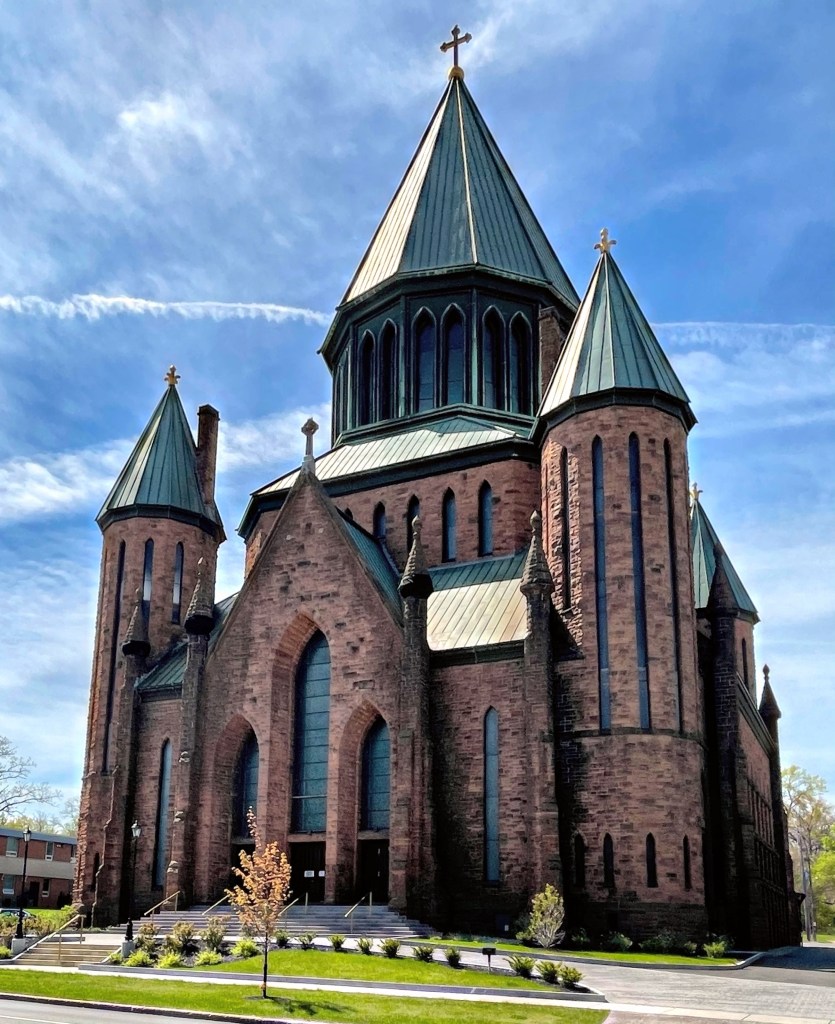
St. John the Evangelist Church // 1900

St. John the Evangelist Church in Schenectady, NY is probably the most imposing church I have ever seen (outside of European cathedrals). The church began in 1898 when Monsignor John L. Reilly purchased land across from Union College’s campus to erect a new church. He began collecting donations to fund a church suitable for Schenectady, and visited Europe to seek inspiration for the design. He worked with architect Edward Loth of nearby Troy, NY on the design which resulted in this massive 120’x130′ structure. The stone church has a small tower at each of its four corners with a central spire reaching 230′ high. The center spire was constructed of steel and glass to cast light onto the sanctuary below (sadly has been replaced with a metal roof). This is definitely one of the more memorable churches I have ever seen! What do you think of it?
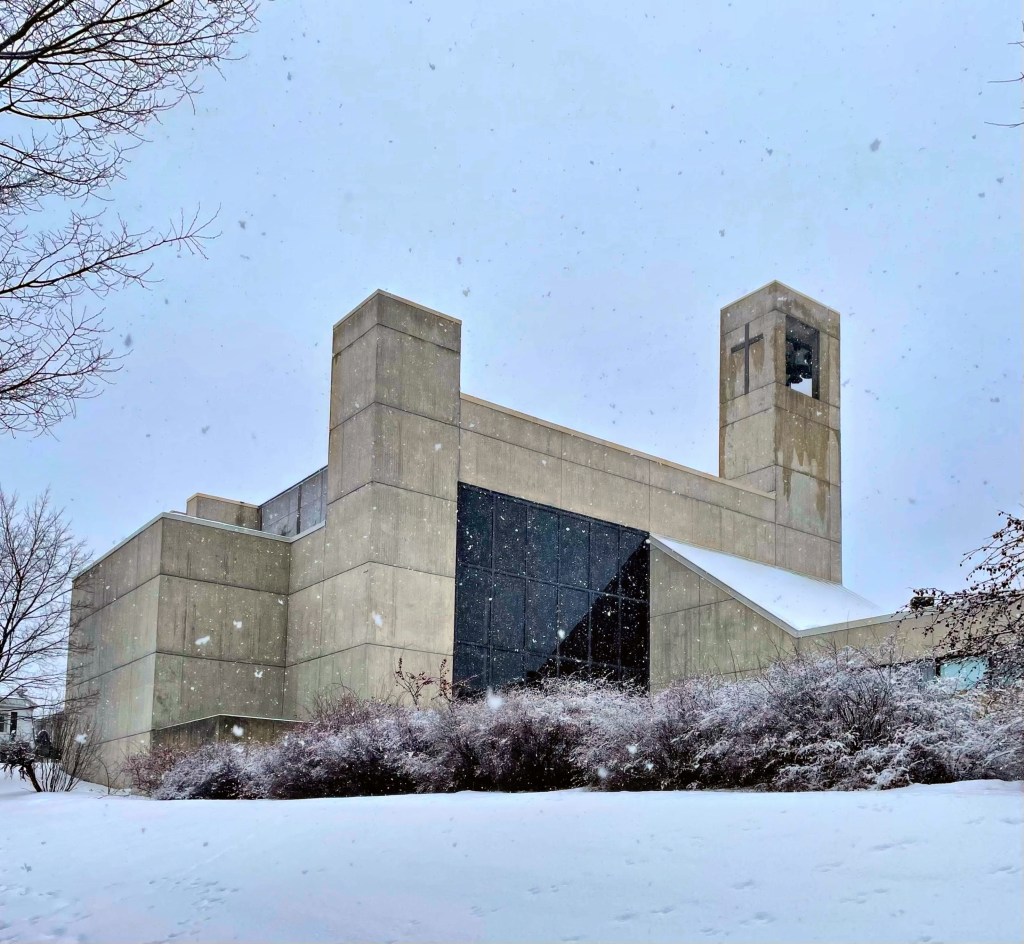
St. Paul’s Cathedral, Burlington // 1973

St. Paul’s Church in Burlington, Vermont, was organized in 1830, when Burlington’s population was about 3,500. About 55 Episcopalians met at a local hotel and laid the groundwork for the parish. In 1832, the fledgling parish dedicated its new building, a neo-Gothic limestone structure, which was enlarged multiple times as the congregation grew as the city did. In 1965, the Diocesan Convention voted that St. Paul’s Church be designated a Cathedral Church of the Diocese (one of two in the state). Just six years later, it was destroyed by fire, sparked by an electrical malfunction in the basement, leading to a new evolution of the church. At the time of the fire, the City of Burlington was engaged in massive urban renewal projects. As a part of this program, the City offered to swap the land on which Old St. Paul’s had stood for a spacious new tract overlooking Lake Champlain and the Adirondacks. Although the decision to change locations was a contentious one, the parish did accept the offer. When discussing designs for a new cathedral, there was a strong desire to make a new statement in architecture, diverging from the traditional Gothic or Colonial designs seen all over the country. An international competition was held to determine the architect of the new Cathedral. The winner was the local firm Burlington Associates, now Truex, Cullins & Partners. Completed in 1973, the Cathedral is made of stressed concrete. The structure stands strong and firm, yet is welcoming. Windows provide sweeping views of Lake Champlain and the distant Adirondacks.

Mary Immaculate of Lourdes Catholic Church // 1909

One of the grandest churches around Boston, Mary Immaculate of Lourdes R.C. Church, is in Upper Falls Newton, a working class village which developed around industrial mills in the 19th century. The church, built in 1909, towers above the workers cottages and smaller frame homes in the neighborhood showing the wealth and importance of the Catholic Church to Irish immigrants who worked and lived nearby. This parish was the first in the town of Newton and it comprised of multiple villages along with parts of Wellesley and Needham. The parish was formed in the 1840s and eventually grew so much it petitioned the Archdiocese to construct a new house of worship worthy of the population. In the early 20th century, a site was secured, and the house on the lot was moved for the erection of a new church. Edward T. P. Graham was selected as the architect, who designed this Renaissance Revival church. The commanding monumental columned portico rises over two stories and supports a projecting pediment which has decorative modillion blocks, cast figures within depicting religious figures. A campanile (bell tower) is located at the rear corner and is of Italian Renaissance design. In 2004, the Archdiocese had put Mary Immaculate on the closing list of churches; however, in 2006, the Cardinal had reconsidered his plan to close the church and decided to close a church in nearby Waban Village instead.