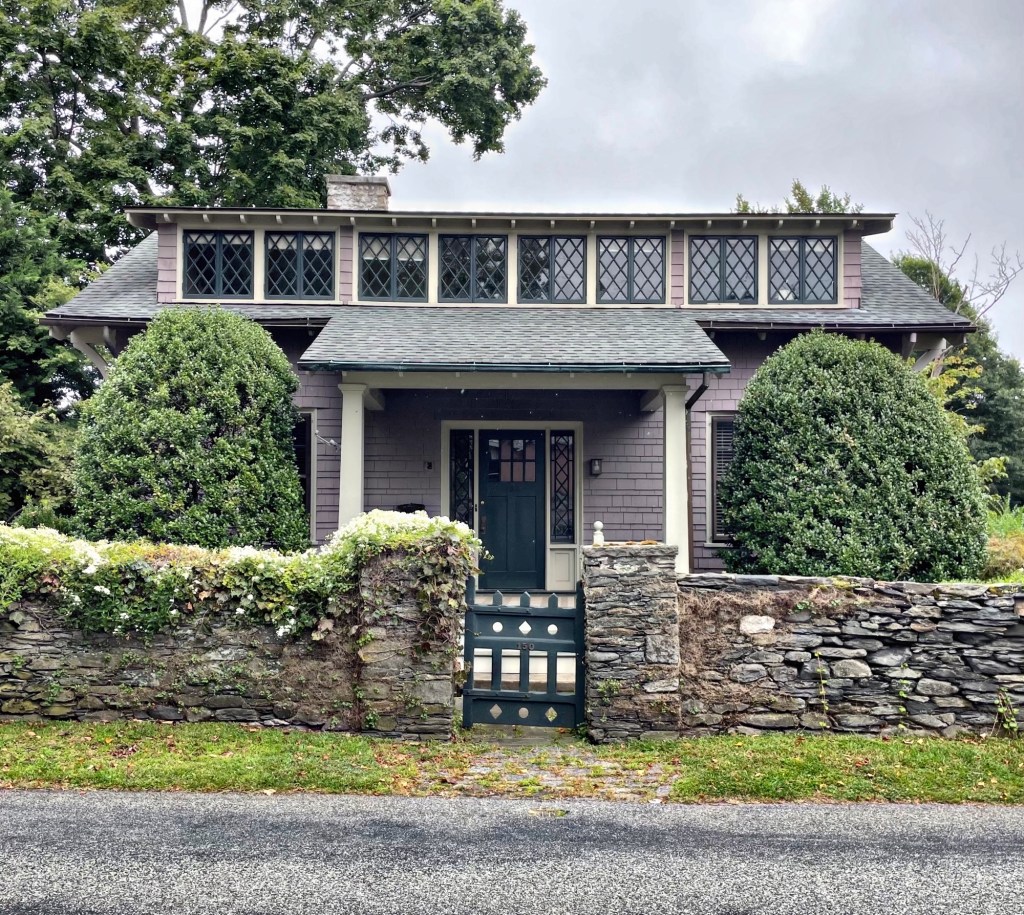
Maud Howe Elliott Bungalow // c.1912

This shingled Craftsman bungalow on Rhode Island Avenue in Newport was built in the 1910s for Maud Howe Elliott (1854-1948), a Pulitzer prize winning author and active member in Newport’s art scene and her artist husband, John Elliott. Maud Howe was born at the Perkins School for the Blind in Boston, founded by her father, Samuel Gridley Howe. Her mother was the author and abolitionist Julia Ward Howe. In 1887, she married English artist John Elliott. John is known for his epic Symbolist murals including working alongside his friend and colleague John Singer Sargent to provide murals for the Boston Public library, and a mural at the Smithsonian Museum of Natural History. In Newport, Maud became a founding member of the Newport Art Association, and served as its secretary from 1912 to 1942. She also took part in the suffrage movement as she was greatly influenced by her mother’s ideas and convictions about women’s role in society and particularly so in terms of women’s suffrage. She fought passionately for women to be liberated from the societal expectations and roles determined to them by male dominated society. This was her home in Newport until her death in 1948.
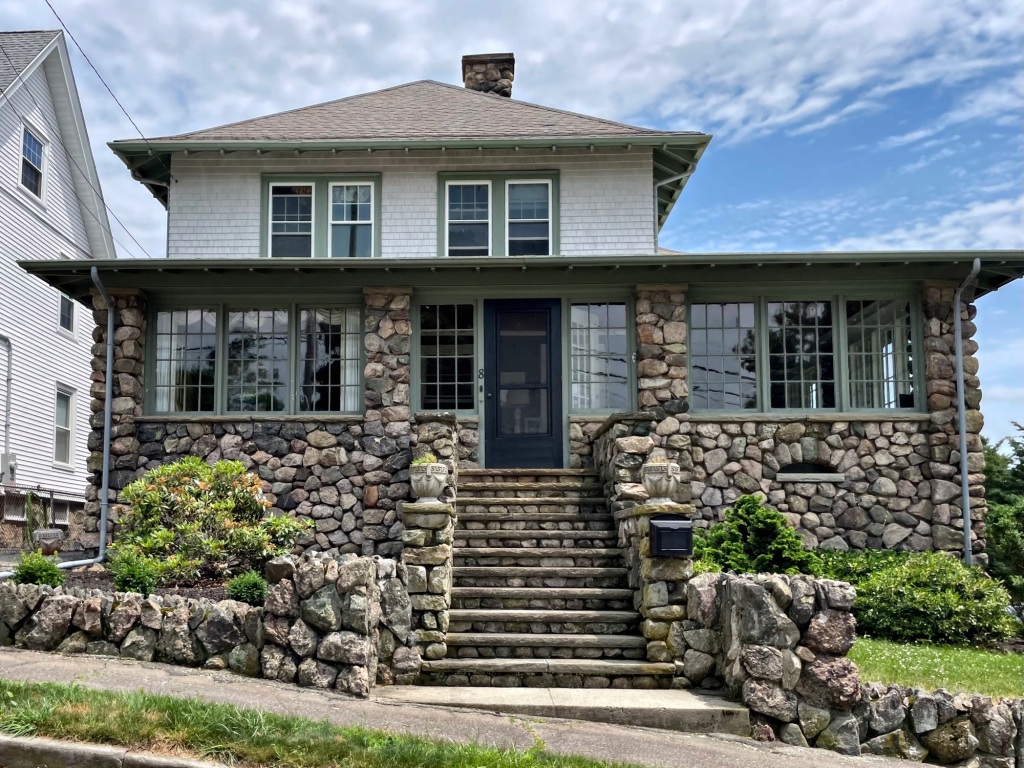
John Smith House // c.1895

Hull, Massachusetts is an often overlooked town (besides Nantasket Beach Reservation), but there are some really great old houses and buildings to be found in the seaside town. This is the John Smith House on Meade Avenue in the Atlantic Hill neighborhood inland from the peninsular part of town. Development here was fairly slow, but took-off in the late 19th century when cottagers began to develop some house lots here. They were soon joined by year-round residents like John Smith, an ice merchant who built this home around 1895. Craftsman in style, the house exhibits a mix of building materials with a rough fieldstone porch and two matching stone chimneys together with wood shingle siding. The stunning stonework extends from the foundation, uniting the house to its terraced, rocky site. It is one of a handful of homes here that have not yet been altered or covered up by vinyl siding.

Mansfield DAR Lodge // c.1830

Tucked away on a side street in Mansfield, I was pleasantly surprised to stumble upon this charming example of a Craftsman bungalow, a style and form not too common in New England. The style, synonymous with the western United States’ population growth in the early 20th century, never took off the same way here as Yankee homeowners and builders often stayed true to the Colonial Revival style (even today). This building is said to date from the early 1800s and was built as a Federal style cape. It was owned by a Margaret Lane in the late 19th century. By the 1930s, the house was significantly altered with a full-length porch supported by tapered shingled columns atop fieldstone bases and new dormers at the roof with flared eaves. The building has been home to a local chapter of the Daughters of the American Revolution (DAR). What a charmer!

Annie Sheldon House // 1909

Even with a declining marble industry by the turn of the 20th century, Dorset, Vermont was seen as a beautiful retreat from city life, and it attracted well-to-do middle-class families to escape to the town for parts of the year. One of those families was head by Harry Waters Sheldon (1869-1942) and Annie C. Bourn Sheldon (1875-1958) who lived in Yonkers, N.Y. with their four children. The family lived in this home as a cottage retreat in 1909 and constructed the only Craftsman bungalow in the village of Dorset. The bungalow was later altered and the porches were enclosed, but it was restored in the past few years!