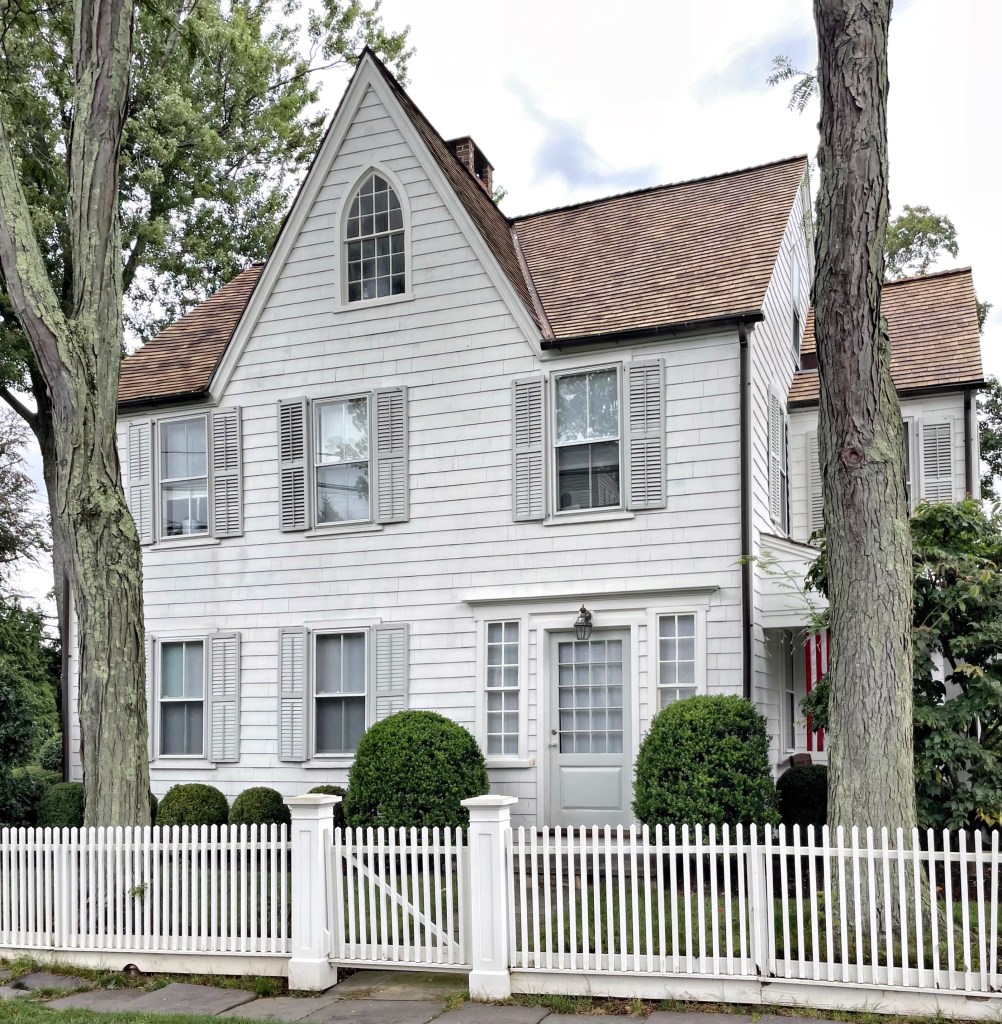
According to a dated board in the attic, this house was built c.1803! The David Bradley House on Old South Road in Southport, Connecticut is a great example of a traditionally designed house that does not need all the bells and whistles to stand out! The house was owned for a number of years by David Bradley, who worked as the village’s postmaster. It was David who likely added the Gothic Revival gable with lancet window and a (since removed) front porch.
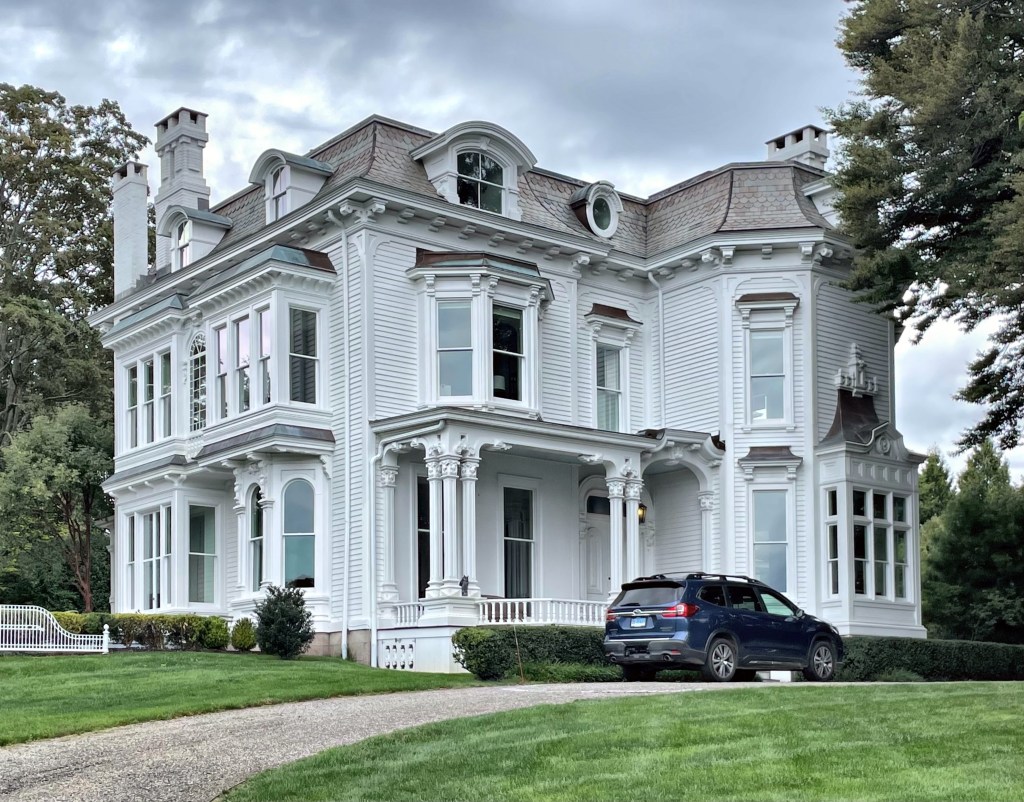
The Southport Chronicle reported on March 1, 1871 that “W. W. Wakeman, is about to erect, on the Hill, a very handsome residence”. The house would be built on Harbor Road in Southport, and was for his sister-in-law, a widow, Sarah Ann Fowler Wakeman and her two daughters, Mary and Frances. The Bridgeport-based architectural firm of Lambert & Bunnell (made up of Henry A. Lambert and Rufus W. Bunnell) teamed up to furnish the plans for this stately Second Empire style mansion. Sarah died in 1872, and the house was occupied by her daughters until 1913.
Located on Harbor Road in Southport, CT, this stunning Italianate residence is properly sited on a small bluff overlooking the village’s harbor. According to historic maps, the house was owned by an “I. Chidsey” who appears to be Isaac Chidsey (1793-1865). The large Italianate style home is boxy in form and stands three full stories with two original one-story side wings. Sleeping porches were added in the early 20th century; those along with the rooftop belvedere, would allow for sweeping views of ships entering and exiting the harbor here. The house was recently restored by the architectural firm of Fairfax & Sammons and it looks amazing!
Southport, the coastal village in Fairfield, Connecticut is an old house lover’s dream! Case-in-point, the Charles Gilman House. Charles Gilman, a Bridgeport lawyer, constructed this house on the ridge parallel to Main Street in Southport between 1871-1874. The building is a fine example of the Stick style of architecture, in which the decoration on facades and gable ends reflects the building’s internal structure. Gilman used the services of two New York architects, J. Cleaveland Cady and William H. Beers, to design the house and the later (1900) library addition, respectively. In the 20th century, the house was owned by Richard Joyce Smith, an attorney who was hired to guide the New Haven Railroad through a long and tricky bankruptcy reorganization ending it it being acquired by the Penn Central in 1975.
Welcome to Southport, one of the most walkable and charming seaside villages in all of Connecticut, and it’s also in Fairfield! Southport became a leading coastal port on Long Island Sound, its ships carrying produce and goods back and forth to New York City. Sea captains houses, historic banks, and stunning churches line the streets in the village and are all in a great state of preservation. This is because much of the old village area is part of a local historic district, first established in 1967, where buildings from three centuries are protected for future generations. This house was built in East Haven, Connecticut by Samuel Bradley in 1715. The saltbox house is evocative of many early Colonial homes of Connecticut built at the time with a large central chimney and symmetrical facade. The house remained in the family until the mid-1940s when it was purchased, disassembled, shipped and reconstructed on this site on Harbor Road in Southport.
According to local historians, this historic saltbox house was built around 1690 by John Smith, a volunteer Sargent in the Fairfield Trainband (a band of citizens trained as soldiers to supplement the regular army) or Militia. The position involved training, strategizing, storing military weaponry of the town, and being responsible for the preparedness of the community in the event of an attack by Native tribes, Dutch, or French forces. The house was later renovated in the Colonial Revival style, but has since been restored closer to its original design as an early First Period saltbox.
One of the finest examples of Italianate residential architecture in the state of Connecticut can be found in Fairfield in the Sturges House. This property was built in 1855 for Henry Sturges Thorp a New York City merchant from a Fairfield family and his wife Julia Ann Thorp, likely as a summer home away from the city. Both Henry and Julia died in 1869 and the property was acquired by Frederick Sturges, the son of Jonathan Sturges a wealthy businessman and philanthropist who had a stunning early Gothic Revival mansion nearby. The Sturges House as it is now known, is a landmark example of the Italianate style with broad overhanging eaves, massive belvedere at the roof, round arched windows, and the tripartite blind windows capped by an elaborate cornice.
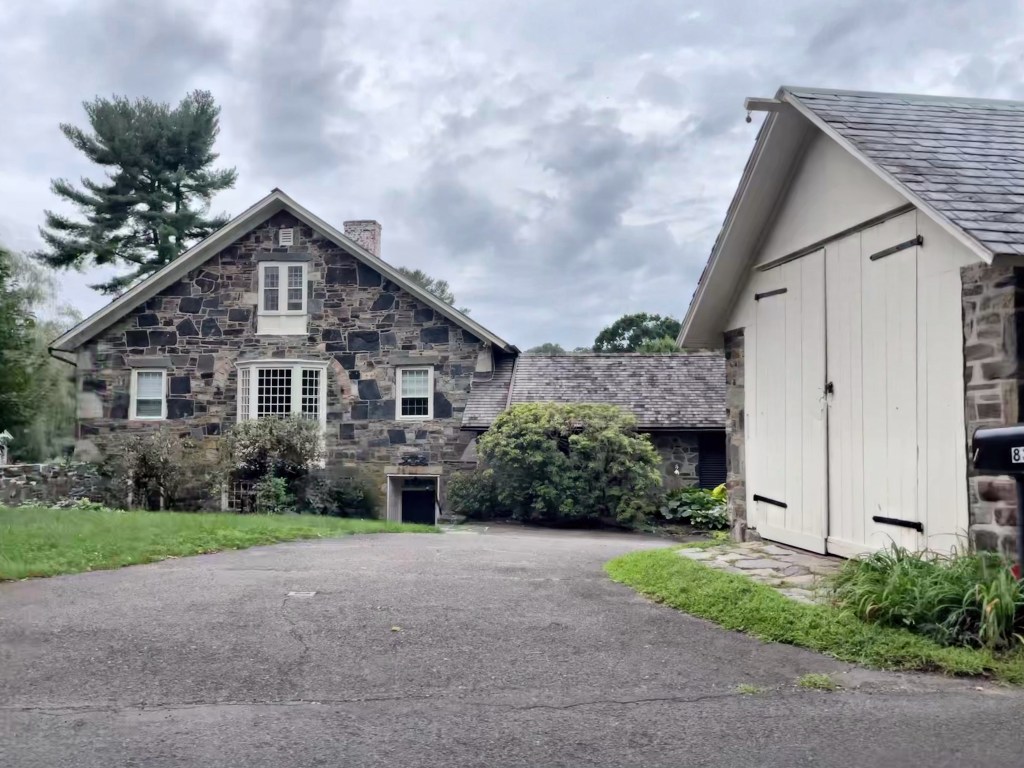
Not many buildings in Greenfield Hill, Fairfield, Connecticut showcase the neighborhood’s transition from farming community to affluent suburb quite as well as this stone barn turned house on Hillside Road. The stone barn was constructed around c.1895 for Frederic Bronson Jr. (1851-1900) a prominent New York attorney and treasurer of the New York Life and Trust Company which was founded by his grandfather, Isaac Bronson. In about 1892, Frederic demolished his ancestral home and hired architect Richard Morris Hunt to design a new country estate for his family. The house was called Verna and is also located in Fairfield. Today Verna is known best as the Fairfield County Day School. As with many wealthy men of the Gilded Age, Frederic wanted his rural retreat to also work as a gentleman’s farm, where he could have staff farm and tend to livestock on the expansive rolling hills bounded by historic stone walls. He appears to have had this barn built for his livestock shortly after the main house, Verna was completed nearby. Bronson died in 1900 and some of the property was later sold off. This property was acquired by a Charles Stillman in 1941 and it is likely him that converted the barn into a charming residence.
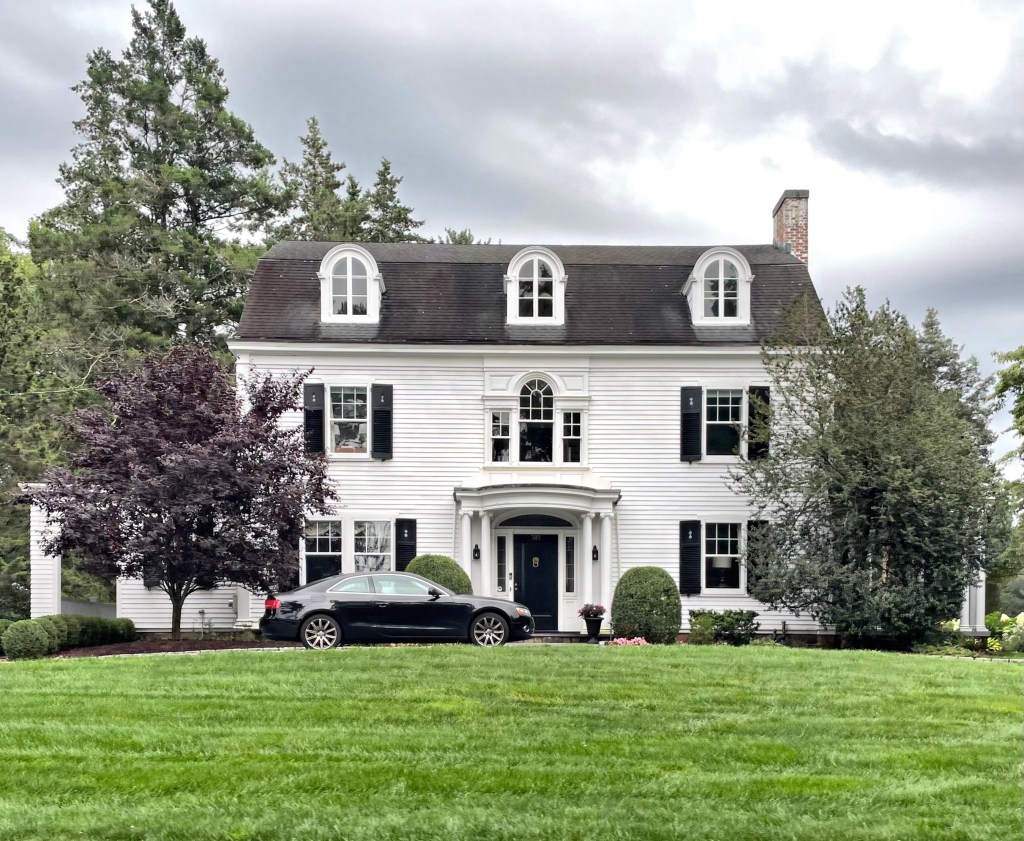
Some towns have the best (and high quantity of) examples of Colonial Revival houses in New England, and Fairfield, Connecticut is definitely one of those towns! This house on Barlow Road was erected in 1927 by Harold Camp Bullard (1879-1949), an engineer at the Bullard Machine Tool Company of Bridgeport, which was started by his father. The architect of the house is unknown, but the property stands out for its bold proportions, prominent Palladian window over the rounded entry portico, and rounded dormers at the gambrel roof.
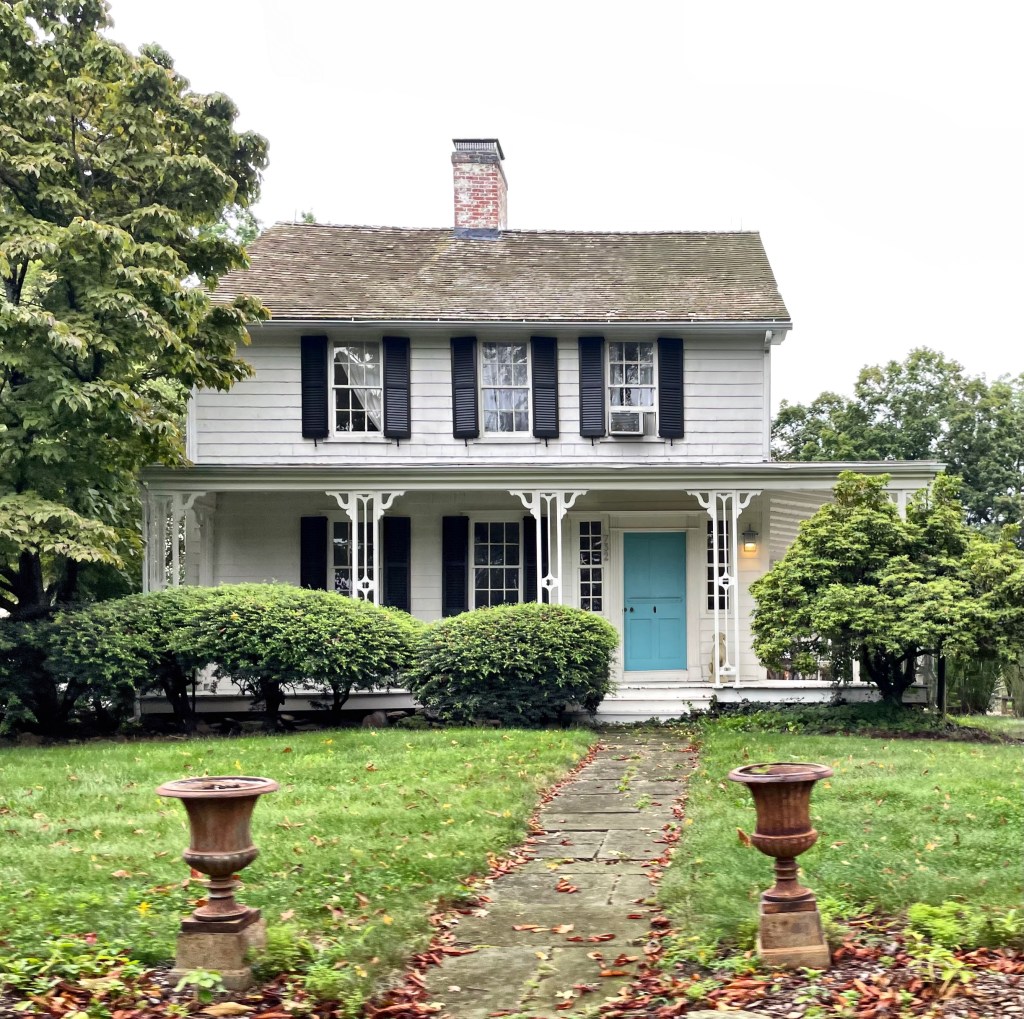
While the Greenfield Hill section of Fairfield, Connecticut has some of the grandest houses (old and new) in the state, there are some more average size homes that just ooze charm and curb appeal. This example on Hillside Road, dates to the 1810s and was seemingly built by Alban Bradley (1767-1832) on land inherited by him from his late father, Seth Bradley. The family farmed on the land from this Federal period farmhouse until it sold out of the family by Alban’s only son, Burritt in 1825. Burritt sold the farm to Zalmon Wakeman who farmed on the many acres of valuable land there. Sometime before his death before the Civil War, the house was “modernized” with Italianate-style porch, which is supported by delicate cut trelliswork. This is a great illustration as to how modest renovations which apply up-to-date decorative details can be done to historic properties without compromising the original structure or its architectural integrity.


 Buildings of New England