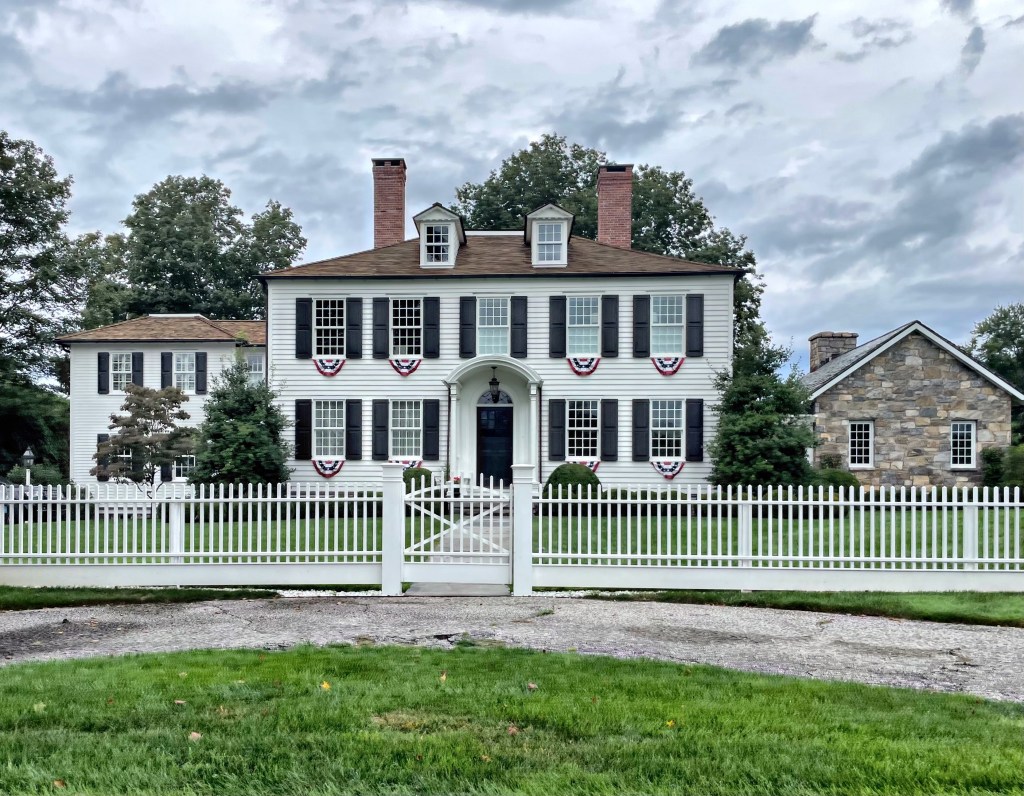
Bradley-Baldwin House // pre-1750

WOW this is an absolute dream home! Tucked away on Meetinghouse Lane in the Greenfield Hill section of Fairfield, CT, you will find the Zalmon Bradley House. It was originally built around 1750 as a modest saltbox and later owned by Zalmon Bradley. The property was inherited by Zalmon’s sister, Sarah, who recently married Dudley Baldwin, an “ardent patriot”. The property was likely updated in appearance by Sarah and Dudley Baldwin giving the house its current four-sided hip roof, chimneys and an exquisite doorway. Dudley and Sarah died young in 1794 and 1795 (at ages 40 and 37 respectively), and the property was inherited by their only child, Abraham Dudley Baldwin. Abraham was watched for years by family, including his namesake, Abraham Baldwin (1754-1807), a senator, congressman, and key figure of the drafting and signing the U.S. Constitution. Abraham stayed in this house often during his time in Connecticut, watching after his nephew along with his sister, Ruth Baldwin Barlow. Abraham Dudley Baldwin as an adult resided in this house with his own family, and was largely engaged in local and state politics and agricultural pursuits. The Bradley-Baldwin House was restored a few years back, and looks amazing!

St. Stephen’s Episcopal Church // 1914

When Ridgefield, Connecticut was settled in 1708 by Europeans, there was only one Episcopal Church in the state, and the general assembly allowed dissenters their own churches so long as they continued to pay taxes to support the Congregational Church. Ridgefield’s first Episcopal church, St. Stephen’s was built in 1740 on land granted by the Proprietors who founded the town and laid out lots along the towns new Main Street. In 1776, St. Stephen’s minister, Epenetus Townsend, a Tory (loyal to the British), was ordered to leave town with his wife and five children when the Revolution picked up steam. He was appointed chaplain to a British regiment and in 1779, the battalion was ordered to Nova Scotia. En route by vessel, a severe storm arose and all passengers were lost. The church was taken over by the commissary department of the American Army. During the Battle of Ridgefield, British troops set it on fire as a statement to the townspeople. The church was replaced two more times until 1914 when the present building was constructed. The Colonial Revival church is absolutely stunning and built from plans by (unknown to me) architect Walter Kerr Rainsford. The rubblestone church is one of the most pleasing designs I have seen in Connecticut!

First Congregational Church, Ridgefield // 1888

The First Congregational Church was first established in Ridgefield, Connecticut just four years after the establishment of the town. Civic leaders in October 1712 successfully petitioned the Connecticut General Assembly for permission to levy a tax for “the settling and maintaining of the ministry in the said Town of Ridgefield.” Rev. Thomas Hauley, the first minister, also served as town clerk and school teacher. The first meeting house, on the town green, opened for worship in 1726. Plans for a new meeting house were drawn up in 1771 to fit a growing population, but construction was not complete until 1800. The second church was built in a more traditional style with a steeple. With a shift in the towns demographic from rural homeowners to ritzy exurb to New York City, a more suitable church was required by the end of the 19th century. Josiah Cleaveland Cady, one of the many great New York architects at the time was hired to design a new church suitable for the wealthy New Yorkers who summered in town to consider a neighbor, and he did not disappoint! The building blends many styles from Queen Anne, to Victorian Gothic, to Romanesque Revival in a way that isn’t clunky as in some other versions.