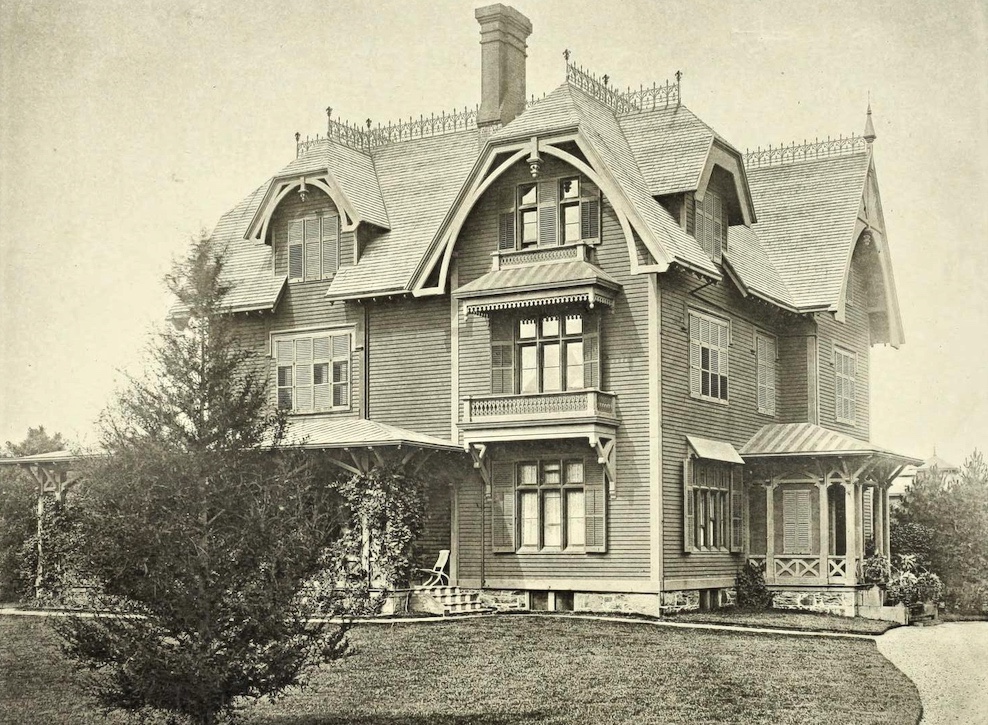
Ms. Rebecca Jones Cottage // c.1870-1899

Formerly located adjacent to “The Lodge” (last post) on Newport’s iconic Bellevue Avenue, this mansion once stood and today, would be one of the finest in town, but it suffered a similar fate as its neighbor. The home was built for Rebecca Mason Jones (1803-1879), a widow (who married her first cousin) and daughter of wealthy New York banker and developer, John Mason. Rebecca made money from her late father’s estate, developing some parts of Manhattan. For her summer residence, she hired local society architect, George Champlin Mason to design the cottage. The cottage (originally thought to have been razed) was moved to 28 Narragansett Avenue to make room for Rose Villa, which also necessitated the demolition of the two neighboring mansions (more on that tomorrow).
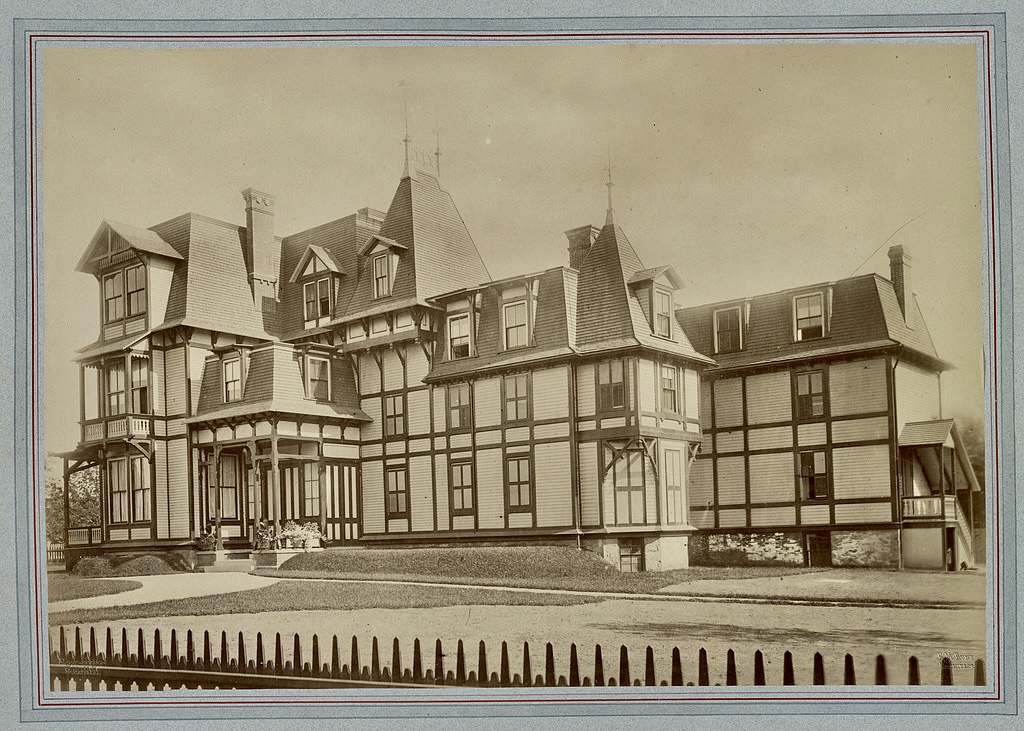
“The Lodge” // 1870-1899

Believe it or not, but Newport, Rhode Island was once a “tear-down town”. Despite having arguably the largest extant collection of Gilded Age mansions, many older, properties were razed and redeveloped as tastes changed between the mid-19th century and the turn of the 20th century. And then there was the 1960s… But that’s for another time. This stunning mansion formerly on Bellevue Avenue was built in 1870 for Elizabeth Underhill Coles (1813-1891), the widow of William F. Coles of New York City by the high-society architect Richard Morris Hunt. The “cottage” was their summer residence and one of the finest Stick style residences built in the seaside town. The irregular layout, half-timbering and complex roof forms show the influence on the emerging Queen Anne style. The mansion was sold out of the Coles Family after Elizabeth’s death and was razed by 1900 for the second mansion on the site (next post).

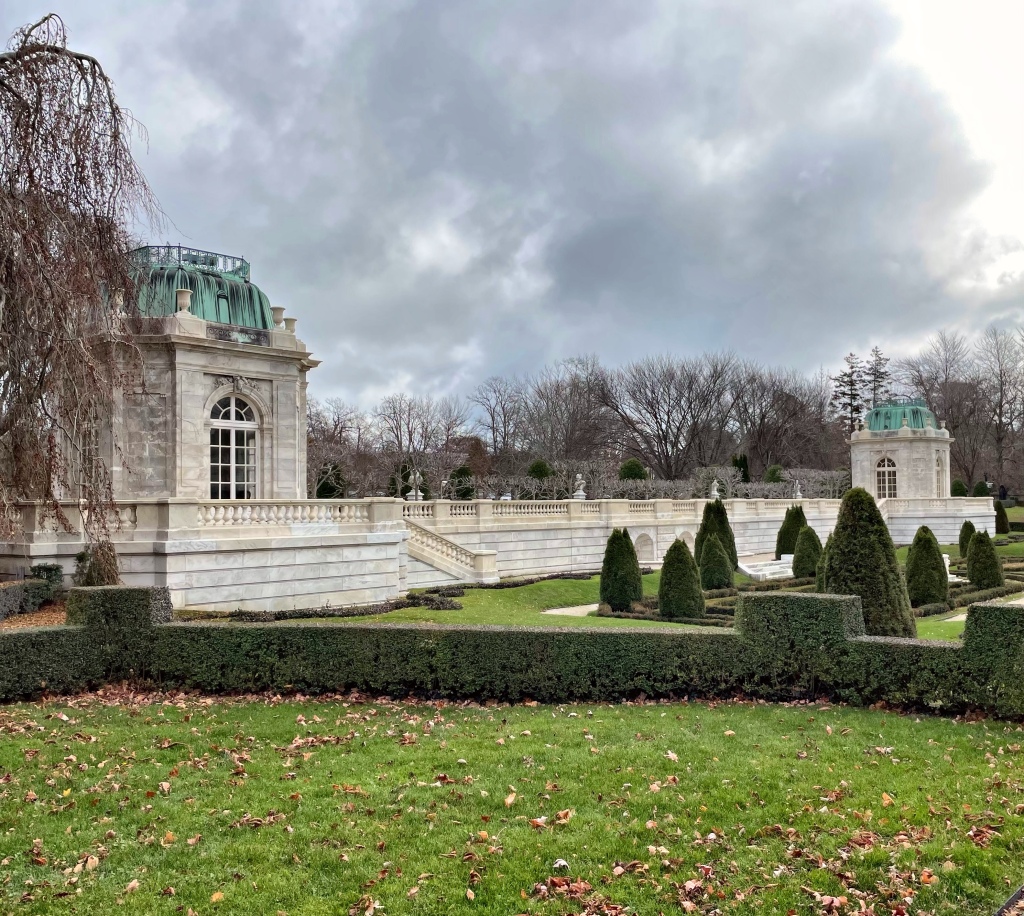
The Elms – Gardens // c.1911

For my last post on the spectacular Elms Mansion in Newport, Rhode Island, I wanted to highlight something I rarely feature on this page, a garden. When the mansion was completed by 1901, architect Horace Trumbauer and his firm went to work to produce plans for a natural landscape with a large lily pond at the far edge of the property. After 1907, the Berwind’s and high-society shifted and landscape ideals were influenced by newer theories in American landscape architecture, which sought influence from historical European gardens. Trumbauer reworked The Elms’ garden to reflect this new emphasis on reviving classical European garden design alongside landscape architects Ernest W. Bowditch and Jacques Greber advising on the parterre design in the sunken garden. A grand allée on the scale of 18th century French palace gardens extends across an expansive lawn toward two formal marble pavilions situated along a minor cross axis above a sunken garden. The marble pavillions appear to have been designed by Trumbauer and are inspired by 18th-century French garden pavilions. The grand context for the gardens is a park-like collection of specimen beech, elms, maples, linden and other large canopy trees. Many of the large trees have since succumbed to disease, but the formal Italian sunken garden remains one of the finest in the United States.

The Elms – Stable and Garage // 1911

By 1911, the Berwind’s wooden stable at their summer home, The Elms, was deemed inadequate and the couple’s new automobiles needed an appropriate structure to protect them from the elements. Edward Berwind purchased a large estate from Ms. Ida Powell Johnson, abutting his sprawling property and razed it to have a new stable and garage structure built there. The two structures are modeled after the Louveciennes Pavillon de Goury in France, built originally for Madame du Barry. Above the garage space lived the stable keepers and gardeners. As the space shifted from stable to garage, it is said that the head coachman, in order to keep his job, became the family driver, but he could never learn to back up, so a large turntable had to be installed in the garage. The complex originally held space for ten carriages, stalls for six horses and room for eight automobiles, as well as harness repairs, laundry rooms and living quarters. The Beaux Arts style building employs the best of French architecture, including a mansard roof, corbels, and raised central pavillion.

The Elms – Pantry and Kitchen

We always see the ornate and entertaining spaces of house museums, but it is always amazing to see the “back of the house” which kept everything running. The two-story pantry and basement kitchen in The Elms are a rare look into the life of servants that worked in these mansions. These types of spaces were designed in a way to allow for servants to tend to the owners and guests, but neve The pantry spans floors one and two and would serve the owners and guests for smaller items and meals. The space features floor-to-ceiling oak cabinets to store china and other items. The basement kitchen is lined with white enamel tile for cleaning.

The Elms – Mr. Berwind’s Bedroom and Bathroom

Mr. Berwind drew the short straw and occupied the smaller of the two bedrooms in the Elms mansion as his wife Sarah Torrey Berwind, got the larger corner room. I was shocked to see just how small the bedroom was for one of the richest men in the country, even if it was just a summer residence that they occupied for a couple months of the year! Mr. Berwind did have a small bedroom, but he spared no expense to furnish it well. The fireplace in his bedroom is of ox-blood marble with gilt bronze mounts. The walls are covered in red silk and the carpet is a late 19th-century Khorassan. His private attached bathroom contains a sink of translucent white onyx.

The Elms – Sitting Room // 1899

The formal Sitting Room at the Elms in Newport, Rhode Island is one of the many statement-rooms found in the Gilded Age mansion. This room is located directly above the Ballroom and is the first space seen when ascending the main staircase onto the second floor. The sitting room was used by the Berwind Family and their guests as a gathering and socializing space, a little less formal than the ballroom downstairs for more elegant events. The Preservation Society of Newport County has done an amazing job at restoring the building and purchasing furniture and fixtures that were sold off when much of the inside of the property was sold off at auction in the 1960s. The Preservation Society restored the red silk walls fabric in the 1980s, bringing the space back to its original grandeur. I cannot think of a better place to just “sit”.

The Elms – Dining Room // 1899

The Dining Room of the Elms Mansion in Newport, Rhode Island, is represents the Gilded Age in all the best ways. The room sits just off the ballroom and like all of the other rooms in the summer residence of the Berwinds, it was designed by famed interior designer Jules Allard. The dining room was specifically to display a collection of early18th-century Venetian paintings purchased by Mr. Berwind from the Ca’ Corner estate in Venice (the Berwinds were avid collectors of 18th century French and Venetian paintings). The iconic coffered ceiling is not of wood, but of molded plaster, grained and painted to imitate oak. Each coffer is decorated with the winged lion of Saint Mark, the patron saint of Venice. Pour custom-made crystal chandeliers hang in the four corners of the room. At the end of the room is a stunning green marble, agate and onyx fireplace that is framed by a ceiling-high pediment supported by carved Ionic columns. Could you see yourself entertaining in this dining room?

The Elms – Library // 1899

Merry Christmas from Buildings of New England!

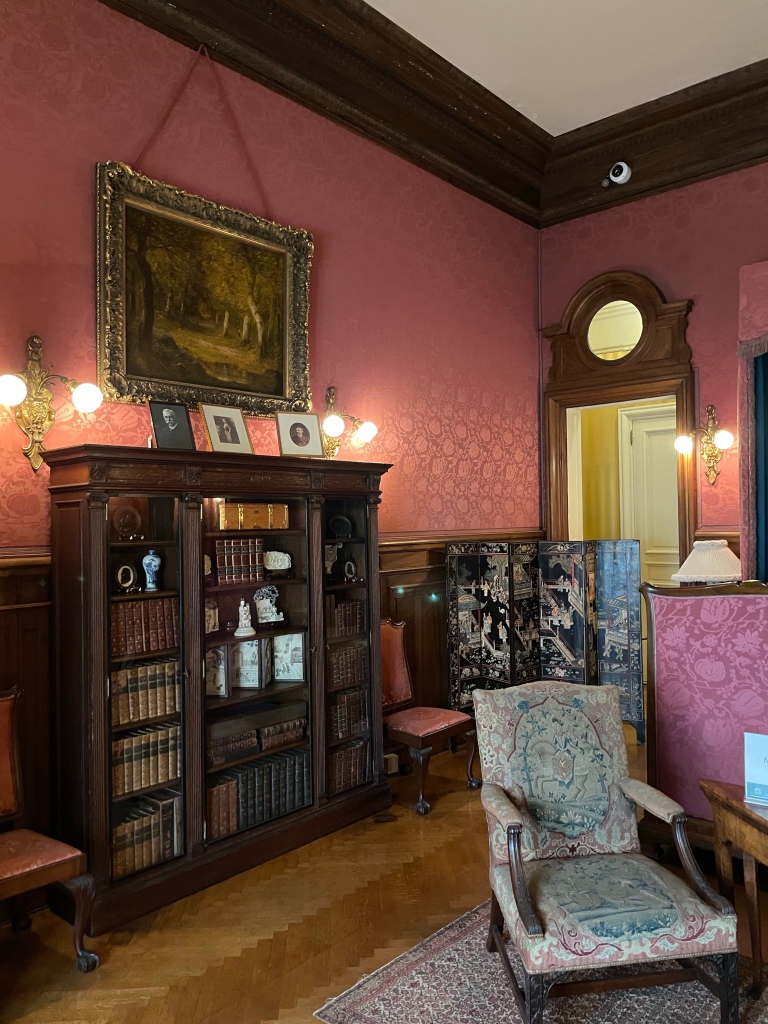
To celebrate, I wanted to feature the library aka the “red room” in the Elms Mansion in Newport, Rhode Island. The library is lined with high wainscoting and walls of inlaid walnut hung with red damask/fabric. The center table, fireplace mantel, and inlaid bookcases were all designed by Jules Allard, and the table in particular displays the exaggerated proportions and classical ornament typical of 16th-century French design. The mantel piece consists of white carved stone with the upper part of richly carved walnut. The room is one of the coziest in the Elms, one of the more refined and “homey” of the Newport Mansions open for tours. From this library, owner Edward Julius Berwind, would keep up with his growing businesses while away for summers in Newport.

The Elms – Ballroom // 1899

The Louis XV style Ballroom of the Elms Mansion in Newport sits just off the Stair and Gallery halls at the core of the building. This room was the scene of lavish parties, including the 1901 housewarming party hosted by the Berwinds to announce the formal opening of The Elms to Newport’s summer society. The large, 50’x45′ ballroom was designed by French designer Jules Allard crafted the Louis XV style paneling with plaster shell and floral ornament. The white relief decorations on the doors, paneling, and cornice are continued in an elaborate ceiling frieze and center medallion of winged cherubs. As a stark contrast from other Gilded Age mansions in Newport, the ballroom has very minimal gold gilding, besides the mirror frames on the wall. The muted cream and white colored walls with ornament show the sophistication and grandeur of the design, not gold.