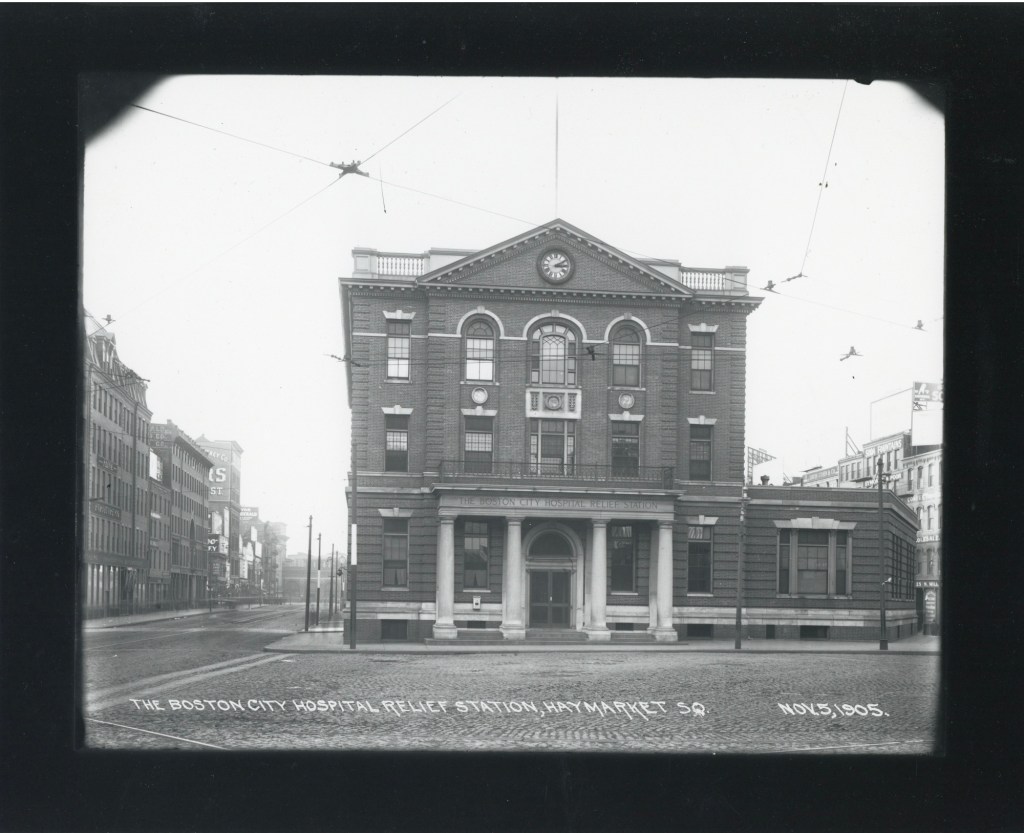
Boston City Hospital Relief Station, Haymarket // 1902-1960s

Image courtesy of City of Boston Archives

In 1858, as Boston began to see a massive influx of immigration into the city and rapid industrialization, the City of Boston authorized the creation of a new hospital whose purpose was the “reception of those sick and injured: citizens of Boston who, from any cause, were unable to otherwise obtain care and treatment,” especially in cases of “acute illness and for the victims of accident or injury.” This was the Boston City Hospital, which was established in the South End, and is now known as the Boston Medical Center. The hospital was thought to be too far away for victims of injury of illness to get to promptly, so a relief station was built in Haymarket Square, replacing the recently demolished Boston & Maine Railroad Station. The new, standalone hospital building was constructed of brick and stood three stories tall and opened in 1902. On its first day of operation, doctors and staff saved the life of a man who had attempted suicide by ingesting carbolic acid. A Boston Globe reporter speculated that had the patient been  transported to the more distant Massachusetts General or City Hospitals, he would have surely died. The Colonial Revival style building was designed by the firm of Kendall, Taylor & Stevens, who specialized in medical facilities and other institutional building designs. The structure was demolished by the 1960s, when much of the Government Center/West End areas were razed for urban renewal.
Howard Athenaeum // 1846-1962

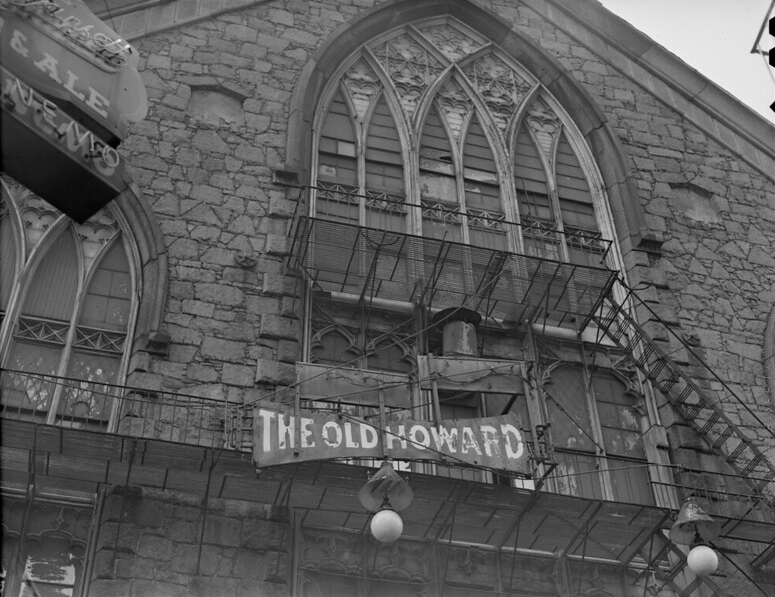
One of the more iconic theater buildings to ever stand in Boston was the Howard Athenaeum, later the Old Howard, which stood on the former Howard Street in Downtown Boston. The origins of the building begin in 1843, when a flimsy, tent was built to serve as a church for the small Millerite sect. The small but loyal congregation eventually abandoned the site following disappointment with the minister’s promise that the world would end in 1844. After Armageddon failed to materialize, the founder of the sect, William Miller, an ex-Deputy Sheriff from Poultney, Vermont, was discredited and the Millerites moved on. After running their former minister out of town, several church members (who had given up all their worldly possessions in preparation for their trip to heaven,) decided to recoup some of their losses by selling the property to Messers Boyd and Beard, who opened a theater here in 1845. A fire destroyed the structure, and it was replaced by a larger, fireproof building that same year. The new building was constructed in 1845 and was designed by architect Isaiah Rogers in the Gothic Revival style with massive granite blocks from Quincy.

The Howard Athenaeum saw many iconic performers and historical events in its 100 years. A young John Wilkes Booth, played Hamlet at the Howard before becoming famous for a more nefarious deed in Washington in 1865. Also, Sarah Parker Remond, a Black anti-slavery activist and lecturer with the American Anti-Slavery Society (and later a medical doctor), had bought a ticket through the mail for the Donizetti opera, Don Pasquale, but, upon arriving, refused to sit in a segregated section for the show. She was forcibly removed and pushed down a flight of stairs. She eventually won a desegregation lawsuit against the managers of the Howard Athenaeum and received $500 in a settlement.

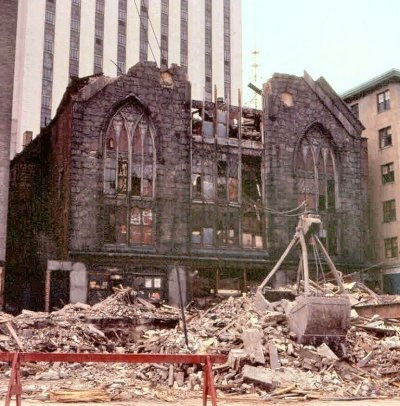
The theater was quickly deemed obsolete and second-tier compared to more modern theatres built nearby. By the mid-20th century, the Old Howard was largely featuring burlesque shows. To keep bringing in audiences, the burlesque performances got more risqué with each year. As a result, the Boston vice squad made the Old Howard the object of their attention. The Boston Vice squad made a 16 mm film during one of their raids in 1953 and captured on film the performance by “Irma the Body”. This film footage resulted in an indecency hearing which eventually led to the closing of the Old Howard in 1953. A fire a few years later along with Urban Renewal led to the demolition of the Old Howard by 1962. Like the former Suffolk Savings Bank (featured previously), the present Center Plaza Building is on the site.

Blanchard Building // c.1855

Image courtesy of Boston Archives.

Did you know that Boston once had it’s own Hogwarts? While we didn’t have wizards and witches in the streets, we did have young magicians learning the tricks of the trade! The Boston School of Magic was founded in the 1880s by William Davis LeRoy (1862-1919), a professional magician who also served as President of the Conjuror’s Club of Boston. Upon opening its doors, the Boston School of Magic was one of a handful of such schools in the country. For $75, you could learn how to escape from a pair of handcuffs from a professional instructor at W.D. Leroy’s “School of Magic”, and even buy some magic items for shows from his large catalogue. Mr. LeRoy was also friends with the famous Harry Houdini, who purchased items from his store and consulted with him on new acts. Houdini was extremely popular in Boston and held many acts and feats of strength here. The Boston School of Magic was located in the second floor of the Blanchard Building at 103 Court Street, a brick commercial building with stone facade constructed in the middle of the 19th century. The building was demolished in the 1920s and replaced with a two-story structure, which too was razed for Government Center.

Brattle Street Church // 1772-1872

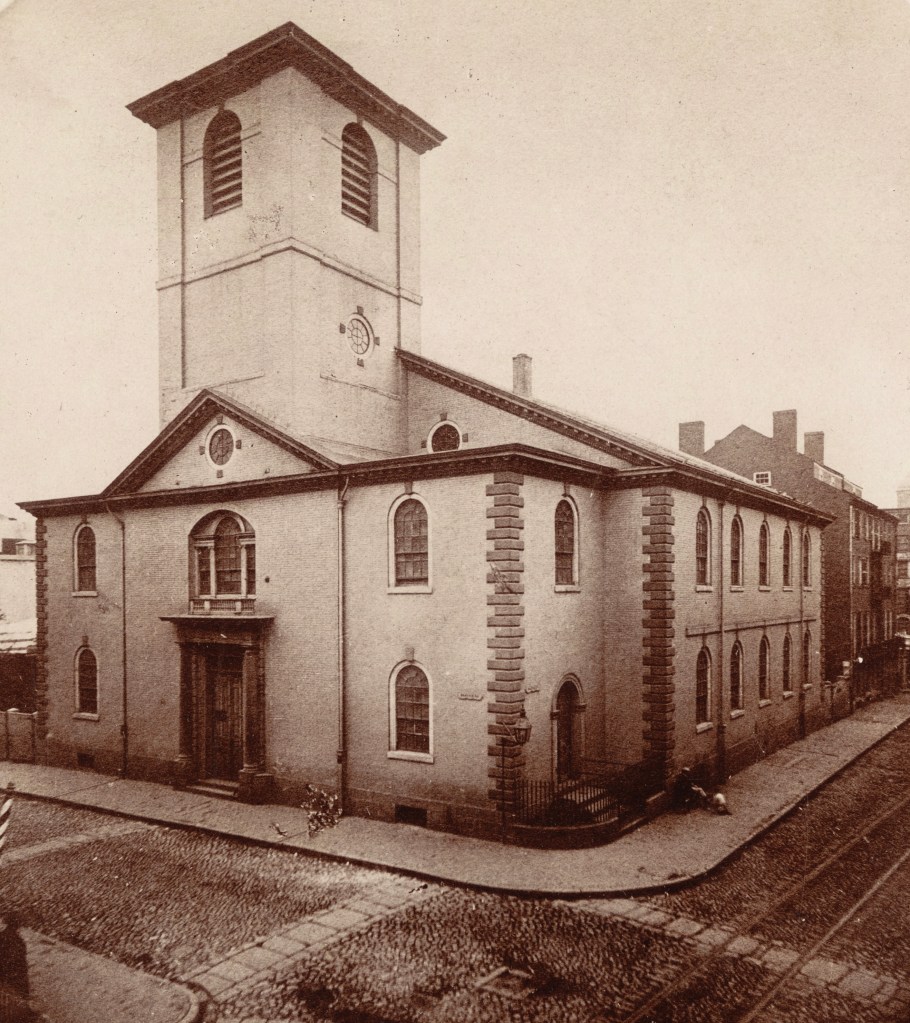
Boston’s constant churning of development has given us amazing architectural landmarks, and incredibly unfathomable architectural loss. One of such cases of loss is the former Brattle Street Church which was located on Brattle Street, roughly where the main entrance to Boston City Hall is located today. Demolition of significant architecture in Boston began way before the period of Urban Renewal in the mid-20th century, and the loss of the Brattle Street Church in Downtown Boston showcases this. The Brattle Street Church had been founded in the 1690s by a group of merchants seeking an alternative to the authority exercised by Increase and Cotton Mather in Boston’s existing congregations. Despite these beginnings, the church remained Congregational through the 18th century. At the time of the Revolution, Brattle Street counted such figures as John Hancock, Samuel Adams, Joseph Warren, and John and Abigail Adams among its parishioners. The original wooden church was replaced in 1772 by this stunning brick building, designed by Thomas Dawes. Just years after the doors opened, the American Revolution upended life in Boston. This building was a survivor, and was apparently hit by cannon-fire by the American batteries at the siege of Boston. A cannonball can be seen lodged into the building at the second floor, to the right of the Palladian window. After the American Civil War, development of the Back Bay led to a shifting population away from the downtown core, and a new church was erected for the congregation, the Brattle Square Church, designed by Henry Hobson Richardson. This church was demolished in 1872, just 100 years after it opened its doors and took a cannon for America.