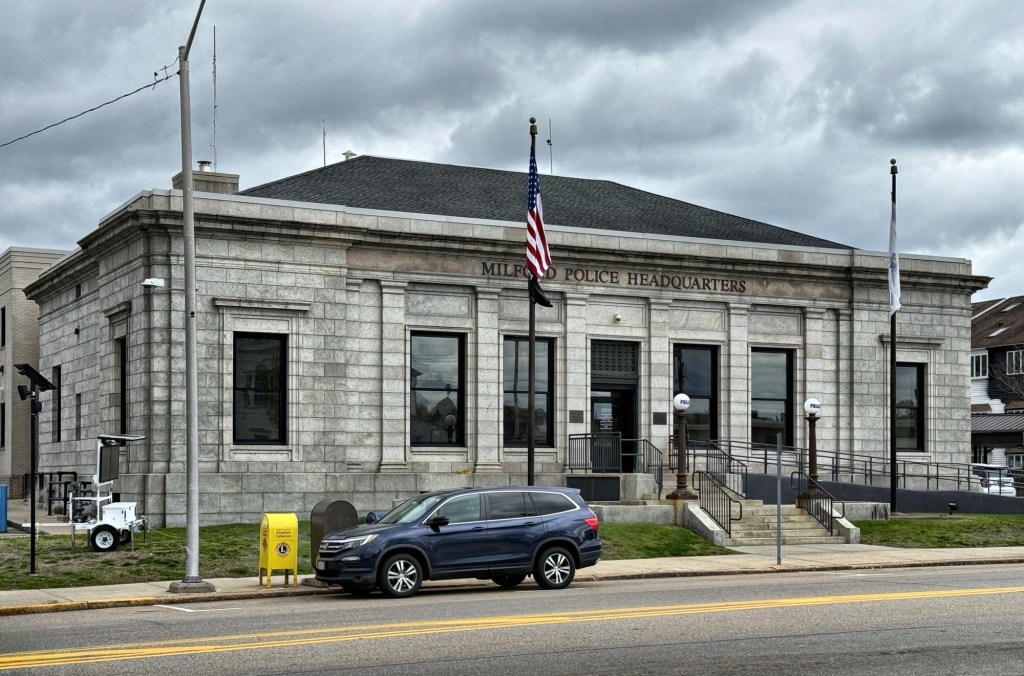
The present Police Station in Milford, Massachusetts, faces the town’s Draper Memorial Park and was built in 1911-12 from locally quarried Milford “pink” granite. While currently a police station, the building was actually constructed as the town’s first purpose-built post office, and constructed after a years’ long planning process to find a suitable site, funding, and design review. When the site and funding was set, James Knox Taylor, supervising architect of the United States Department of the Treasury and supervising architect of hundreds of federal buildings built throughout the United States during the period from 1897-1912, was hired to furnish designs. When his plans were unveiled, the community protested against the use of any granite other than the locally quarried “pink” Milford granite in the construction of the local post office. Mr. Taylor conceded and after two years of delays, the Post Office officially opened in 1914. Rectangular in plan, the granite structure is Classical Revival in style with its projecting cornice, symmetrical facade, and pilasters dividing the bays on the facade. The building also included a New Deal-era mural inside. The USPS moved into a contemporary building across the park in the 1960s and the Town of Milford purchased the old Post Office, converting it to the community’s Police Department Headquarters.