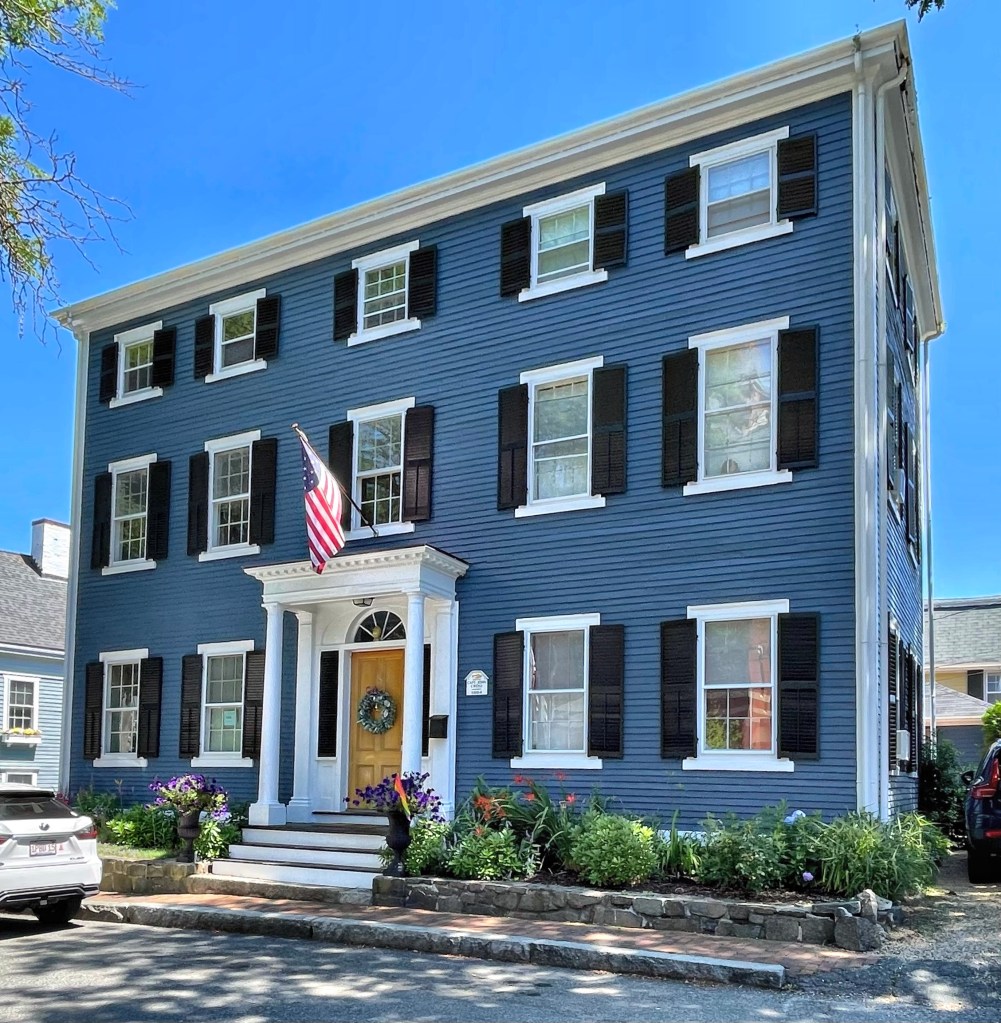
Cross-Kimball House // 1804

In 1803, sea-captain John J. Cross (1768-1804) began building a large Federal style house on land he purchased from his success on the open sea, largely working for the Hoopers. Sadly, before the home was finished, Captain Cross and all his men aboard his ship, the “Traveller” died at sea. The home, which was to be finished by the time of his return was left abandoned when news got back to the shore of the ship’s loss. His wife and three children were devastated and likely sold the property not long after. The property was owned later by Edmund Kimball, a sea-merchant who married into the Hooper Family. Kimball did well for himself and eventually owned multiple vessels. After his first wife, Mary Hooper Kimball died bearing him six children, Edmund remarried to Lydia Mugford Russell. The family home across from the town’s common has been very well preserved since and is an excellent example of a vernacular three-story Federal home on the North Shore.
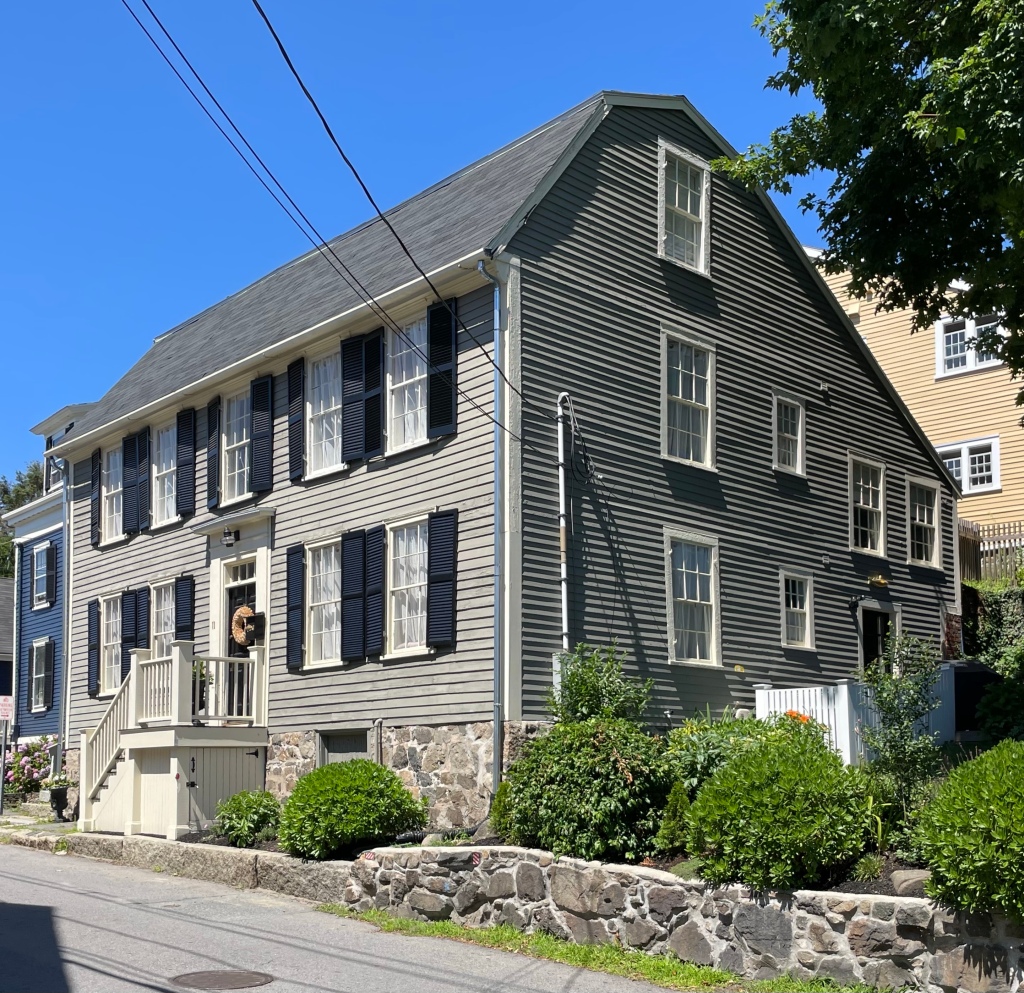
Pearson-Bessom House // c.1720

In 1720, James Pearson acquired a house lot on Windmill Hill in Marblehead, and he soon after built a house in the bustling harbor town. He lived in the house until 1734, when it was sold to a Giles Irwin. After Mr. Irwin’s death, it was conveyed to John Patton and John Bailey, both mariners, who likely split up the home inside. From this, fireplaces were punched into the central chimney inside, totaling 10 fireplaces in the home! John Bailey also worked as the Captain of Fort Sewall during the War of 1812. His wife Mary, served as temporary commander of Ft. Sewell after his death until a successor was appointed. The house eventually came under the ownership of siblings Carrie Florence Bessom (1867-1944) and her brother Frank Lewis Bessom (1870-1952). Florence operated an antiques store in town and Frank worked as a welfare commissioner. The home is a great example of a Georgian, Colonial-era home with a gambrel roof and even has the two (what I believe to be) separate coal doors in the raised stone foundation when the home was occupied by two families.

Trevett House // c.1715

One of my favorite houses in Marblehead, Massachusetts is the Trevett House on Washington Street, a perfectly preserved stretch of Colonial-era homes that transports you to centuries past. The Trevett House was built around 1715 by merchant Samuel Russell, a wealthy merchant and slaveholder in town, who had this house built as a gift for his sister Elizabeth Trevett and her husband Captain Benjamin Trevett. The house passed to their son Russell Trevett and then on to his son Captain Samuel Trevett. Captain Trevett (1751-1832) was born in this house and is best known for leading the Marblehead artillery company to Boston, fighting at the Battle of Bunker Hill in 1775. At the battle, Captain Samuel Trevett was the only artillery officer that day to make a pretty good account of himself. He disobeyed Col. Gridley’s orders to remain off the Charlestown Peninsula and fire at the navy from the relative safety of Cobble Hill. He survived the battle and the war and died at his family home in 1832. The Marblehead Arts Association bought the house in 1928, and the amazing paneled interiors were featured in publications on early Colonial architecture, and documented as part of the Historic American Buildings Survey.

Powsland-Homan-Dixey House // 1732

The colonial home at 33 Washington Street in Marblehead was built in 1732 for (and likely by) Jonathan Powsland, a joiner (furniture maker-carpenter). In the 1740s, Peter Homan added the rear lean-to, giving the home a saltbox appearance, possibly after he married into the Powsland family. The home was eventually owned by the Dixey Family. John Dixey (1776-1868) spent a good part of his life as a ship master and had several sons that also went to sea. The most well known son was Richard W. Dixey (1809-1860) who, along with two other Marbleheaders, captained the ship that took the first American Consulate to China.