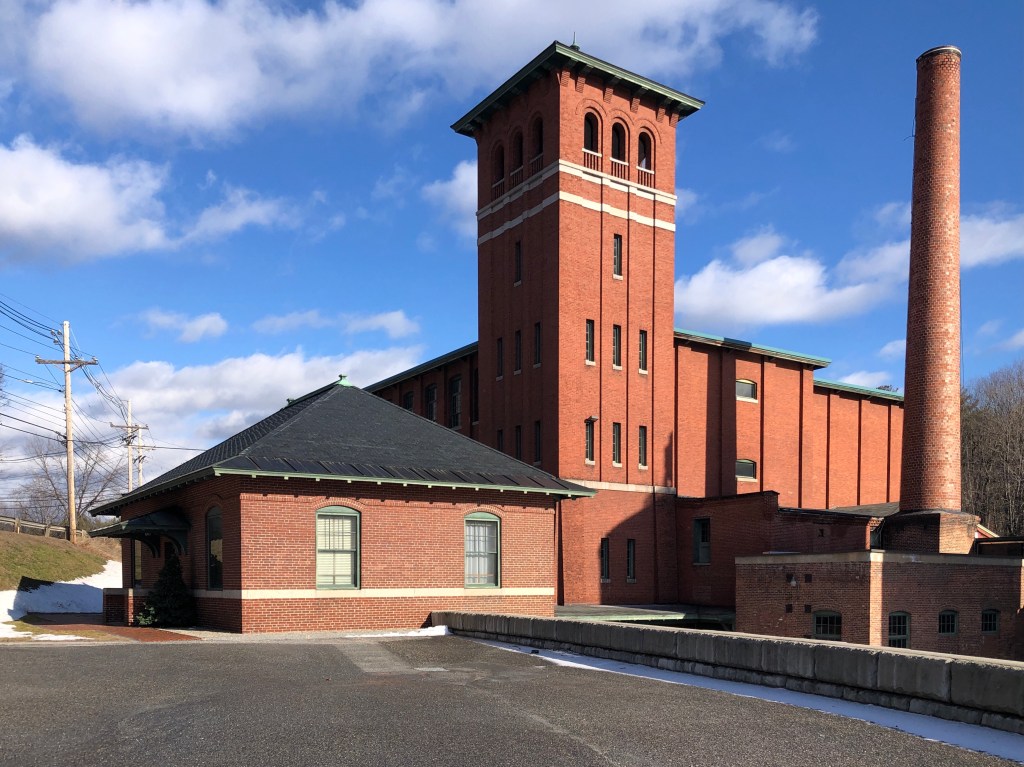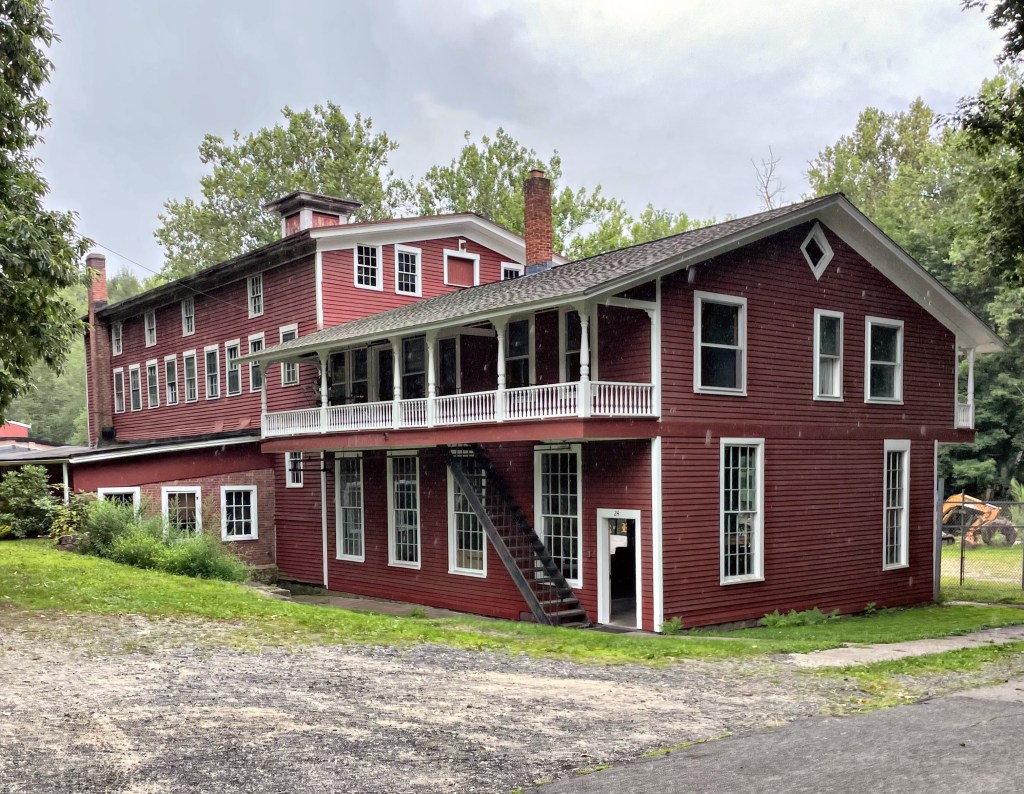
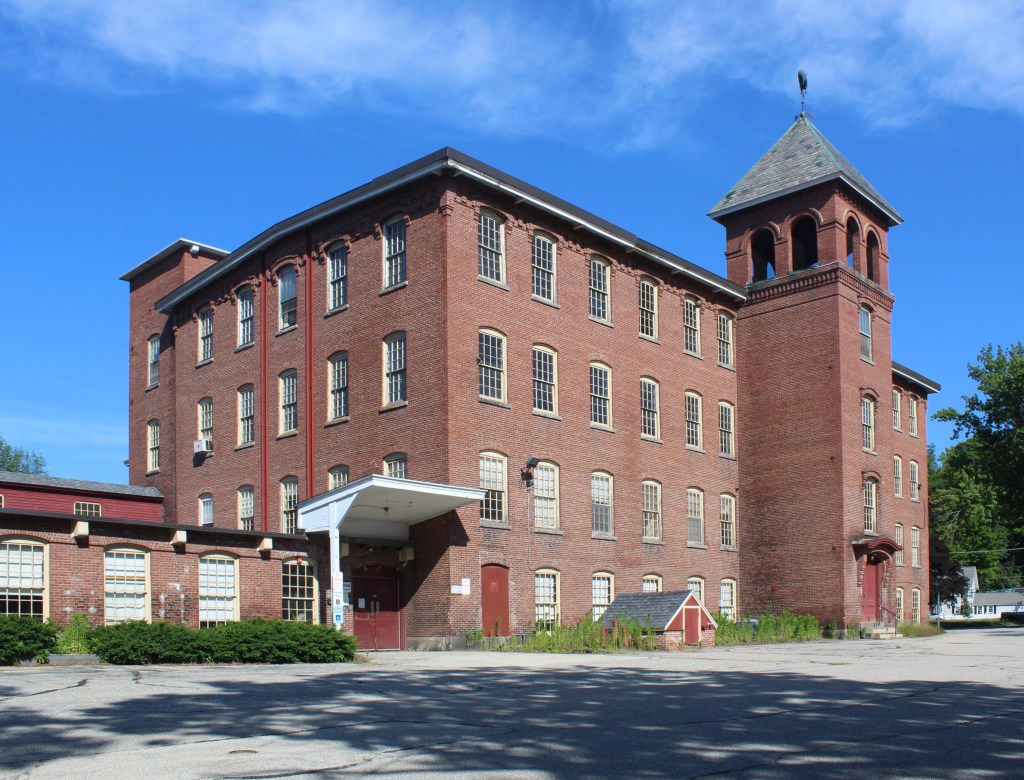
Hawkins Company Factory // 1866

The Hawkins Company was originally organized by Ira L. Hawkins for the manufacture of tacks, buttons, and other metal specialties. The firm appears to have begun operations in Waterbury, Connecticut around 1890 acquired control of the former Blake, Lamb and Company, an animal trap manufacturer established in Waterbury during the mid-19th century. In 1899, Hawkins purchased this four-story woolen mill located in the South Britain section of Southbury that had formerly been operated by the Bradley and Hoyt Company. All of the Hawkins Company’s operations were moved to this plant c. 1900. Production of animal traps quickly became the primary focus of the Hawkins Company and the former Bradley and Hoyt Company mill was enlarged in several phases in order to accommodate demand. The Hawkins Company eventually closed its doors during the late 1960s. The building has been recently painted and maintained well, but it is unclear to me what it is used for, anyone know more?
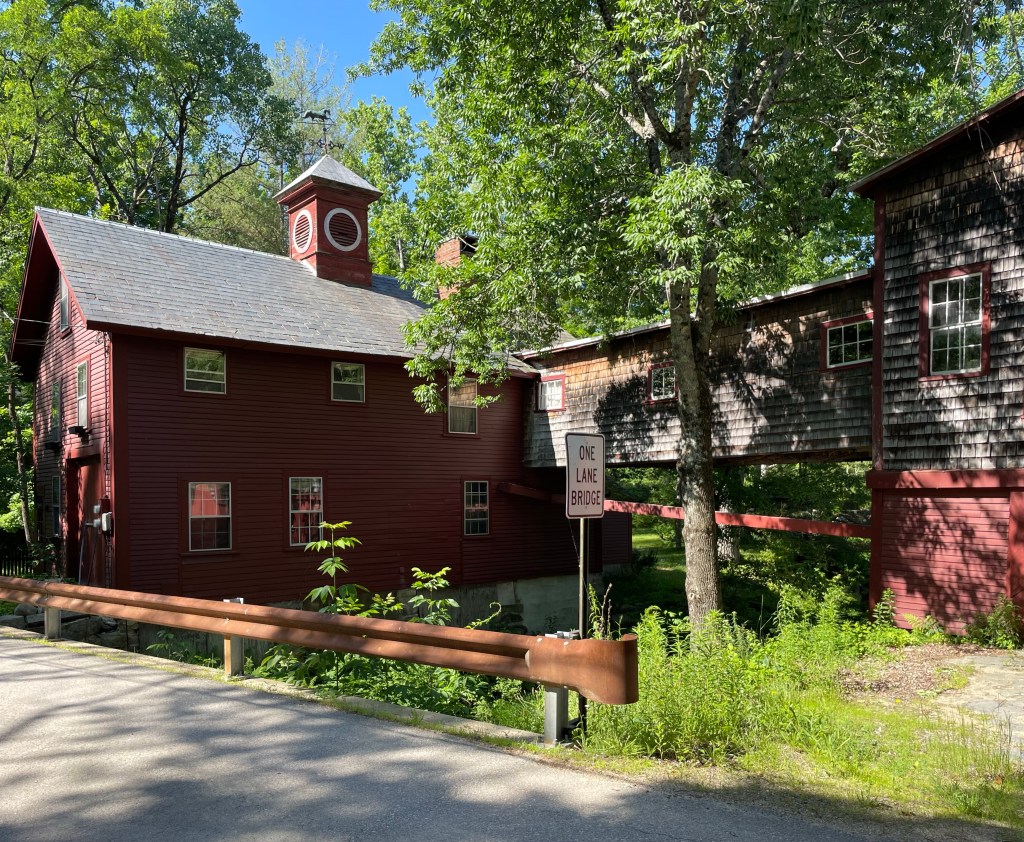
Cragin-Frye-Savage Mill // 1858

There’s not much that is more picturesque and stereotypical New Hampshire than old, wooden mill buildings. When I was looking for a town to explore in NH, I got stuck on a photograph of the old Cragin-Frye Mill in Wilton, and off I went! Daniel Cragin (1836-1921) was born in Merrimack, NH of Scottish descent. In 1856, age 21, he rented a room in a woolen goods mill, and he built knife trays and wooden toys which he turned into a business. He started his business with ten dollars, and turned a profit from the beginning, so much so that by 1858, he accumulated enough money to purchase a nearby existing building for his own operation. The mill was water-powered and grew quickly. The Daniel Cragin Mill began production of sugar boxes and dry measure boxes. The mill closed briefly after Cragin retired in the early 20th century. In 1909, Whitney Morse Frye and his father, Dr. Edmund Bailey Frye, bought the mill from Cragin. Frye continued the Cragin line of wooden trays, boxes, and pails in addition to his normal processing of grains. Whitney Frye died in 1961, and his employee, Harland Savage Sr. purchased the old mill, continuing operations. After his retirement in 1981, his son Harley and his wife Pam Porter Savage took over operations and they have operated the mill to the present day as Frye’s Measure Mill. The mill is one of a few remaining operating water-powered measure mills in the United States!

Colony-Abbott Worsted Mill // 1882

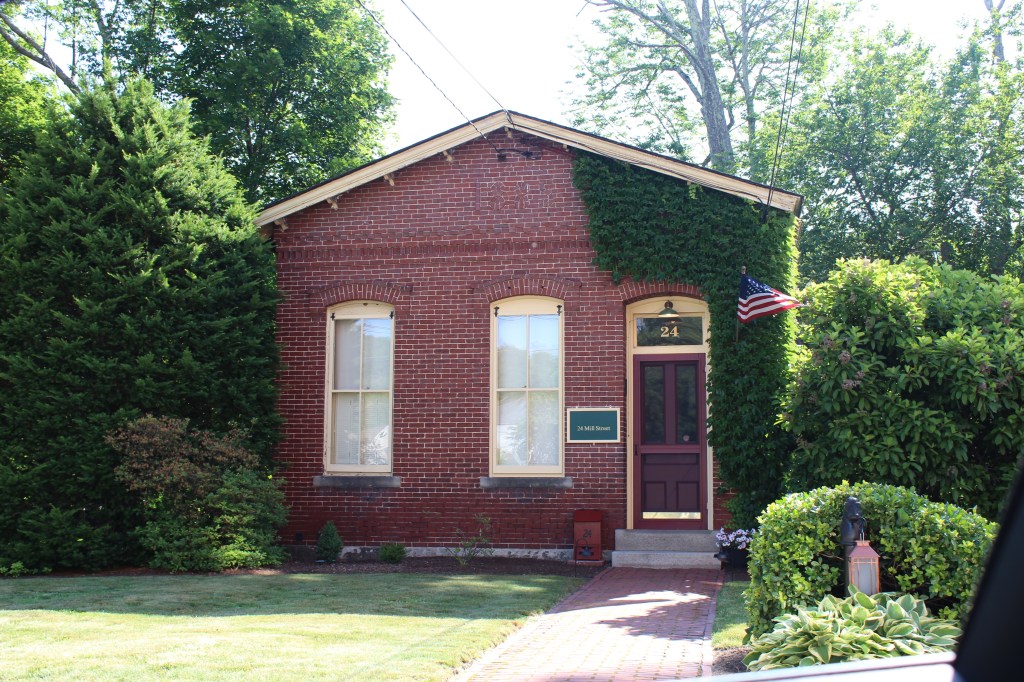
The site along the southern bank of the Souhegan River in East Wilton, NH has been the location of successive mills since 1814. These wooden mills were wiped out by fire, and the land was vacant until 1882, when members of the mill-owning Colony family of Keene, NH bought the site for a new cotton mill. That year they built a three-story brick mill building atop a raised basement level. Colony Bros., the company, began their manufacturing in early 1883. They produced woolen flannel and other woolen goods and employed 70 workers in the factory. The building was powered by steam and water from the adjacent Souhegan River. In 1894, the Colony Bros. mill passed into the hands of Philip Amidon, who formed the Wilton Woolen Company, who produced everything from traditional woolen goods to the finest cashmere. In 1932, the struggling mill was purchased by the Abbotts, owners of two local mills and others in Massachusetts. Abbott Worsted produced a very fine finished cloth, with much of their product going to New York City where it was made into fine men’s suits. The building was later purchased in 1971 by Leonard Peterson, to house his growing company, Label Art. The company has for many years been a nationwide distributor of pressure sensitive labels. Their occupancy likely saved the buildings from the wrecking ball, like so many others did at the time!

Oh, and how cute is the 1885 office for the mill?! The date is found in the brickwork!

Lapham Woolen Mill // 1879

I have gotten a lot of requests recently to feature an old New England mill town, and I wanted to highlight a lesser-known one, so here is Millbury, Massachusetts! This gorgeous mill building was constructed between 1879-1919, impacted by over forty years of growth and design. The Lapham Woolen Mill is the largest and most intact 19th century industrial building in Millbury and sits in the middle of Bramanville, an industrial village in the town, off Singletary Brook, a branch of the Blackstone River. The Lapham Woolen Mill was built on the location of the former Burbank paper mills, which were in operation in Bramanville between 1775-1836. The Lapham Woolen Mill was started in the mid-1870s by Mowry A. Lapham, who oversaw the company’s growth after the Civil War, manufacturing clothing and other woolen goods. After Mowry’s death, the company’s pollution into the brook got the best of them and they disbanded, selling it. The mill was then purchased by Josiah and Edward Mayo, and their business partner Thomas Curtis. The group renamed the existing business the Mayo Woolen Company. The complex was occupied by Steelcraft Inc., a manufacturer of medical supplies, until recently. The building’s future was threatened until 2020, when a proposal to restore the old mill, and add new housing on the site was proposed. Fingers and toes are crossed to see this gorgeous building restored!

Dexter Richards and Sons Woolen Mill // 1905

The Dexter Richards and Sons Woolen Mill is the last surviving textile mill in Newport, New Hampshire. It was one of the city’s largest and most successful industries and employers. Built in 1905 on the banks of the Sugar River – which supported industrial activity as early as 1768 – the mill reflects the evolution of water-powered mills throughout the city and the region for more than a century. Designed by Peterborough native Edward A. Buss, Richards Woolen Mill is a typical three-story brick mill building from the early 20th century with granite, brick and metal architectural flourishes; it stands out for its five-story Romanesque tower with three tall arched windows on each side. At the base of the tower, above the entrance, are two slate roundels with the dates “1848” and “1905,” marking when both a previous mill on the site and the existing mill were built. In addition to running the mill, the Richards family was instrumental in establishing the Newport Electric Company (1892) and brought both Western Union Telegraph service (1866) and the Concord & Claremont Railroad (1871) to Newport. Richards and Sons, Inc. dissolved in 1926. The property was purchased by Harry W. Brown and Associates and was renamed the Gordon Woolen Mill. That business made wool linings for Army clothing during World War II. The mill was later owned by William Ruger Jr. an heir to the Ruger Firearms Company. Within the last couple years, the mill was purchased for redevelopment into housing, which has not yet materialized.