Chinook Kennels // c.1920

The Chinook Kennels in Tamworth, stand today as a lasting vestige of a lesser-known dog breed and the State Dog of New Hampshire, the Chinook. The Chinook owes its existence to one man: Arthur Treadwell Walden, who lived in the Wonalancet village of Tamworth, operating a farm and inn with his wife, Katherine Sleeper Walden. The breed derives principally from one male ancestor born in 1917, named “Chinook”, who was Walden’s lead dog, bred with Huskies, mastiff, and shepards to create the iconic breed today. As Arthur Walden developed the breed, he built kennels on the grounds of the Wonalancet Farm, this structure which is a log cabin of sorts. Walden brought his dog, Chinook, then 12-years-old, with him on the Byrd Expedition to the Antarctic, and he went missing while hauling supplies miles overland from ship to shore, and was presumed to have died there. When he returned home, Arthur sold the kennels and the core of his breeding stock to Milton and Eva B. ‘Short’ Seeley, who moved the kennel building down the road to its present site. The old building has been converted to a home and remains a private, single-family residence today.

Old New Ipswich Center Schoolhouse // 1829

Presently owned and occupied by the New Ipswich Historical Society, this handsome brick building was originally constructed in 1829 as a schoolhouse for young students in town. The structure is located on Main Street and replaced wood-frame school that was located on the other side of the road. Almost immediately after it was built, the building and its location were heavily criticized as early as 1847. There were up to 92 pupils in its two rooms, both of which were accessed by a central entrance, causing those entering and leaving to disrupt both classrooms. Additionally, the closeness to the road caused noise and dust to enter the classrooms. The school closed in 1860 and was used for a time as a blacksmith shop before it was acquired by the New Ipswich Historical Society in 1939.

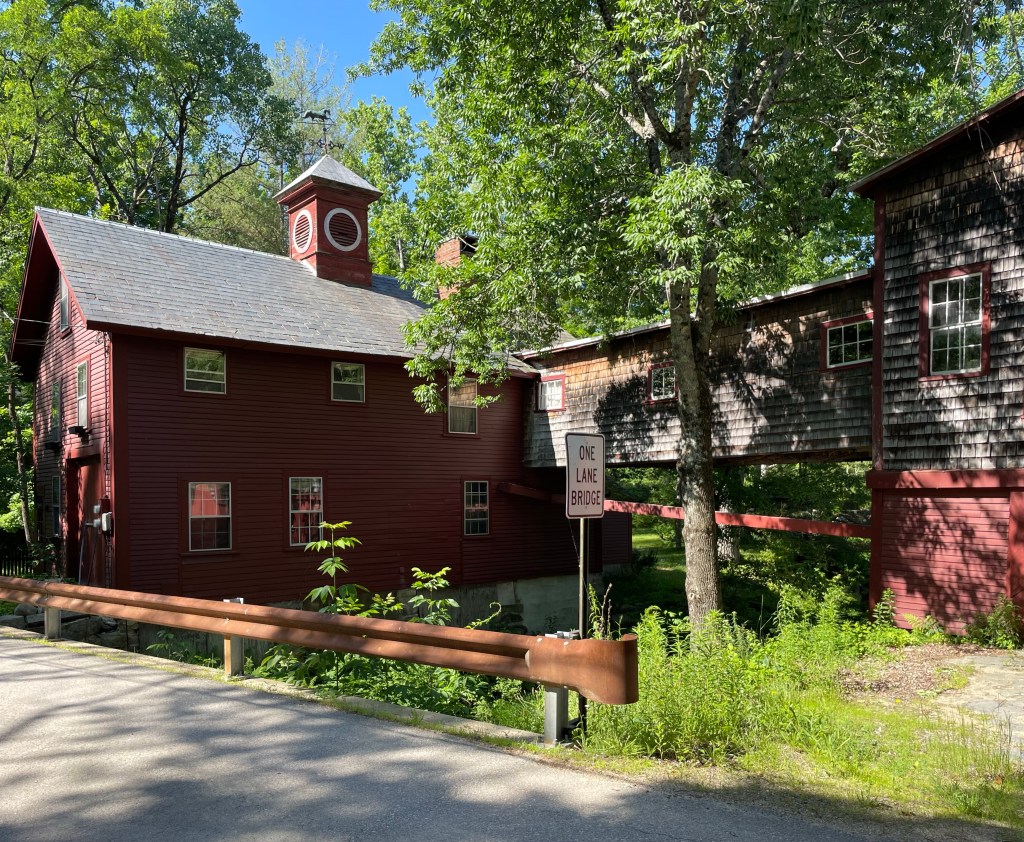
Cragin-Frye-Savage Mill // 1858

There’s not much that is more picturesque and stereotypical New Hampshire than old, wooden mill buildings. When I was looking for a town to explore in NH, I got stuck on a photograph of the old Cragin-Frye Mill in Wilton, and off I went! Daniel Cragin (1836-1921) was born in Merrimack, NH of Scottish descent. In 1856, age 21, he rented a room in a woolen goods mill, and he built knife trays and wooden toys which he turned into a business. He started his business with ten dollars, and turned a profit from the beginning, so much so that by 1858, he accumulated enough money to purchase a nearby existing building for his own operation. The mill was water-powered and grew quickly. The Daniel Cragin Mill began production of sugar boxes and dry measure boxes. The mill closed briefly after Cragin retired in the early 20th century. In 1909, Whitney Morse Frye and his father, Dr. Edmund Bailey Frye, bought the mill from Cragin. Frye continued the Cragin line of wooden trays, boxes, and pails in addition to his normal processing of grains. Whitney Frye died in 1961, and his employee, Harland Savage Sr. purchased the old mill, continuing operations. After his retirement in 1981, his son Harley and his wife Pam Porter Savage took over operations and they have operated the mill to the present day as Frye’s Measure Mill. The mill is one of a few remaining operating water-powered measure mills in the United States!