Emery-Scudder Barn // c.1845

There is something so enchanting about vernacular buildings with a backdrop of New England nature. This mid-19th century barn is located in the Chocorua Basin area of Tamworth, New Hampshire, and it tells the story of the area from its agricultural past to become a prominent summer colony in the White Mountains. The barn was once part of the Emery Farm that was purchased by Boston couple, Rebecca and Marshall Sears Scudder, the son of hardware dealer Charles Scudder of Brookline, who had the house moved and used the property as their summer retreat. The Emery Farmhouse was renovated and renamed, ‘Birchentower’ and purchased by Scudder’s half-brother, Horace Elisha Scudder (1838-1901) in 1889 from Rebecca following the death of her husband. Horace was a writer of numerous novels, children’s books, histories and biographies and introduced Hans Christian Anderson to the English-speaking world. A year after buying Birchentower, he became editor of the Atlantic Monthly, a post he held for eight years. The Scudders preserved the old Emery Barn across from the summer cottage which now sets the bucolic scene from the new scenic vista overlooking Chocorua Lake and Mountain beyond.

George Dodge House – Highland House // c.1790 & c.1850

Built in the 1790s by a Salem mariner, merchant and tanner, George Dodge (1750-1821), this large Federal-period residence in Tamworth, New Hampshire, is now preserved and lives on as the Highland House, a historic bed & breakfast. The residence was owned by George Dodge, who arrived to town and engaged in local affairs, serving as town clerk and housing the local congregation in his barn until the town house was built in 1794. Dodge assisted with bringing Rev. Samuel Hidden to Tamworth as it’s pastor, and settled in nicely to the community until he was lured back to Salem following the death of his father, whom he inherited a sizable fortune. George Dodge does not appear to have returned back to Tamworth, but willed his property here to the Congregational Church. By the mid-19th century, the house was renovated in the Greek Revival style, with the addition of the Classical door surround and corner pilasters (and likely the addition of the third floor and gable roof). The dwelling stands as a stately country mansion, with rooms for rent as the Highland House, which opened in the 1990s.

Our Lady of Perpetual Help Chapel, Tamworth // 1905

Located in rural Tamworth, New Hampshire, the Our Lady of Perpetual Help chapel was built as a vernacular, Roman Catholic house of worship in 1905 and later altered into the present shingled-Gothic style. The chapel was originally a typical late-Gothic, rural chapel with white clapboard siding and a belfry, and it served as the house of worship for many local, working-class residents of Tamworth, specifically in the summer months. Many members of the church likely worked at the mills in nearby towns or as housekeepers in the large summer mansions in the White Mountains. By the 1940s, the chapel was renovated with the present shingle siding and Tudor portico, around the time that the summer chapel became a year-round church. As the membership dwindled in the late 20th century, the Catholic Diocese deconsecrated the church and sold it to a private owner. Since then, the building has been preserved inside and out, and used as a weaver’s studio, but is now (2026) for sale!

Chinook Kennels // c.1920

The Chinook Kennels in Tamworth, stand today as a lasting vestige of a lesser-known dog breed and the State Dog of New Hampshire, the Chinook. The Chinook owes its existence to one man: Arthur Treadwell Walden, who lived in the Wonalancet village of Tamworth, operating a farm and inn with his wife, Katherine Sleeper Walden. The breed derives principally from one male ancestor born in 1917, named “Chinook”, who was Walden’s lead dog, bred with Huskies, mastiff, and shepards to create the iconic breed today. As Arthur Walden developed the breed, he built kennels on the grounds of the Wonalancet Farm, this structure which is a log cabin of sorts. Walden brought his dog, Chinook, then 12-years-old, with him on the Byrd Expedition to the Antarctic, and he went missing while hauling supplies miles overland from ship to shore, and was presumed to have died there. When he returned home, Arthur sold the kennels and the core of his breeding stock to Milton and Eva B. ‘Short’ Seeley, who moved the kennel building down the road to its present site. The old building has been converted to a home and remains a private, single-family residence today.

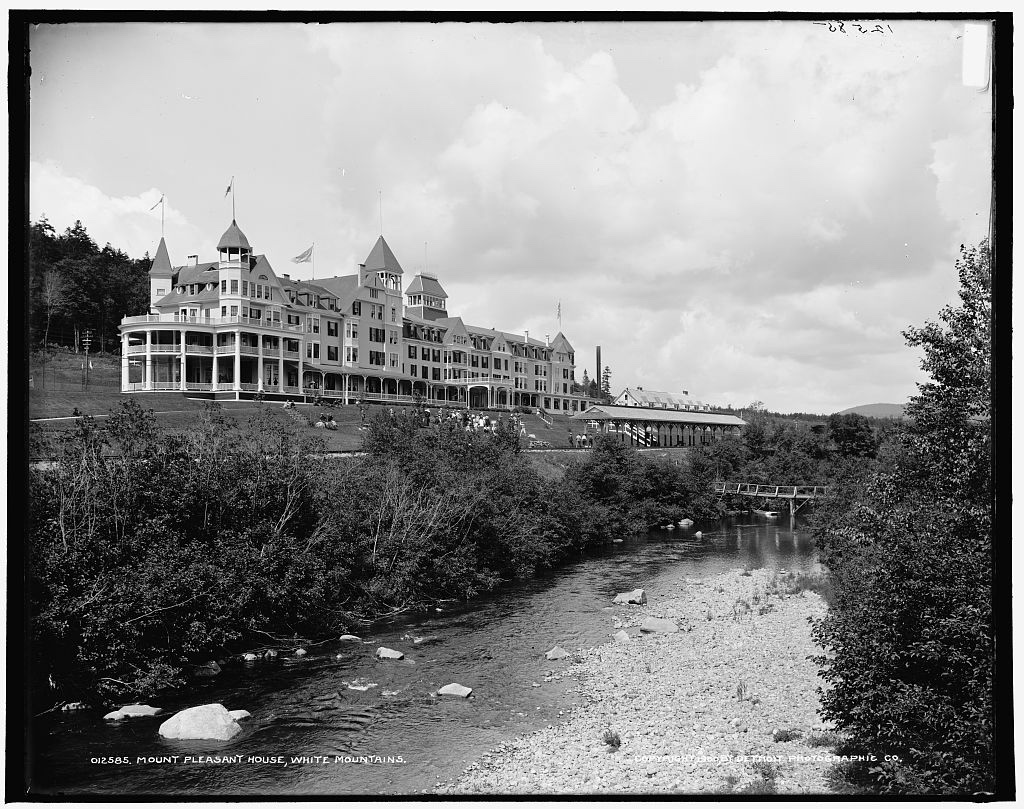
Mount Pleasant House // 1875-1939

One of the earlier grand hotels in the White Mountains of New Hampshire, was Mount Pleasant House, built in 1875 after the arrival of the railroad through Crawford Notch. The hotel was located on a small hill where the Lodge at Bretton Woods is currently sited, across the street from the iconic Mount Washington Hotel. It was built by lumberman and investor John T.G. Leavitt and opened the following year. It was then a simple, almost box-like structure with only forty rooms, later expanded and “modernized” to accommodate the growing waves of affluent visitors from New York City and Boston every year. In 1881, Leavitt sold the hotel to Oscar Pitman and Joseph Stickney, the latter eventually became sole owner and acquired land across the street to build the Mount Washington Hotel in 1900. Possibly as a practice for his larger endeavor across the street, Stickney hired one of Portland’s leading architects, Francis H. Fasset, to design the additions and alterations. When Stickney died in 1903, just a year after his larger hotel was built, both properties were willed to his wife, Caroline. She ran the company through changing economic conditions and when she died, in 1936, the hotels were left to her nephew, F. Foster Reynolds. Reynolds decided that the Mt. Pleasant was not worth the expense needed to maintain it, and in 1939, ordered the building demolished, replaced decades later with the present building.

Crawford Depot // 1891

The railroad line through Crawford Notch in the White Mountains of New Hampshire was completed and opened in 1875 by the Portland and Ogdensburg Railroad, and had a transformative effect on the local economy. Soon after completion, tourists arrived in droves during the summer months to take in the area’s scenic beauty and clean air. From this, wealthy investors built large resort hotels, like the Mount Washington Hotel, to satisfy the demand of the affluent visitors. The Portland and Ogdensburg was taken over by the Maine Central Railroad in 1888, and this depot was built in 1891. It was one of the most elaborate stations built by that railroad’s Mountain Division, because of its prominent location in the mountains. The Crawford Depot presently serves as a visitor center and shop operated by the Appalachian Mountain Club. Nearby is the trailhead to Mount Willard, which has some of the best views for a modest hike.