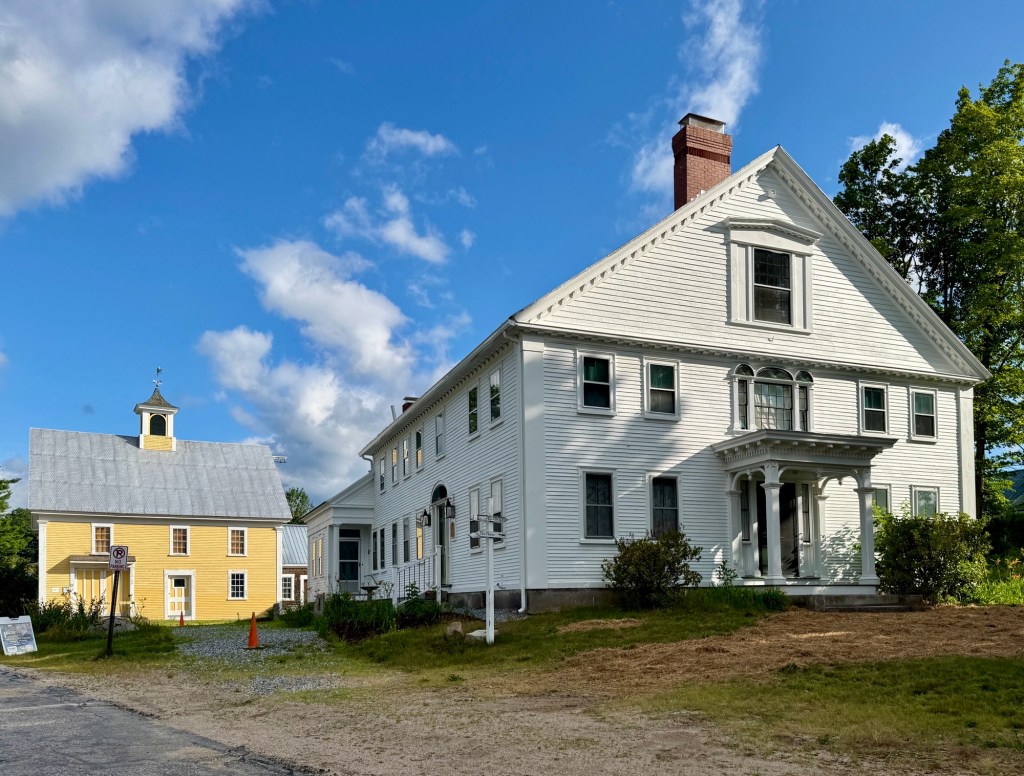
The Peirce Mansion on Court Street in Portsmouth, New Hampshire, is one of the finest, high-style Federal period homes in the United States. Built in 1799 for John Peirce (1746-1814), the residence is said to have been designed by Bradbury Johnson, a local carpenter and builder who was inspired by the designs of Charles Bulfinch. John Peirce began his career in the counting room of Daniel Rindge and worked in business and banking in Portsmouth. Peirce opposed the American rebellion against England but did not serve either side during the war. After the Revolution, in 1789, John Peirce was one of the leading citizens appointed to escort President George Washington around Portsmouth. The Peirce Mansion remained in the family over 150 years until it was sold by his descendants to the Middle Street Baptist Church in 1955, who extensively modified the residence to serve as a vestry and meeting space for church activities. The building was moved back from the road with the four tall chimneys were removed. Architecturally, the Peirce Mansion stands out for its massing, hip-roof with cupola adorned by a balustrade and urns, and the facade with elliptical arches, molded medallions, pilasters, and the Federal style entry treatment with fanlight transom and sidelights.
The Long-Ladd House at 3 Richards Avenue in Portsmouth, New Hampshire, showcases the versatility of the Federal style, an architectural style that dominated American architectural tastes from the 1780s through the 1830s. This house dates to 1812 and was built for George Long (1762-1849), a sea captain and trader until engaging in politics in his later years. He remained in the home until his death in 1449, leaving the property to his only heir, Marcy, and her husband, Henry Hurd Ladd. The Long-Ladd House is constructed of brick with the facade dominated by four, full-height pilasters breaking up the bays. A center portico shelters the main entrance which is adorned by a fanlight transom and classical surround. In a city full of Federal style homes, this one really stands out!
The Larkin-Ladd House at 180 Middle Street in Portsmouth, New Hampshire, is a three-story, masonry Federal-style residence with symmetrical facade, built for one of the city’s wealthiest merchants. Samuel Larkin (1773-1849) was born in Charlestown and moved to Portsmouth, marrying Ann Jaffrey Wentworth, a daughter of Col. Joshua Wentworth. During the War of 1812, Samuel Larkin made his fortune as an auctioneer, selling the contents of English ships captured by local privateers. It is believed that fourteen privateers and their crews worked out of Portsmouth Harbor and are said to have captured an estimated 419 British ships! With the profits from stolen goods from these British ships, Larkin purchased lots on Middle Street and began construction of this stately residence. He (and mostly his wife), had twenty-two children, although roughly half of them died before reaching adulthood. By the late 1820s, financial hardship fell on Larkin and he sold this property, moving into his house next door, which before this was his original residence and later rented to boarders. The Federal style mansion was later owned by Henry H. Ladd, a prosperous Portsmouth shipping merchant, who also served as President of New Hampshire Bank and Portsmouth Savings Bank. The Larkin-Ladd House is undoubtedly one of the finest Federal style residences in New England, and stands out for its entrance, flanked by Palladian windows and the slightly recessed elliptical surrounds at the first and second floor windows. Additionally, the historic stable, also from the 1810s, maintains much of its architectural integrity.
Master mariner Charles E. Blunt Sr. (1768-1823) built this large Federal period home on Pleasant Street in Portsmouth, New Hampshire near the turn of the 19th century for his bride, Abigail Laighton, and their new family. Charles Blunt was a wealthy sea captain who would be out at sea for months at a time, trading in the west indies. On a voyage near Havana Cuba in March, 1823, his vessel was boarded in the night by two piratical boats, with six men each, and Captain Charles Blunt was brutally murdered and thrown overboard. The ship’s cook was stabbed, and fed to the hogs on the brig, with the remainder of the crew maltreated and the goods plundered. The Captain Blunt House follows a symmetrical, five-bay, center entrance form, with cedar shake shingles, three pedimented dormers and large portico over the door.
The Tredick House is located at 187 Marcy Street in Portsmouth, New Hampshire and was built in 1802 for Captain Jonathan Martin Tredick (1777-1803) and his new wife, Martha Marshall on land gifted to them by Jonathan’s father, William Tredick. In a tragic shift of fortune, Captain Jonathan Tredick never got to live in his new house as he died at sea, with accounts differing, either from fever or being swept overboard. At the time, Jonathan and Martha had two children, 2 year-old Catherine Marshall Tredick (1801-1822) and newborn Jonathan Marshall Tredick (1802-1875). Martha, a sudden widow at the age of 26 with two children, was aided by her family and that of her late husband, and operated a store nearby to supplement her income until her death at home in 1872, she was 96 and never remarried. The late Georgian style house features a hipped roof with central chimney, pedimented dormers and a pedimented entry and 9-over-six sash windows on the house.
The people and buildings of Portsmouth, New Hampshire, have always been closely tied to the sea. Many old houses and commercial buildings here were built for merchants, ship builders, sea captains, and fishermen, who made their living from the charming port town. This historic house at 333 Marcy Street in the Downtown area of Portsmouth, was built around 1812 for Benjamin Damrell (1781-1821) a sea captain, privateer during the War of 1812, and member of the Portsmouth Marine Society and Alert Fire Society of Portsmouth, a volunteer fire fighting group. Captain Damrell died in 1821 while at sea and his property was inherited by his widow, Lucy, who appears to have remained here for some time, raising their daughter.
Appleton Academy (aka the New Ipswich Academy) was established in New Ipswich, New Hampshire, in 1789, being the second oldest private academy in the state. The school was named after benefactor Samuel Appleton, the largest early donor, who grew up in town at his father, Isaac Appleton’s homestead. This is the fourth Academy building in New Ipswich. The original 1789 frame building was outgrown and in 1816, it was decided that the academy would be shared with the new town hall building, occupying the second floor. Sharing a prestigious academy building with the town functions was deemed insufficient, and a new prominent site near Appleton Common was acquired, with a new brick academy building constructed there in 1853. The Italianate style structure was funded by the Appleton Family, and was designed by Boston architect, William Washburn. In January 1941, the main Academy building was destroyed by fire. The next year it was rebuilt, closely following the design of the earlier brick structure. The school closed in 1974 and was used by a non-profit and schools until it sold in 2018 and appears to be a residence now.
Built on a terraced knoll on Main Street in the enchanting village of New Ipswich, New Hampshire, the Charles Barrett House is a stunning late-Georgian residence that was restored in the 20th century. Charles Barrett (1739-1808) moved to the town from Concord, Massachusetts, and did quite well for himself, as just decades later, he would build his son one of the finest homes in the state, the Barrett House, next door. The house’s current appearance reflects a restoration circa 1960. Like many 18th century houses, it was altered in the 19th century with Victorian-era embellishments, including a Mansard roof, 2/2 sash, and a matching carriage house. Under the direction of Historic New England, the house was returned to its more simple, original, Georgian design.
The Barrett House (also known as Forest Hall) is a Federal style mansion located in New Ipswich, New Hampshire and one of the finest buildings in the entire state. The mansion was built around 1800 by Charles Barrett Sr. for his son Charles Jr. and daughter-in-law Martha Minot as a wedding gift. Its grand scale was encouraged by Martha’s father, who promised to furnish the house in as lavish a manner as Barrett Sr. could build it. The interiors are elegantly furnished, and numerous reception rooms were designed for entertaining in a cosmopolitan manner. An elaborate allée was later added to the landscape, with a flight of stone steps flanked by maples rising up the hillside behind the house and leading to an elegant summerhouse. After Charles and Martha died, the estate remained in the family. However, after the railroad bypassed New Ipswich, the town entered into a decline. Charles Barrett’s descendants stayed on, but today Forest Hall remains essentially a relic of the Federal era. After 1887, the family used the house only in the summer-time. It was donated to Historic New England in 1948. Historic New England has ever-since opened up the property to those who want to see one of the best examples of a rural, Federal style estate in New England and its well preserved interior and grounds.
This house on Main Street in New Ipswich, New Hampshire, was built for Mrs. Dorothy “Dolly” Everett, (1770-1859), a sister of Samuel and Nathan Appleton, who returned to New Ipswich after her husband’s death. Her husband was David Everett (1769-1813), who had been a student at New Ipswich Academy, then attended Dartmouth, after which he studied law and practiced in Boston where he founded the Boston Patriot in 1809, and published works of drama and poetry, as well as political writings and died while on a trip to Ohio. Dolly’s house in New Ipswich is a unique, high-style blending of Federal and Greek Revival styles, with a notable entry with its recessed paneled entry, narrow paneled doorway surround with small corner blocks and paneled door. The wide, molded outer surround with its pateras and corner blocks, faceted tablet over the door and partial sidelights show the influence of architectural plan books of the period. In her will, Dolly Appleton Everett left her home to the local Congregational Church, who used the property as a parsonage into the 20th century. It was purchased in the mid-20th century as a summer residence and has remained a private home ever since.
One of the oldest (if not the oldest) extant houses in Ipswich, New Hampshire is this Colonial home on Appleton Road, which gets its name from the first owner, Isaac Appleton. Deacon Isaac Appleton III (1731-1806) was one of the town’s original settlers who came to New Ipswich from Ipswich, Massachusetts. He held the office of town clerk and of selectman and was a deacon for thirty years. He responded to the call to arms from Concord to fight in the American Revolution. Deacon Isaac Appleton III was the father of Samuel Appleton, a wealthy Boston merchant; and Nathan Appleton, a merchant and politician in Boston and head of the famous Appleton Family which would influence Boston business and politics for generations. Samuel Appleton would fund and establish the Appleton Academy in New Ipswich, the second oldest in New Hampshire after Phillips Exeter Academy. The Isaac Appleton Homestead remains in a great state of preservation and sits just outside the town center.
Isaac Lord (1772-1838) was born in Maine, but would spend much of his time transforming the small town of Effingham, New Hampshire. Isaac married the love of his life, Susanna Leavitt in Exeter in 1793 and the couple moved to Effingham, living and working in a tavern he built. Isaac prospered as an innkeeper, merchant, farmer, and entrepreneur, becoming Effingham’s wealthiest citizen, making the village he owned buildings to be called Lord’s Hill in his name. From 1818 to 1822, Isaac and Susanna lived in Portland, but he was ridiculed for “having money but no culture”. Growing tired of the city, he decided to return to Effingham. Mrs. Lord found the village too quiet and longed for the social life to be had in Portland, Maine. To convince his wife to remain with him, Isaac promised her a mansion that rivaled the homes in wealthy seaports like Portland and Portsmouth and began working on his mansion in Effingham in 1822. After years, the massive estate was completed, but Susanna remained in Portland. A heartbroken Isaac moved into the large mansion and continued business until his death in 1838. The Isaac Lord House consists of a three-story main block with a grand cupola on its roof and a three story ell to its rear. Stables and a carriage house are also on the lot today. I would do anything to see the inside of this beauty!
The town of Effingham, New Hampshire, was settled by members of the Leavitt family of Hampton, New Hampshire, led by Captain John Leavitt. From them the settlement first took the name “Leavitt’s Town”. In 1749, the land here was officially granted by Governor Benning Wentworth, and he renamed it “Effingham” for the Howard family, who were Earls of Effingham in England and who were related to the Wentworths by marriage. The town was incorporated in 1778, six years after this house was built. This is the Dearborn-Keay House, a 1772 Colonial home in Effingham, built by Benjamin Dearborn, who was an early settler of the area from Hampton, New Hampshire. The homestead was enlarged by his nephew Asahel Dearborn in the early 1790s, giving the home its present appearance. After later ownership in the Dearborn Family, the property was purchased by Cyrus Keay, who would die in the home in 1894. The property remained in the ownership of the Keay family for many years more.