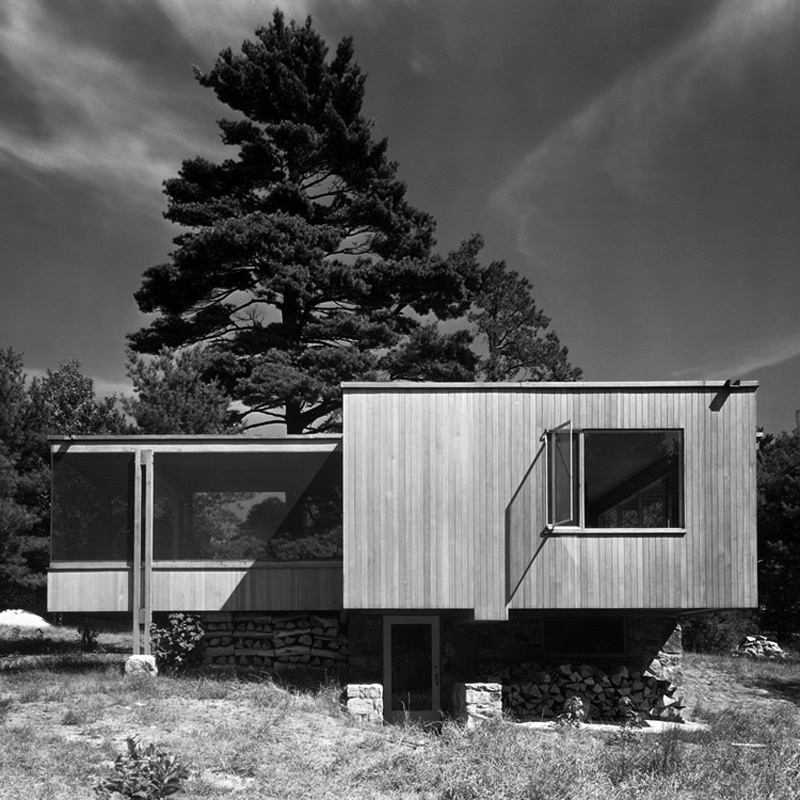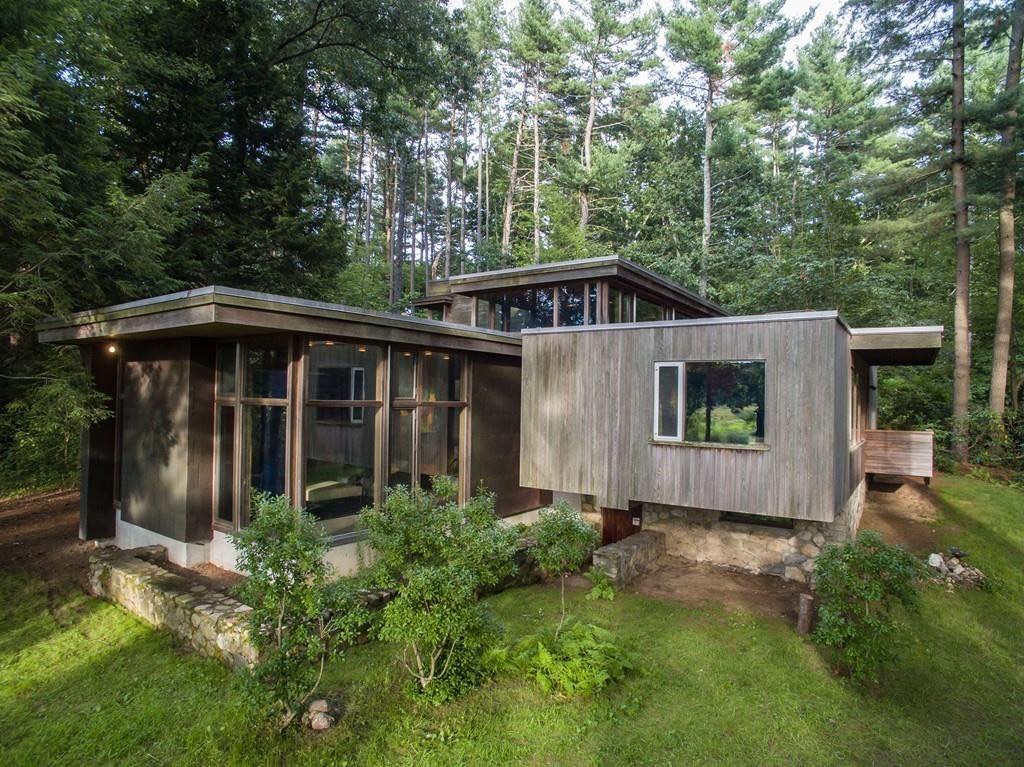
Chamberlain Cottage // 1940

Nestled into the forests of Wayland, Massachusetts, one of the most significant examples of early Modernist architecture, the Chamberlain Cottage, represents the European Bauhaus style adapted to the American landscape and New England vernacular. Designed in 1940 and completed in 1941, the house was commissioned by Harvard Economics professor, Henry Chamberlain and his wife, Margareth, as a weekend retreat from Cambridge. Professor Chamberlain commissioned Marcel Breuer and his mentor, Walter Gropius, then Dean of the Harvard Graduate School of Design, to design a home with a specific request for a screened porch similar to Gropius’ residence in nearby Lincoln. For the Chamberlain Cottage, the design responds to the uneven terrain and the potential for river flooding by two distinct parts: a grounded stone base and a cantilevered wooden volume above. The lower stone level functioned as a foundation while providing storage for a canoe and housing a fireplace that extends vertically through the structure; with the upper wooden volume containing living spaces. Despite its compact size for weekend visits, the upper level is well planned and includes a living space, kitchen, a single bedroom, and the porch. Due to its small scale and siting, the one-bedroom cottage was not easily adaptable for modern living. After falling into disrepair in the 1980s and ’90s, the home was purchased by architects Sidney R. Bowen and Angela Watson, who expanded the structure over the course of a decade to its current size of 3,742 square feet. It has been occupied and lovingly maintained by later owners. It remains a private residence.

424 Massachusetts Avenue // 2002

Modern architecture can often compliment and blend into the context of historic neighborhoods, and this example in Boston’s South End neighborhood is one of the best examples locally. In 2002, developers eyed a long-vacant lot on the busy Mass. Ave corridor through the South End and began designs of a contextual addition to the streetscape. Dolezal Architecture was tasked with designing a modern residential building that would comply with local historic district regulations, a balance that can be difficult to accomplish. Employing traditional masonry, solid-to-void ratios, massing, and bays, but in a modern context, the building blends in with its surroundings yet is architecturally interesting. The building contains ten condos in a single building which reads more like two distinct structures.

Socony-Mobil Building // 1956

One of the unsung heroes of Modernist architecture in New York City is one of my personal favorites, the Socony-Mobil Building at 150 E 42nd Street in Manhattan. Completed in 1956 from plans by Wallace Harrison of the iconic firm of Harrison & Abramowitz, the development stands out amongst the competing masonry buildings and glass skyscrapers in the area. At the time of its completion, the Socony–Mobil Building was the first skyscraper to have its exterior wall entirely clad with stainless steel, as well as being the largest air-conditioned building in the world! The base is clad with opaque blue glass panels framed with stainless steel moldings; above, the tower and wings are clad in over 7,000 embossed stainless steel panels. The firm reviewed over 100 different designs until they settled upon the four raised relief panels: a rosette-like motif for above and below the windows; a large and small rosette to flank the windows, and two variants displaying a design of interlocking pyramids. The panels were likely designed by or inspired by Oskar Nitzchke (1900-91), a German-born designer who worked at the firm and worked on the similar style Alcoa Building (1953) in Pittsburgh. The building was developed as a speculative project, but the largest tenant, the Socony-Mobil Oil Company, later renamed Mobil, helped to give way to the naming rights. The building was landmarked by the City of New York in 2003.

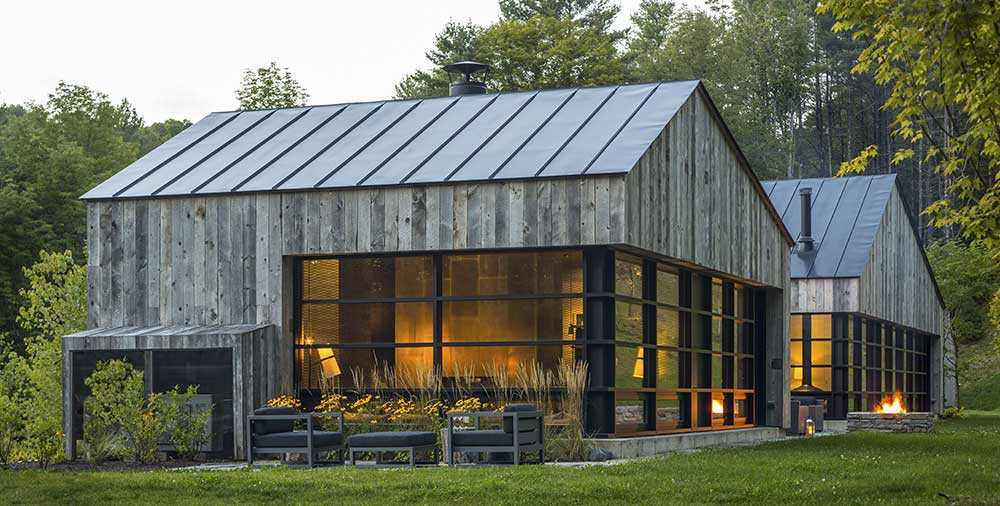
Woodshed // 2017

“Woodshed”. Image by Jim Westphalen.

In researching historic buildings in the tiny Vermont town of Pomfret, I was stunned to find images of this stunning Modern design in the town. Designed by the Birdseye Design Firm based out of Richmond, VT, “Woodshed” was completed by 2017 and serves as both a guest house and entertainment space for the main residence down the road. From the firm’s website, “The project is conceptually inspired by the vernacular woodshed, a familiar and iconic element in the Vermont landscape. The residence is composed of two asymmetric gable roof forms, akin to the traditional woodshed, connected by a central entryway”. The common thought on new construction is typically bland and “cookie-cutter” McMansions or boxy apartments, but this project is a testament to thoughtful Modern design found in even the smallest towns in the region!

New Kent Memorial Library // 1972

Between 1900 and 1970, the town of Suffield doubled its population, and the 1899 public library was outgrown. The city gathered funds to construct a new library, knowing that the endowment for the day-to-day operations of the library by Sidney Kent, in memory of his parents, would transfer to a new building as long as the name carried with it. The town hired Warren Platner, an architect, interior designer and furniture designer, based out of New Haven. Platner designed the Modern library with a concrete frame, faced with pink stone and white painted brick above, surrounds a central garden court. The flat coffered concrete roof and overhanging concrete project outwards over the terraced exterior courtyards. The interior is on five floor levels connected by gradual ramps with no stairs inside (at least at the time of construction). The town proposed a plan to demolish the library in 2008, replacing it with a larger library, but it was voted down by residents, saving (what is believed to be) the only free-standing Platner building remaining in the country.