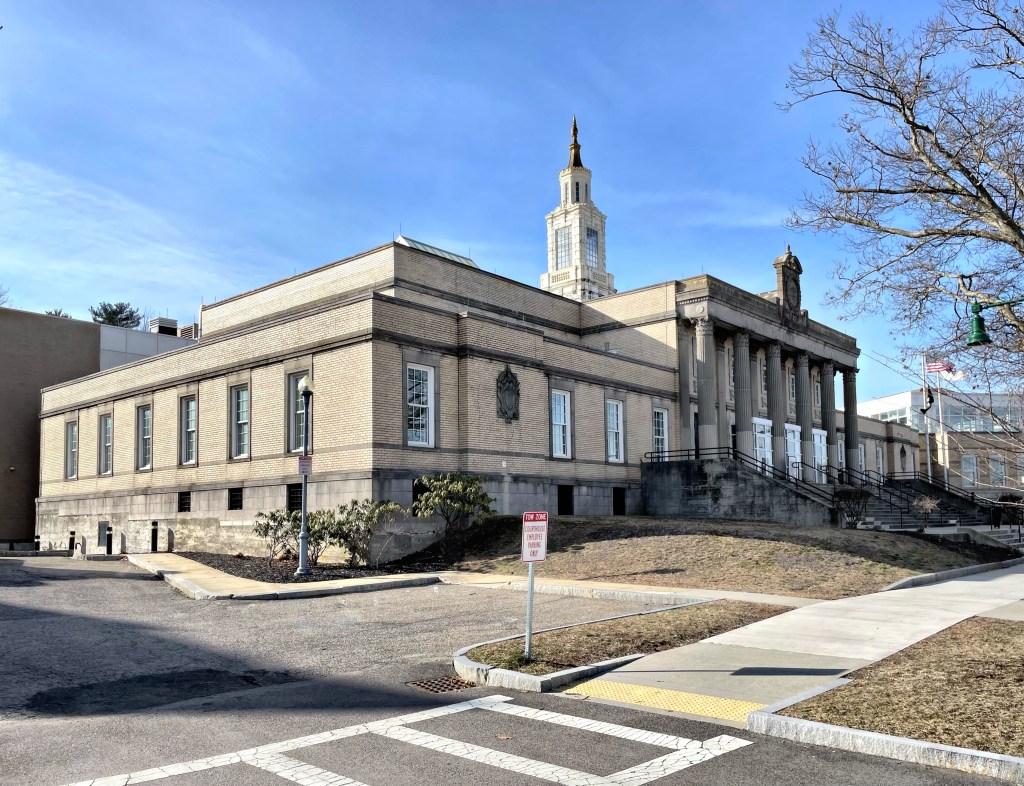
West Roxbury District Courthouse // 1922

Boston neighborhoods are very confusing, and how the West Roxbury District Courthouse came to be located in Jamaica Plain is just one example. The independent Town of West Roxbury was in existence from 1851 until 1874, a mere 23 years, bookended by its time as a section of the Town of Roxbury and being annexed into the City of Boston. West Roxbury originally included parts of the Jamaica Plain and Roslindale neighborhoods. Ultimately, West Roxbury became one of the city’s eight large districts and its municipal court division is served by this Neo-Classical style building. Built in 1922, the current West Roxbury Courthouse building on Arborway, was and still is, from a municipal court perspective as well as an historical perspective, in West Roxbury. The West Roxbury District Courthouse was designed by Timothy G. O’Connell and Richard Shaw of the firm O’Connell and Shaw who were best known for their ecclesiastical designs in New England, largely specializing in the Gothic and Arts and Crafts styles. Their design for the West Roxbury Courthouse remains one of their finest non-religious buildings and a departure from their traditional styles.
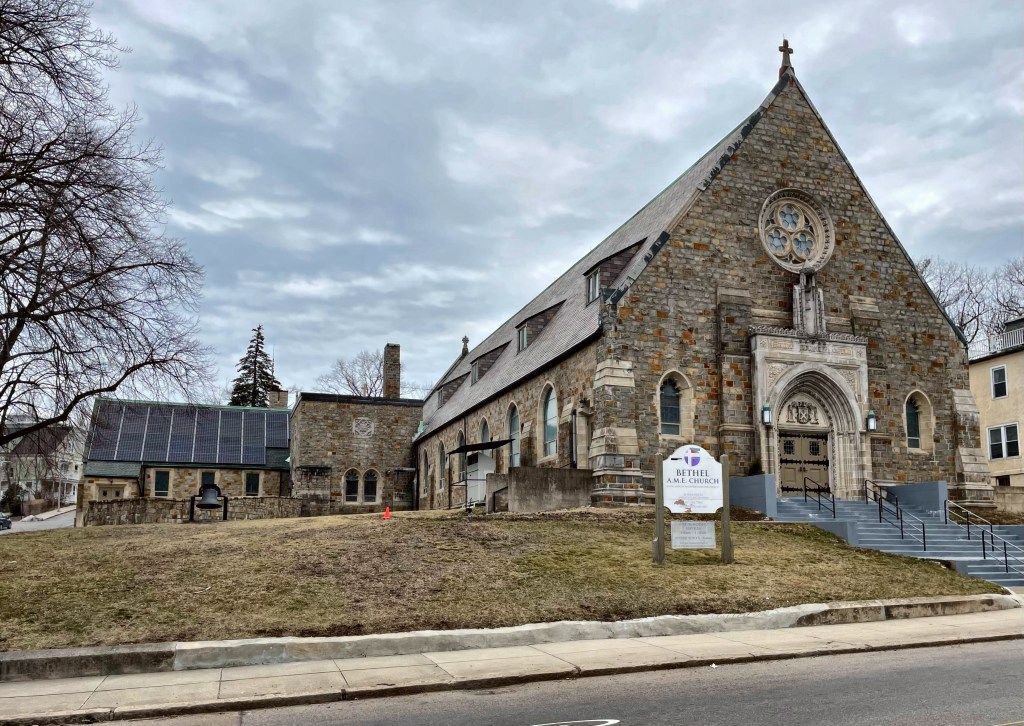
St. Andrew R.C. Church – Bethel AME Church // 1921

During the rich Arts and Crafts movement of Boston, dozens of churches and their associated buildings were constructed using principles of the movement, which sought to incorporate English design with hand-crafted detailing, moving away from the mass-produced features and architecture seen in the Victorian-era/Industrial Revolution. After WWI, the Forest Hills neighborhood of Boston saw a massive influx of residents and housing construction, leading to the desire for a new neighborhood church. The Roman Catholic Archdiocese commissioned Boston architects Timothy O’Connell and Richard Shaw, who specialized in ecclesiastical design to build the new church. Opened in 1921, the building is constructed of random ashlar walls with buttresses, lancet windows, and a large rose window, all nods to Gothic architectural precedent. Demographic changes and declining church attendance led the parish, for the first time in 1995, to accept aid from the archdiocese to meet expenses. Unable to justify keeping the church open, the Archdiocese sold the church to Reverend Ray Hammond and the Reverend Gloria White-Hammond, a husband-and-wife pastoral team, who started a local African Methodist Church (Bethel AME Church) in the neighborhood.