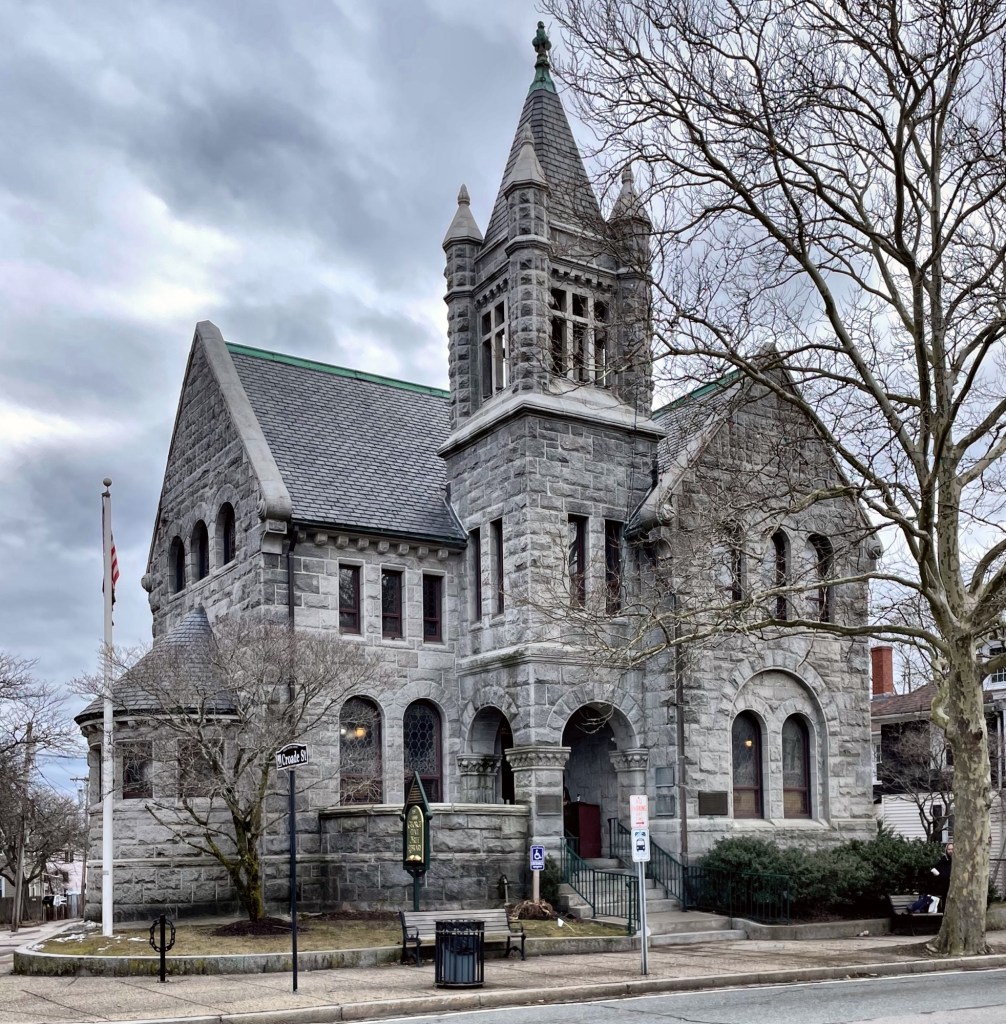
George Hail Free Library // 1888

The George Hail Free Library on Main Street in Warren, Rhode Island, is a unique, Victorian-era public library building that has been lovingly preserved by the community. Built in 1888, the building cost just over $16,000 and was designed in a more vertical expression of the Romanesque Revival style by the Providence architectural firm of William Walker and Son and built of rough-faced granite. The library is named after George Hail (1793-1873), a merchant, philanthropist, industrialist, and native son of Warren. His second wife, Martha Hail died in 1882 and left $5,000 and their home to the Warren Public Library provided that the name of the Library be changed to the George Hail Free Library in memory of her husband. The Library Committee agreed and planning began soon after for a new, purpose built library we see today. The exterior is distinguished, but the interior is also well-preserved, with original cherry woodwork grained to resemble mahogany, brass gaslighting fixtures, fireplaces, and leaded glass windows patterned with stained glass, together with some of the original furniture, that preserve a sense of the original setting.
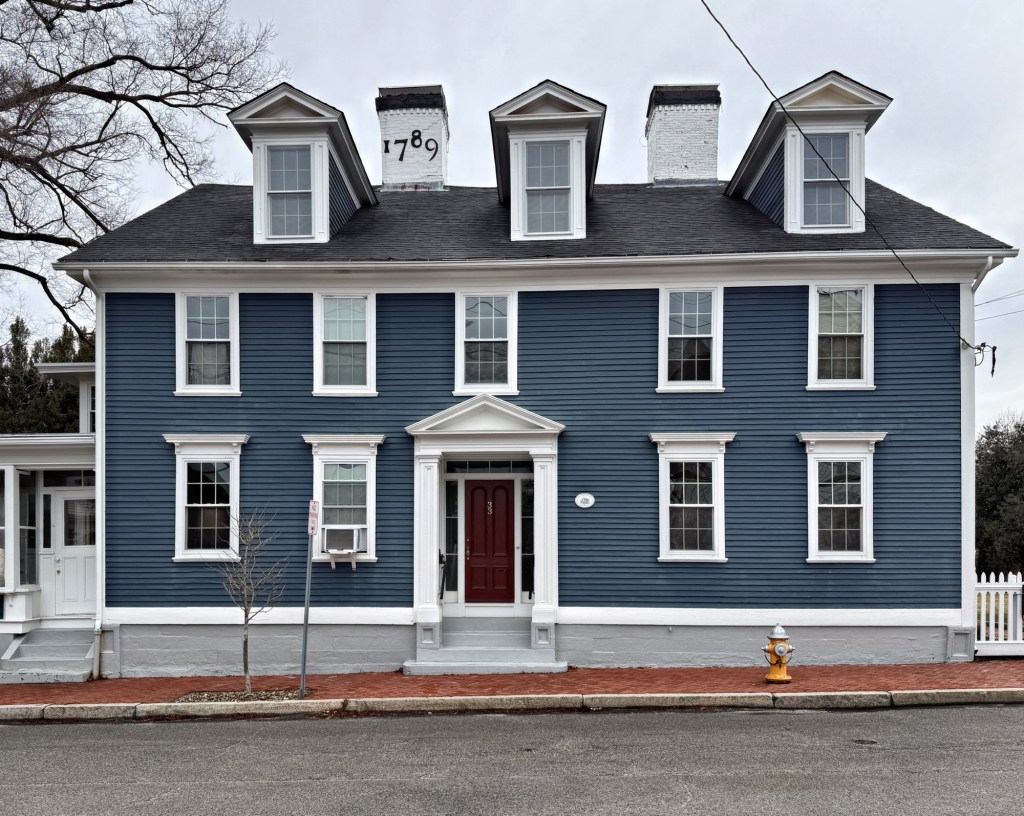
General Nathan Miller – Commander Joel Abbot House // 1789

The Miller-Abbott House at 33 Miller Street in Warren, Rhode Island, is significant architecturally as well as for its owners, who included a Patriot in the American Revolution and naval officer. The first owner, Nathan Miller (1743-1790) was a prominent local shipbuilder in Warren, Brigadier General of the Rhode Island Militia during the Revolutionary War, and delegate for Rhode Island to the Confederation Congress in 1788. This home was built in 1789, a year prior to his death in 1790; after-which, the general’s daughter, Abigail, and her husband, Charles Wheaton inherited the property and lived here with Nathan’s widow, Rebekah. In 1803, the house was expanded, likely when the right two bays were added to the home. Their daughter Laura married Joel Abbot in 1825 and resided here afterwards. Joel Abbot (1793–1855) was a Naval officer in the War of 1812, and after later important promotions, in 1852, he was made Commander by Commodore Perry. Soon after, Commodore Perry asked Abbot to accompany him on his famous Japan expedition, where U.S. ships sought to explore, surveying, and the establish diplomatic relations and negotiate trade agreements with the various nations in Japan, the first time in history. General Abbot died in Hong Kong in 1855 and his body was returned to Warren for burial. The Miller-Abbot House remains well-preserved despite replacement windows and retains its large side and rear yards in the dense downtown.

Warren Town Hall // 1890

Warren, Rhode Island, is one of the lesser-visited coastal communities of the state, but retains one of the best waterfront historic districts in all of New England. With a small population of just over 11,000 residents, the downtown is extremely walkable with a tight network of streets, lined with stellar buildings and homes of nearly every architectural style and period, and are largely preserved showcasing what New England communities were like in centuries past. On bustling Main Street, the Warren Town Hall was designed by the Providence-based firm of William R. Walker & Son, architects, and constructed between 1891-1894. Designed in the Romanesque Revival style, the two-story building with five-story central tower also features Classical detailing like the terra cotta swags and brick pilasters. Before the 1938 Hurricane, the tower was even higher, incorporating an open stage topped by a parapet and a clock face on each of the segments of its still extant dome, which now has a slightly reconfigured mini-cupola topping. Additional detailing includes a terra cotta bust of the sachem/leader Massasoit with leafage, above a fluttering ribbon inscribed “Sowams,” the Wampanoag settlement that preceded Warren. The Warren Town Hall remains well preserved by the local government and a visual landmark on the town’s Main Street.