Osborne Memorial Hall // 1920

Weare is the largest town in Hillsborough County, New Hampshire by land area. As a result, the town’s villages historically were fairly isolated (especially before the arrival of the automobile). Social halls were important gathering places for some of these rural communities, allowing for events and celebrations to be held in a designated location. Before 1920, South Weare only had a Union Church which could meet this demand. In her will, Nellie Osborne donated funds in the memory of her husband Wellman Osborne, who grew up in Weare, to erect a social hall there. South Weare residents established the South Weare Improvement Society to make use of the money and oversee construction of the Memorial Hall. The Arts and Crafts style community building with its pyramidally roof opened in 1921. After numerous decades of deferred maintenance and dwindling use of the facilities, Osborne Hall was in decline and danger of demolition. Luckily, new members banded together and funded a restoration and modernization of the building. Here’s to another 100 years!
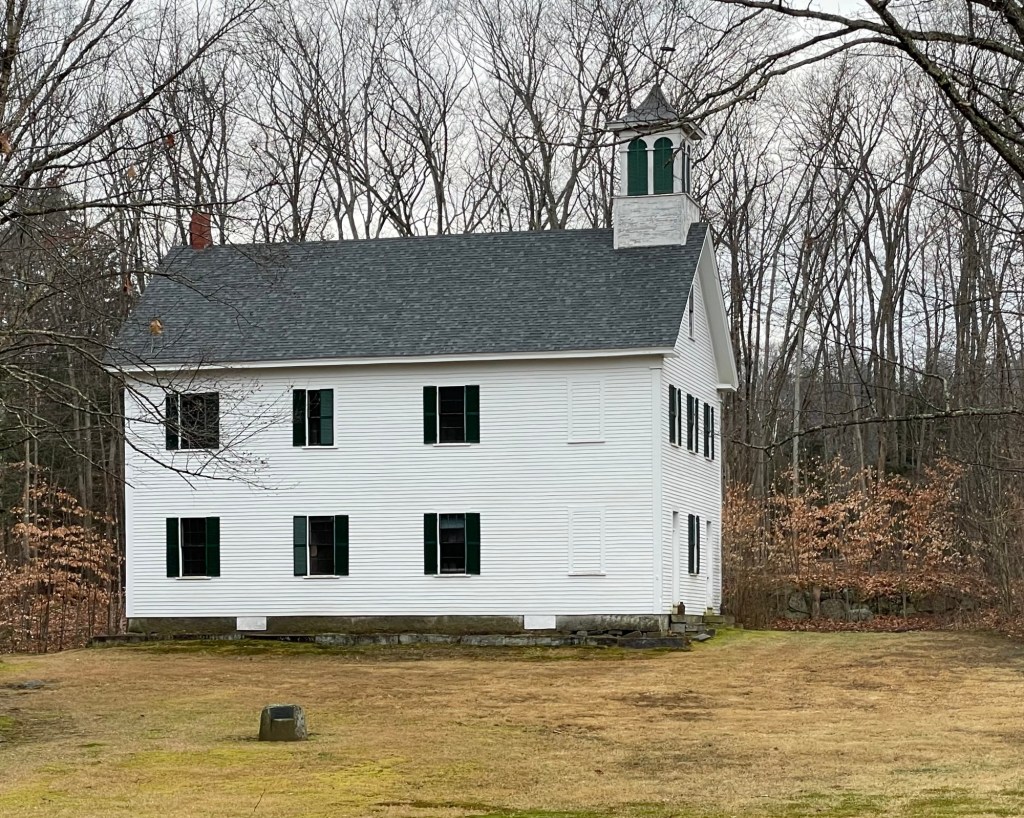
Clinton Grove Academy // 1874

Clinton Grove Academy of Weare, New Hampshire was the first Quaker seminary in the state when it was founded in 1834 by Moses Cartland (1805–1863). Moses Cartland was a Quaker abolitionist who served as the first Principal of the school and for fourteen years after. He later would move to Lee, NH, and aided those who escaped slavery in the south, sheltering them and assisting them on their way north to Canada. The original Academy here served as a private high school and included a classroom building, boarding house, barn and sheds. Students came from as far away as Ontario, Nova Scotia, Minnesota and Texas to study here under Mr. Cartland. In 1872, the Academy complex burned. It was quickly rebuilt as one structure here, in 1874. This building served as a district school until the 1930s. Today, it looks like the building is largely vacant, anyone know what its purpose is?

Weare Town House // 1837

Weare, New Hampshire has a pretty cool history. Located at the northern edge of Hillsborough County, the land presently known as Weare was granted to veterans of the Canadian wars in 1735 by Governor Jonathan Belcher, who named it “Beverly-Canada” after many of the veteran’s hometown, Beverly, Massachusetts. After various disputes over the settlement and naming of the town, it became known as “Weare’s Town” before being incorporated by Governor Benning Wentworth in 1764 as Weare, after Meshech Weare, who served as the town’s first clerk and later went on to become New Hampshire’s first Governor. The town grew slowly during the 18th and 19th centuries around five major villages, with farmland and forests connecting them. Near the geographic center of town, this Town House was built in 1837 to be a government and religious center of the town. Originally, town meetings were held on the first floor and the Universalist Church met on the second floor and the local high school was installed on the second floor in 1919. The building remains the town offices with event space for rent inside today. The building is a great example of a vernacular Greek/Gothic Revival town house of the period with a two-stage tower with pinnacles at the corners of each stage and a louvered belfry at the bell.