Mathewson-Dunn Residence // c.1815

This Federal-style house sits on the heavily trafficked Pompey Hollow Road in the center of Ashford, Connecticut. Early history of the residence is sparse, but by the 1860s, it was the home to Charles Mathewson (1812-1880), who came to Ashford from Woodstock in 1850 and bought a saw and grist mill nearby. The mills were operated here until 1865, when he was succeeded by the firm of Lombard & Mathewson, manufacturers of fertilizers and wholesale dealers in agricultural implements. After successive ownership, the property, which included a 135-acre farm, was purchased by the Catholic Diocese of Hartford in 1921 with the intention of establishing a new parish in the Ashford area. The Diocese assigned Father William J. Dunn, a Connecticut native and son of Irish Immigrants, to this daunting task. Since they had no church building, he partitioned off a section of his own home to serve as a chapel for about 100 worshipers, until the purpose-built St. Philip the Apostle Church was built in the 1930s. The Federal style house here has an elaborated center bay which includes the entrance on the first story and a Palladian window on the second story. The main entrance is flanked by pilasters with Doric capitals which are replicated at the corners of the residence as well.

Church Farm // 1821

Here is your reminder that you can find amazing, high-style historic houses even on the most remote back roads in New England! This is Church Farm, located in Ashford, Connecticut, in the state’s Quiet Corner (northeast section of the state). The main part of the Church Farm house was built by Zalmon Aspinwall (1769-1844) and Mary Snow Aspinwall, his wife, in 1821; it is believed the house incorporates an earlier dwelling built in 1791 by Robert Snow in the ell. The Aspinwalls were a well-to-do Mansfield Center family, with more than 1,500 acres of land. Zalmon Aspinwall, who was related by marriage to the Snows, also held mortgages on several other Ashford farms. In the 1840s the house came into the hands of Lucinda Aspinwall Church (1807-1876) and her husband John Church. John was primarily a farmer, with 135 acres under cultivation in 1850, probably most as pasture and fodder for his 140 sheep, with which he raised wool. Subsequent generations of the Church Family retained ownership of this property Church Farm as the family homestead and country retreat. Servant rooms were added to the ell, and a large barn (said to be the second largest in Windham County) were built in the 1890s. The large Colonial Revival portico, added c.1930 to replace Victorian verandas, completed the house’s transformation into a country estate. The property was most recently gifted to the Eastern Connecticut State University Foundation, Inc., in 2007 by Joseph and Dorothy (Church) Zaring, and the house and grounds are maintained by the University.

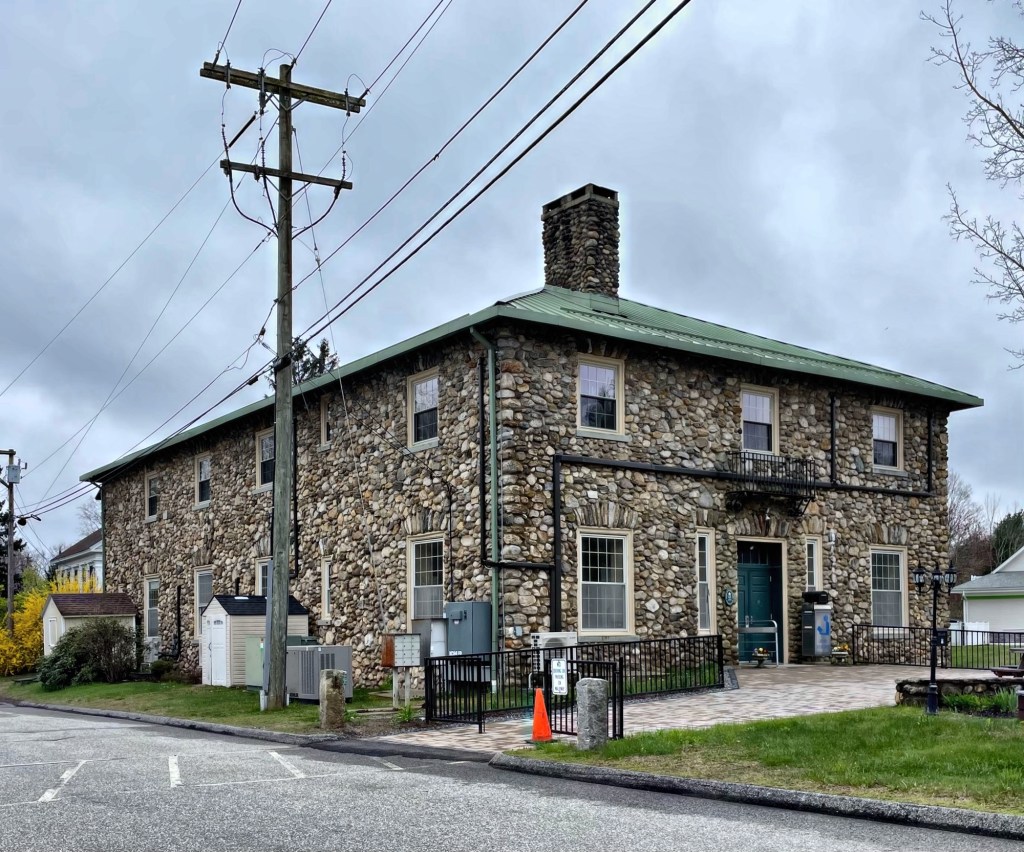
Babcock Library – Knowlton Memorial Hall // 1924

In the 1840s, Archibald Babcock (1780-1862) from Ashford, Connecticut, went west to engage in the California Gold Rush to seek his fortune. He did well and upon his return, moved to Charlestown, Massachusetts and began purchasing property for redevelopment. Upon his death in 1862, Mr. Babcock bequeathed $3,000 to the Town of Ashford start a “free” library there. For the next 60 years the library was located in a variety of private homes and country stores in town until the 1920s when this stone structure was built to house the town hall and library. Construction was made possible by a gift from Charles Knowlton, whose family had lived in the area since the 18th century. When built, it featured a number of modern innovations, including electrical service (generated on site), and steam heat. In addition to town offices and the library, the building also has an auditorium which is used for town meetings. Architect Herbert Loud furnished plans for the building which is rustic Arts and Crafts in style with randomly laid fieldstone walls with wide mortared joints. The roof eaves show exposed rafter tails below the shallow hipped roof.

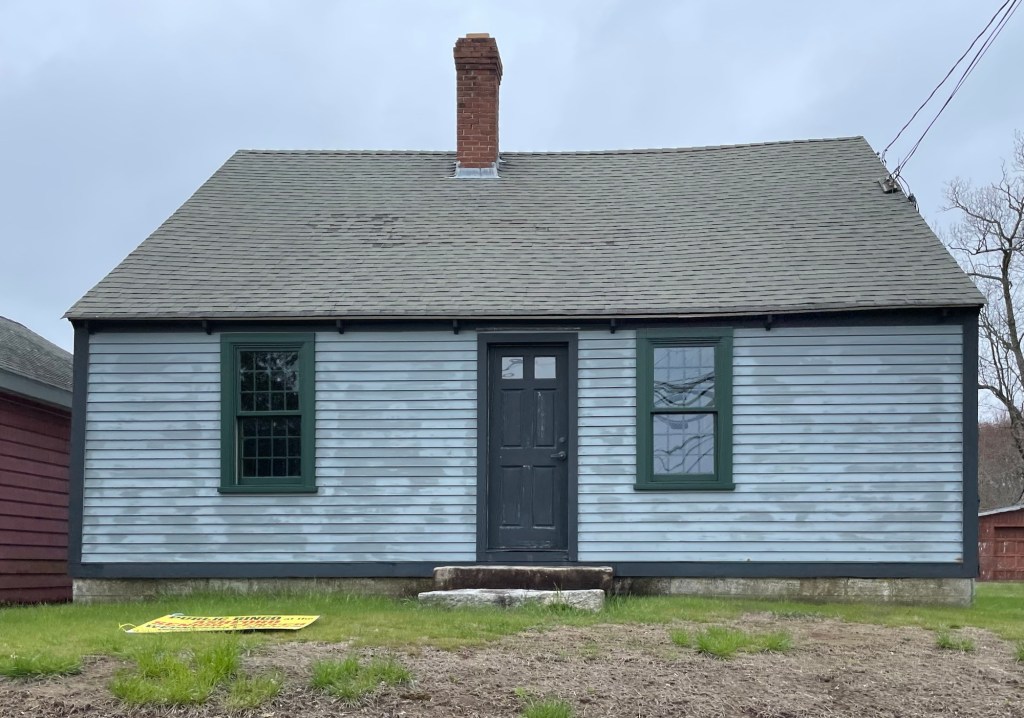
Stebbins-Tremko House // 1773

Ashford, Connecticut is located in a part of Windham County at the northeast part of the state which is sometimes referred to as the Quiet Corner, due to its limited access to larger cities and more bucolic scenery. Formerly known as New Scituate, Ashford was settled in 1710 and incorporated as a town in October of 1714. One of the town’s early houses is this cape style dwelling, built around 1773 for Thomas Stebbins (1748-1826). By the 20th century, the small house was owned by George Tremko (1907-1981) who worked as the town’s postmaster for some years in the post office just nextdoor. After Tremko’s death, the town acquired the property through eminent domain, with the hopes of redeveloping the prominent site for a new library. Luckily, the local historical society advocated for its preservation, and grants were acquired, which helped to restore the 1770s house.