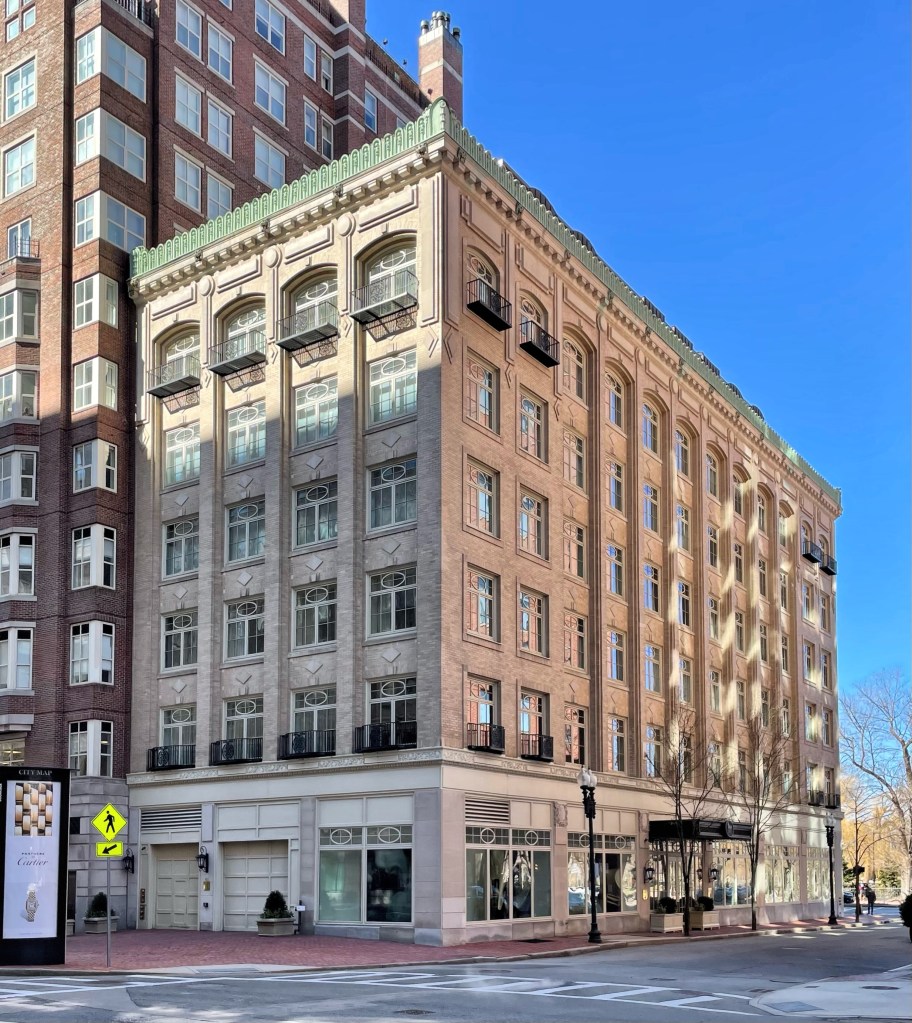
Garden Building // 1911

The only building that survived the wrecking ball of Urban Renewal on the stretch of Boston’s Boylston Street, south of the Public Garden was this six-story commercial building, known as the Garden Building. In 1911, architect Julius Adolphe Schweinfurth furnished plans for the new commercial building which was in the Beaux Arts style. The first floor was originally planned for three stores, with the upper five floors containing offices. A recessed penthouse floor served as studio space for artists and photographers with the large windows and skylights, the unobstructed views of the Public Garden didn’t hurt either! When the bulldozers of urban renewal came in the 1970s and 1980s to the area, this building surprisingly survived, and was reincorporated into the larger Heritage on the Garden condo development.
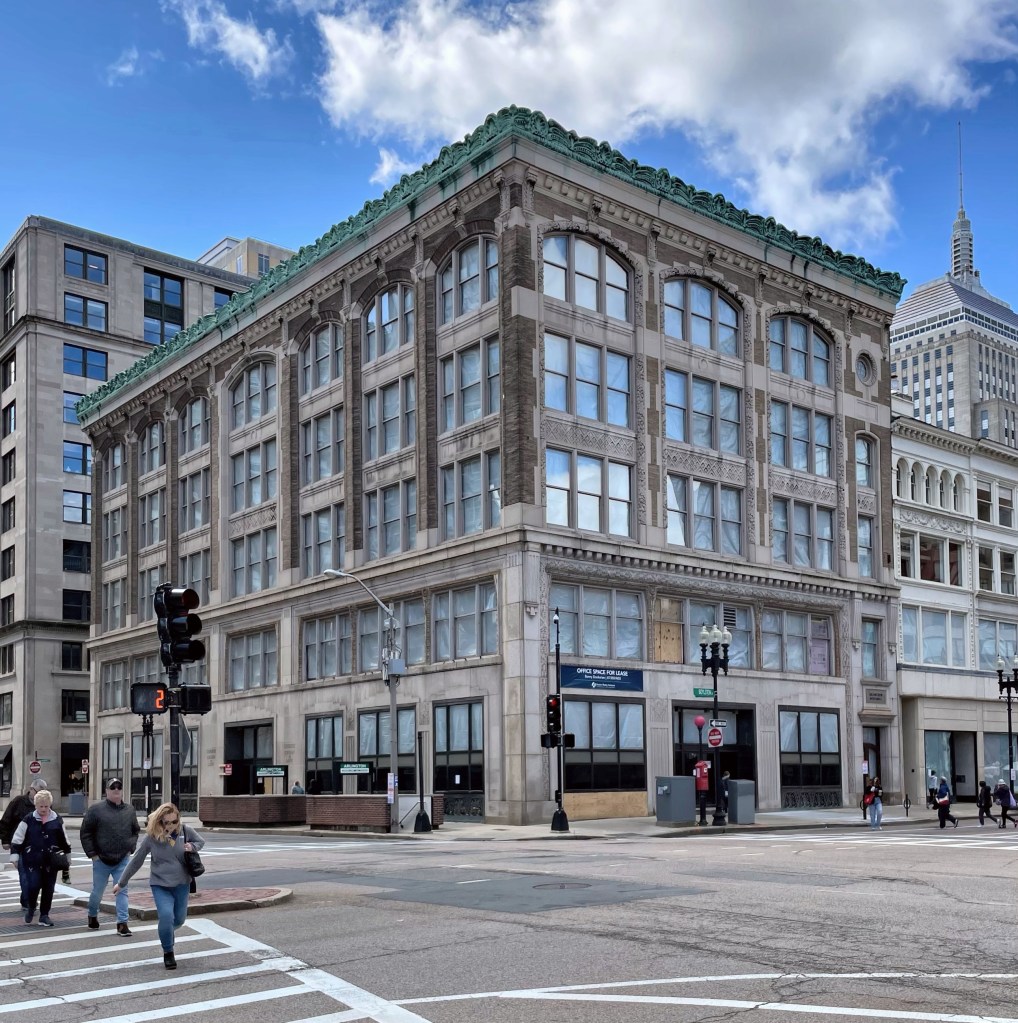
Arlington Building // 1904-2022

This one took me a while to write about because it still pains me to see it was demolished… The Arlington Building was constructed in 1904 as a mid-block building on Boylston Street, across from the Public Garden for the Bryant and Stratton Commercial School. It was designed by architect William Gibbons Rantoul of the firm Andrews, Jacques & Rantoul in the Beaux Arts style. The school building was significantly altered when Arlington Street was extended southward through Boylston Street, making this building suddenly a corner landmark. The new Arlington Street elevation was modeled after the Boylston Street facade. By 1929, Shreve, Crump & Low, established in 1796, the oldest purveyor of luxury goods in North America, moved into the building. The next year, they hired architect William T. Aldrich to add Art Deco embellishments and storefront designs, along with interior renovations to modernize the structure. The luxury company had downsized and moved out of the building, and its prominent site was threatened when owner/developer Druker Co. submitted for a demolition permit to raze the building (and others on the block) to erect a modern office/commercial building. After years of fighting between local preservationists and business interests and developers, the latter won and the building was demolished by late 2022. The new building, 350 Boylston Street, is presently undergoing construction, and in my opinion, is a poor attempt to fit into the surrounding context and is neither as unique or inspiring as the former building.

The Elms – Stable and Garage // 1911

By 1911, the Berwind’s wooden stable at their summer home, The Elms, was deemed inadequate and the couple’s new automobiles needed an appropriate structure to protect them from the elements. Edward Berwind purchased a large estate from Ms. Ida Powell Johnson, abutting his sprawling property and razed it to have a new stable and garage structure built there. The two structures are modeled after the Louveciennes Pavillon de Goury in France, built originally for Madame du Barry. Above the garage space lived the stable keepers and gardeners. As the space shifted from stable to garage, it is said that the head coachman, in order to keep his job, became the family driver, but he could never learn to back up, so a large turntable had to be installed in the garage. The complex originally held space for ten carriages, stalls for six horses and room for eight automobiles, as well as harness repairs, laundry rooms and living quarters. The Beaux Arts style building employs the best of French architecture, including a mansard roof, corbels, and raised central pavillion.

The Elms – Mr. Berwind’s Bedroom and Bathroom

Mr. Berwind drew the short straw and occupied the smaller of the two bedrooms in the Elms mansion as his wife Sarah Torrey Berwind, got the larger corner room. I was shocked to see just how small the bedroom was for one of the richest men in the country, even if it was just a summer residence that they occupied for a couple months of the year! Mr. Berwind did have a small bedroom, but he spared no expense to furnish it well. The fireplace in his bedroom is of ox-blood marble with gilt bronze mounts. The walls are covered in red silk and the carpet is a late 19th-century Khorassan. His private attached bathroom contains a sink of translucent white onyx.

The Elms – Mrs. Berwind’s Bedroom // 1899

On the second floor of The Elms mansion in Newport, you will find two separate bedrooms for the owners Edward and Sarah Berwind, a husband and wife of high society. The larger of the two bedrooms was for Mrs. Berwind as you know what they say, “happy wife, happy life”. Mrs. Berwind’s bedroom has cream-colored woodwork covered with custom-woven celadon green damask with borders of coordinated green, gold, and cream material. She had an adjoining bathroom and her chambers had access to her husband’s chamber along with a shared fireplace.

The Elms – Sitting Room // 1899

The formal Sitting Room at the Elms in Newport, Rhode Island is one of the many statement-rooms found in the Gilded Age mansion. This room is located directly above the Ballroom and is the first space seen when ascending the main staircase onto the second floor. The sitting room was used by the Berwind Family and their guests as a gathering and socializing space, a little less formal than the ballroom downstairs for more elegant events. The Preservation Society of Newport County has done an amazing job at restoring the building and purchasing furniture and fixtures that were sold off when much of the inside of the property was sold off at auction in the 1960s. The Preservation Society restored the red silk walls fabric in the 1980s, bringing the space back to its original grandeur. I cannot think of a better place to just “sit”.

The Elms – Dining Room // 1899

The Dining Room of the Elms Mansion in Newport, Rhode Island, is represents the Gilded Age in all the best ways. The room sits just off the ballroom and like all of the other rooms in the summer residence of the Berwinds, it was designed by famed interior designer Jules Allard. The dining room was specifically to display a collection of early18th-century Venetian paintings purchased by Mr. Berwind from the Ca’ Corner estate in Venice (the Berwinds were avid collectors of 18th century French and Venetian paintings). The iconic coffered ceiling is not of wood, but of molded plaster, grained and painted to imitate oak. Each coffer is decorated with the winged lion of Saint Mark, the patron saint of Venice. Pour custom-made crystal chandeliers hang in the four corners of the room. At the end of the room is a stunning green marble, agate and onyx fireplace that is framed by a ceiling-high pediment supported by carved Ionic columns. Could you see yourself entertaining in this dining room?

The Elms – Library // 1899

Merry Christmas from Buildings of New England!

To celebrate, I wanted to feature the library aka the “red room” in the Elms Mansion in Newport, Rhode Island. The library is lined with high wainscoting and walls of inlaid walnut hung with red damask/fabric. The center table, fireplace mantel, and inlaid bookcases were all designed by Jules Allard, and the table in particular displays the exaggerated proportions and classical ornament typical of 16th-century French design. The mantel piece consists of white carved stone with the upper part of richly carved walnut. The room is one of the coziest in the Elms, one of the more refined and “homey” of the Newport Mansions open for tours. From this library, owner Edward Julius Berwind, would keep up with his growing businesses while away for summers in Newport.

The Elms – Ballroom // 1899

The Louis XV style Ballroom of the Elms Mansion in Newport sits just off the Stair and Gallery halls at the core of the building. This room was the scene of lavish parties, including the 1901 housewarming party hosted by the Berwinds to announce the formal opening of The Elms to Newport’s summer society. The large, 50’x45′ ballroom was designed by French designer Jules Allard crafted the Louis XV style paneling with plaster shell and floral ornament. The white relief decorations on the doors, paneling, and cornice are continued in an elaborate ceiling frieze and center medallion of winged cherubs. As a stark contrast from other Gilded Age mansions in Newport, the ballroom has very minimal gold gilding, besides the mirror frames on the wall. The muted cream and white colored walls with ornament show the sophistication and grandeur of the design, not gold.

The Elms – Stair and Gallery Hall // 1899

Stair Hall

Immediately upon entering the main entrance of The Elms, one of the finest Gilded Age mansions in Newport, you are enveloped in the Stair Hall or foyer. The space is stunning, with walls lined in limestone and purple Breccia marble pilasters and columns with bronze capitals and bases. The floors are of white marble bordered in green with stairs in white Italian marble. At the beginning of the stairs, there are two large urns of green marble and pink granite, each with four bronze female figures. The urns bear the name of the decorator, Allard et Fils of Paris, who was responsible for crafting the details of the period rooms for the mansion. At the top of the first set of stairs is the Gallery Hall, a long hall connecting many rooms on the first floor and also serving as a gallery of irreplaceable art including two early 18th-century oil paintings depicting episodes in the history Scipio Africanus, the ancient Roman general who conquered Carthage by Venetian artists Paolo Pagani and Giovanni Antonio Pellegrini. The space is grand, yet cozy and feels more like a home than the larger Breakers mansion.

Gallery Hall