The Elms – Ballroom // 1899

The Louis XV style Ballroom of the Elms Mansion in Newport sits just off the Stair and Gallery halls at the core of the building. This room was the scene of lavish parties, including the 1901 housewarming party hosted by the Berwinds to announce the formal opening of The Elms to Newport’s summer society. The large, 50’x45′ ballroom was designed by French designer Jules Allard crafted the Louis XV style paneling with plaster shell and floral ornament. The white relief decorations on the doors, paneling, and cornice are continued in an elaborate ceiling frieze and center medallion of winged cherubs. As a stark contrast from other Gilded Age mansions in Newport, the ballroom has very minimal gold gilding, besides the mirror frames on the wall. The muted cream and white colored walls with ornament show the sophistication and grandeur of the design, not gold.

The Elms – Stair and Gallery Hall // 1899

Stair Hall

Immediately upon entering the main entrance of The Elms, one of the finest Gilded Age mansions in Newport, you are enveloped in the Stair Hall or foyer. The space is stunning, with walls lined in limestone and purple Breccia marble pilasters and columns with bronze capitals and bases. The floors are of white marble bordered in green with stairs in white Italian marble. At the beginning of the stairs, there are two large urns of green marble and pink granite, each with four bronze female figures. The urns bear the name of the decorator, Allard et Fils of Paris, who was responsible for crafting the details of the period rooms for the mansion. At the top of the first set of stairs is the Gallery Hall, a long hall connecting many rooms on the first floor and also serving as a gallery of irreplaceable art including two early 18th-century oil paintings depicting episodes in the history Scipio Africanus, the ancient Roman general who conquered Carthage by Venetian artists Paolo Pagani and Giovanni Antonio Pellegrini. The space is grand, yet cozy and feels more like a home than the larger Breakers mansion.

Gallery Hall

The Elms // 1899

One of my favorite things to do each holiday season is to explore Newport and the mansions all gussied up with lights, ornaments and holiday cheer. This year, I visited The Elms, one of my absolute favorite buildings in Newport, which is a house museum! Stay tuned for some room features, similar to my series last year on The Breakers mansion.

The Elms was commissioned in 1898 by coal baron Edward Julius Berwind (1848–1936) and his wife Sarah Torrey Berwind (1856-1922) as a summer cottage where the couple could escape the woes of city life for a few weeks of every year. Edward was “new money” (his parents were middle-class German immigrants); and by the 1890s, he was hailed as “one of the 58 men who rule America”, making him one of Newport’s most important summer residents. To live up to his new status, he hired Philadelphia architect Horace Trumbauer, who took inspiration from the 18th century Château d’Asnières in France. The site on the iconic Bellevue Avenue is not directly on the water, so Trumbauer sought to enhance the siting of the mansion by elaborate landscaping (more on that later). The house was built to be fireproof, after the complete loss of the original Breakers mansion in 1892 and is clad with Indiana limestone. The couple held many lavish parties in the Elms until 1922, when Mrs. Berwind died. Mr. Berwind invited his youngest sister, Julia, to become his hostess at his New York and Newport houses. Mr. Berwind died in 1936 and Julia continued to summer at The Elms until her death in 1961. Childless, Julia Berwind willed the estate to a nephew, who did not want it and fruitlessly tried to pass The Elms to someone else in the family. Finally the family auctioned off the contents of the estate and sold the property to a developer who wanted to tear it down. In 1962, just weeks before its date with the wrecking ball, The Elms was purchased by the Preservation Society of Newport County for $116,000. It remains one of the most visited house museums in the nation to this day.

Woodlawn Cemetery – Entrance Gate // 1897

Woodlawn Cemetery in Everett, MA was established in 1850 as a rural, private cemetery in the tradition of Mount Auburn Cemetery in Cambridge. The story of Woodlawn Cemetery began in 1850 when a group of ten prominent Bostonians petitioned the Massachusetts General Court to organize a corporation “for the purpose of procuring, establishing and preparing a cemetery or burial place for the dead in Malden” (present-day Everett was established in 1870 from Malden). When you approach the main entrance of the cemetery, you are greeted by the entrance gate and tower. Completed in 1897 to replace an earlier wooden gate, the Entrance Gate consists of a central stone tower and two side entrances. The gate, tower, and adjacent lodge (next post) were designed by Boston architect William Hart Taylor, who was buried at the cemetery upon his death in 1928. The tower has decorative sculpted terra cotta which includes winged angels at the corners with outstretched arms that once hold trumpets. Below the medallion which is centered on each side, there is the bust of a winged child, supposedly a carved likeness of the architect’s young son who died at the age of six and is buried at Woodlawn.

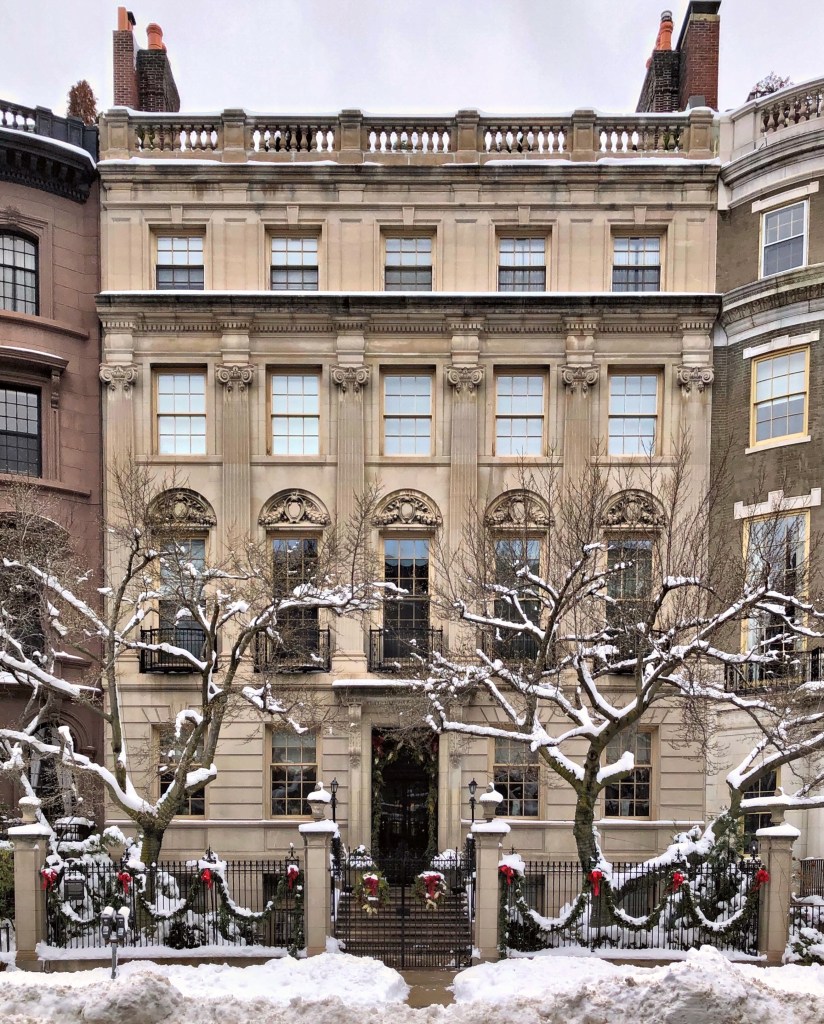
Baylies Mansion // 1903

Commonwealth Avenue in Boston’s Back Bay neighborhood is a dream, no matter what time of year, though I am a huge fan of it in the winter so the leaves don’t obscure the architectural details! This home just steps from the Public Garden was built in 1903 for Walter Baylies (1862-1936) and his wife, Charlotte. The couple had purchased a c.1860 Second Empire mansion (basically a sister house or twin to the adjacent at 3 Commonwealth Ave), and demolished it for a more “modern” residence. Baylies was extremely wealthy with investments in nearly everything, and he wanted his city residence to stand out amongst the earlier, brick and brownstone townhouses on the eastern edge of the neighborhood. Architect Arthur Rice designed the house in the Renaissance Revival style, and it is finished with Indiana Limestone. Of particular note is the one-story ballroom, which was built to the side of the home, set back behind a small garden. An empty house lot, formerly occupied by a stable, was used simply for the Baylies’ ballroom, constructed in 1909 for their daughter. Talk about a status symbol! The home was purchased by Walter’s heirs in 1941 by the Boston Center for Adult Education. The home was again purchased in 2020, and is back to a single-family home! I can’t even imagine how stunning the interior is!

Clarendon Court // 1904

Built at the tail-end of the Gilded Age in Newport, this turn-of-the-century mansion evokes feelings of country estates in England. “Clarendon Court” was built in 1904 for Edward Collings Knight, Jr. (1863-1936) and his first wife, Clara W. Dwight (1862-1910). Edward C. Knight was a railroad executive and amateur artist who “exhibited more talent at spending money than making it”, which was evident from his architectural taste and timing for building such an expensive home in Newport, which was beginning to wane in popularity at the time. Clarendon Court was actually designed in the 18th century by Colen Campbell, a renowned Scottish architect. The country estate was never built, but Gilded Age architect Horace Trumbauer, found the design in one of Campbell’s old books, and except for removing the cupolas over the wings either side of the central block, he reproduced a perfect copy. Trumbauer had just a year before designed a townhouse for the couple in Philadelphia. Edward Knight originally named the mansion “Claradon Court” after his wife Clara. In 1930, Claradon Court was purchased by Maisie Caldwell (1878-1956) and her third husband, Colonel William Hayward (1877-1944), legendary commander of the “Harlem Hellfighters” during World War One. Maisie had inherited a fortune of $50 million from her second husband, Morton Freeman Plant, a railroad and steamship magnate. The couple renamed the mansion Clarendon Court, a more traditional name.

Clarendon Court was later purchased by Claus von Bülow and Martha Sharp Crawford, who was known as “Sunny von Bülow”. Sunny was worth over $75 million and updated the mansion and grounds to exceptionally elegant conditions. It was known that Sunny and Claus had a rough marriage, but it came to a head when on December 26, 1979, after the family had come together for Christmas at their mansion, she was found unresponsive and was rushed to the hospital where she slipped into coma but was revived. After days of testing, doctors determined the coma was the result of low blood sugar and diagnosed her as hypoglycemic, warning her against overindulging on sweets or going too long without eating. No foul play was suspected at the time. One year later, on the evening of December 21, 1980, while celebrating Christmas with her family at their mansion, she again displayed confusion. She was put to bed by her family, but in the morning she was discovered unconscious on the bathroom floor. She was taken to the hospital where it became clear that this time she had suffered severe enough brain injury to produce a persistent vegetative state. A hypodermic needle was found in a black bag in Bulow’s study and coupled with their maid’s testimony he was subsequently charged with her murder, accused of injecting his wife with insulin so he could live at Clarendon on her money with his mistress. His mistress was the actress Alexandra (Moltke) Isles, better known as “Victoria Winters” in Dark Shadows. In 1982, in a sensational case that gripped the country, Bülow was convicted. But, he appealed in 1985 and was acquitted. His stepchildren then filed a $56 million law suit against him, which was dropped two years later: Bülow agreed to divorce his comatose wife, relinquish all rights to her fortune, leave the country and never to profit from the story. Bülow moved to London where he kept a low profile for the rest of his life while Sunny remained in a vegetative state in New York until she eventually passed away in 2008. 

The Breakers – Library // 1895

Tied as my favorite room with the Morning Room at the iconic Breakers Mansion in Newport, the jaw-dropping library is almost too good to be true. The library was designed to be the centerpiece of life for Cornelius Vanderbilt, who was always well-read. The walls are paneled with Circassian walnut cut in Europe and stamped with gold. The ceiling is coffered with more gold leaf. The fireplace in the library is probably my favorite in the mansion, which was acquired from a 16th-century French chateau, Chateau d’Arnay Ie Duc. The walls in the library and its smaller alcove are covered with wainscoting of Circassian walnut decorated with low relief carving and gold leaf; the walls above the woodwork are covered with panels of gold-embossed Spanish leather. Yes, leather walls! What is your favorite part of the Breakers Library??

The Breakers – Music Room // 1895

You know you’ve “made it” if you have a music room, especially if you have one in your summer mansion in Newport! The Music Room in The Breakers evokes the opulent Parisian interiors of the Second Period and when inside the room, you just feel sensory overload (in the best way possible. The room is located off the Great Room and Morning Room, at the southern end of the house. The Music Room was used for recitals and dances for the Vanderbilt Family and guests. The room displays ornate woodwork and furnishings designed by Richard Van der Boyen and built by J. Allard of Paris. The room looks like it was plucked out of a French building and dropped into the mansion, and that is because it was! The room’s interior was constructed completely in France and then sent to America where it was installed at The Breakers by French craftsmen. My favorite parts of the interior are the bay window at the end and the gilt gold coffered ceiling.

The Breakers – Morning Room // 1895

Possibly my favorite room in The Breakers mansion is the Morning Room, found on the first floor, just off the Great Hall and lower loggia. The Morning Room is executed in a late Renaissance style and faces east to catch the morning sun and provides sweeping views of the Atlantic. It served as a family sitting room at all times of the day. The interior design, including the fixtures, woodworking, and furniture, were designed by French architect Richard Bouwens van der Boijen and designer Jules Allard. The predominant grey, and gold colors of the Morning Room are echoed in its fireplace which is made of Campan marble. On the walls, you will find the most stunning shimmering silver wall panels, depicting ancient Greek goddesses. It was originally believed that these features were silver leaf, but the Newport County Preservation Society investigated further, determining it is actually platinum! The Vanderbilts clearly wanted this room to shimmer with the sunrise, so the use of platinum, which never tarnishes, was a great solution!

The Breakers – Great Hall // 1895

Merry Christmas from The Breakers! This 1895 Gilded Age mansion is the best to explore during December, when the halls are decked and stunning Christmas trees adorn the lavish rooms (learn more about the mansion in my last post) When you walk into The Breakers, you enter the Great Hall. Architect Richard Morris Hunt designed the Great Hall after the open-air courtyards in Italian villas, but enclosed due to the tough New England winters. The palatial space (measuring 50 foot square), even if crowded by tourists trying to get the perfect shot on their smartphones, feels spacious yet somehow welcoming given the art museum-like detailing. The walls are made of carved limestone from Caen on the coast of France and adorned with plaques of rare marbles. Elaborately carved pilasters decorated with acorns and oak leaves support a massive carved and gilt-cornice which surrounds a ceiling painted to depict a windswept sky, further expressing the open-air courtyard feeling envisioned by Hunt, the architect. Four bronze chandeliers dangle from the gilded ceiling, and flood the room with warm light, evoking warm summers in Italy.