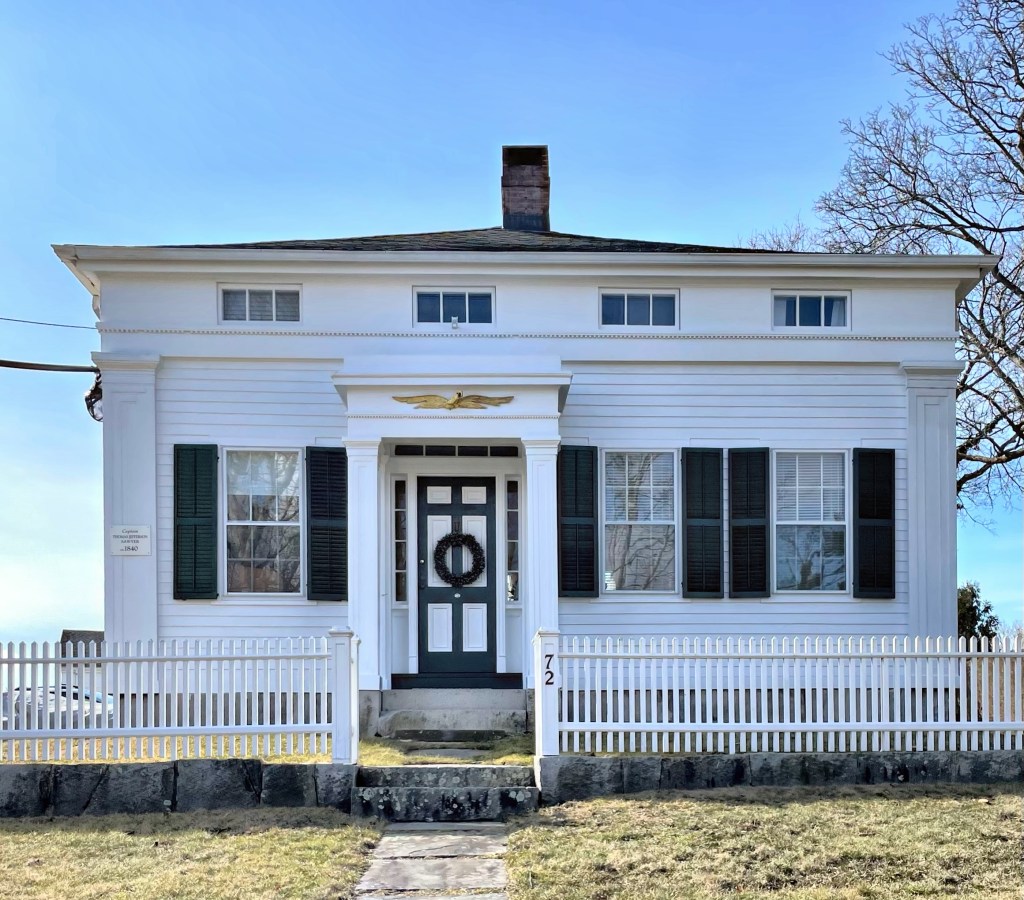
Moses Latham House // c.1845

Noank is a charming seaside village within the town of Groton that is centered on a peninsula at the mouth of the Mystic River where it spills out into the Long Island Sound. Historically, the area was known as Nauyang (meaning “point of land”) and was a summer camping ground of the Pequot people, but they were driven out in 1655 following the Pequot War. White settlement was slow here until the mid-19th century, when the shipbuilding and fishing economy took off here. As a result, houses, stores, churches and industries were built, and an entire village was formed. Most extant homes here were constructed starting in the 1840s as the village (and nearby Mystic) saw economic growth from the maritime trades. This house, the Moses Latham House, was constructed for Mr. Latham in about 1845. The house is Greek Revival in style with flush-board siding, a fan light in the gable which reads as a pediment, and a simple portico supported by fluted Doric columns.

Portland Mariner’s Church // 1828

Talk about a unique church! The Mariner’s Church in Downtown Portland was built in 1828 and is modeled after Faneuil Hall in Boston and East India Hall, Salem, Massachusetts; and was the first Greek Revival building in Portland (with some lingering Federal flair). It also for many years was Portland’s largest building! Its concept was that of a place of worship and education center for seamen of the port city between their voyages on the open sea. The ground floor was designed to house shops for merchants whose rent would support and maintain the building. The structure is virtually unchanged from how it looked nearly 200 years ago and showcases the importance of the sea to the port towns and cities of New England!

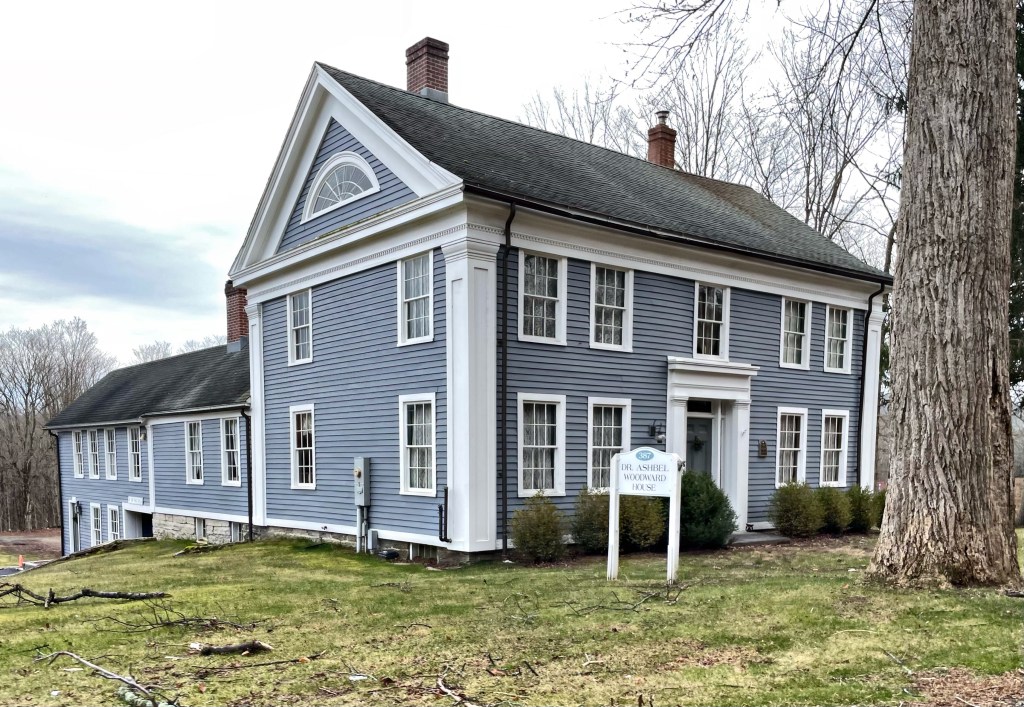
Dr. Ashbel Woodward House // 1835

The Ashbel Woodward House in Franklin, Connecticut was built in 1835, on land purchased by Doctor Ashbel Woodward, a prominent local physician, a year prior. Woodward, was a graduate of Bowdoin College, and he began practice in Franklin in 1829, serving as the town’s primary medical practitioner until his death in 1885. Though in his 60s at the outbreak of the Civil War, Woodward perhaps lent his greatest service to his country when he served as a battlefield surgeon and medical facilities inspector for the Union army. Besides his work in medicine, Woodward collected literature and numerous artifacts pertaining to Franklin’s past and eventually wrote a book detailing the town’s history. The Ashbel Woodward House is an excellent example of the Greek Revival architectural style in a five-bay form. Interestingly, there are semi-elliptical windows in the pediment gable ends on the side elevations, seemingly a nod to the Federal style that was waning out of style at the time. The property is in use today as a museum, documenting the life of Dr. Woodward and the people of Franklin, Connecticut.

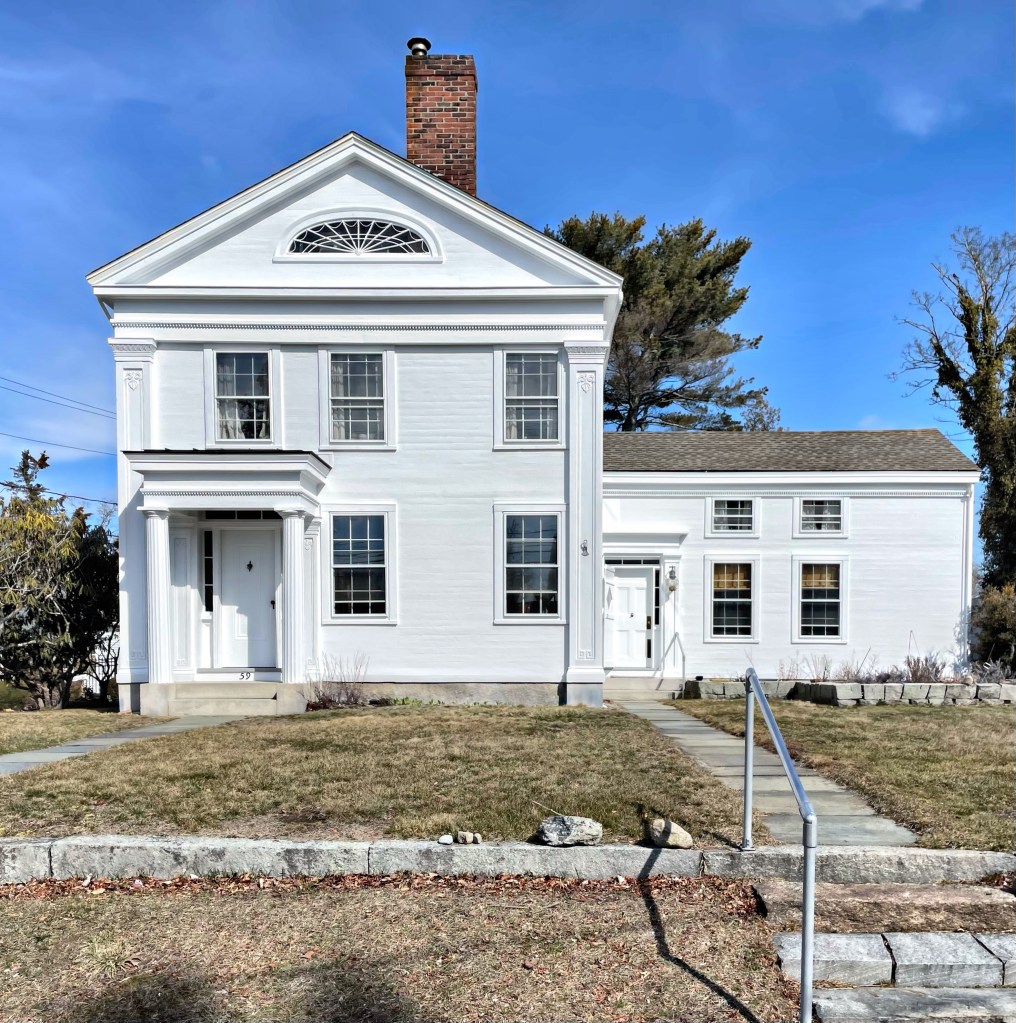
Dr. Stephen Sweet House // c.1845

Connecticut has some of the most stately early 19th century homes in New England, from the larger cities to rural towns like this beauty in little Franklin, Connecticut. This dwelling was built in the 1840s for Dr. Stephen Sweet (1798-1874) a physician near the town green. It was built after his second marriage, after his first wife’s death. His second wife, Matilda, died in the home during childbirth at age 44, along with their son just days later. The house is an excellent example of the Greek Revival style, with a gable roof running parallel to the main street, central entrance and corners framed with pilasters and frieze band at the cornice. At the side of the house, which also fronts a street, the stately home commands the corner with a second entry (maybe for in-patients), and a pair of quarter-round windows in the pediment.

Franklin Congregational Church // 1863

When the town of Franklin, Connecticut was still a part of Norwich, it was known as West Farms. The residents there had a meetinghouse built there as it took too long to travel into Norwich for town meetings and church services. The first meetinghouse was built in 1718 on what became Meetinghouse Hill. Decades later, the primitive building was replaced by a newer structure. That building was replaced two more times until the present Congregational Church was erected in 1863. The building takes cues from the Greek Revival church designs of decades prior and looks to the future with Italianate detailing and steeple. There remains a small, but active congregation here to this day, who maintain the old building very well!

Tew Brothers House // 1845

This Greek Revival house in Newport was built in 1845 for the Tew Brothers. The home was likely a double-house with two doors for each family, as the current entry looks to be of a more recent vintage. The house features a full-length columned porch which has small brackets in the eave, an early nod to the emerging Italianate style. The property was recently renovated and sold for just over $1 Million. Talk about a steal!

Coolidge Homestead // c.1840

In 1876, a four year old Calvin Coolidge moved to this house in sleepy Plymouth Notch, Vermont, which was purchased by his father and he lived here continuously until 1887 when he began to attend the Black River Academy at nearby Ludlow, Vermont. The house was likely built in the mid-19th century as a modest Greek Revival cape and was Victorianized in the late 19th century by Calvin Coolidge’s father, when he added the two-story bay window, dormer, and side additions. The house remained in the Coolidge family until 1956 when it was given to the State of Vermont as part of the Calvin Coolidge Historic Site.

Union Christian Church of Plymouth Notch // 1840

Located next to President Calvin Coolidge’s birthplace and the Coolidge Family store, the Union Christian Church of Plymouth Notch in Vermont stands as another of the village’s well-preserved buildings with direct ties to the former president. The church was built in 1840 as a modest, vernacular Greek Revival building with a two-stage tower and originally was the town’s meetinghouse. The building was dedicated as a Congregational church in 1842. President Coolidge attended services here as a child and later when visiting his hometown as Governor of Massachusetts and President of the United States. In 1942, the
building became a union church for all congregations.

Coolidge Family Store // c.1830

Built before 1835, this typical country store in Plymouth, Vermont, consists of a two-story main block with a one-story storage ell on the southern (left) side, each of frame and clapboard with gabled roof. The building was the village’s country store and was owned by the Coolidge Family, made famous by Calvin Coolidge, the 30th President of the United States. This store was built years before a home for the Coolidge Family was built attached at the rear. The attached house was the birthplace of President Calvin Coolidge in 1872, and the building was where after the death of President Warren Harding, Col. John Coolidge, Calvin’s father, a notary public, administered the presidential oath of office to his son in the family dining room at 2:47 a.m. on August 3, 1923. The old house and store are preserved by the State of Vermont as a living museum to President Coolidge and his family.

President Calvin Coolidge Birthplace // 1840

The President Calvin Coolidge State Historic Site in Plymouth, Vermont preserves the birthplace and childhood home of Calvin Coolidge, the 30th President of the United States. This iconic historic village appears much as it was during Coolidge’s lifetime. The homes of the Coolidge family, their relatives and friends are joined by the 1840 church, 1890 schoolhouse, cheese factory, and historic agricultural structures and barns. More on all of these later. First up is the birthplace of President Coolidge. This squat 1 1/2-story dwelling was built in 1840 at the rear of the Coolidge Family store which fronts the main road. By the 20th century, the old home was altered, but was restored in 1971 just in time for the 100th birthday celebration by the State of Vermont for Coolidge, dedicating the village as a historic museum.