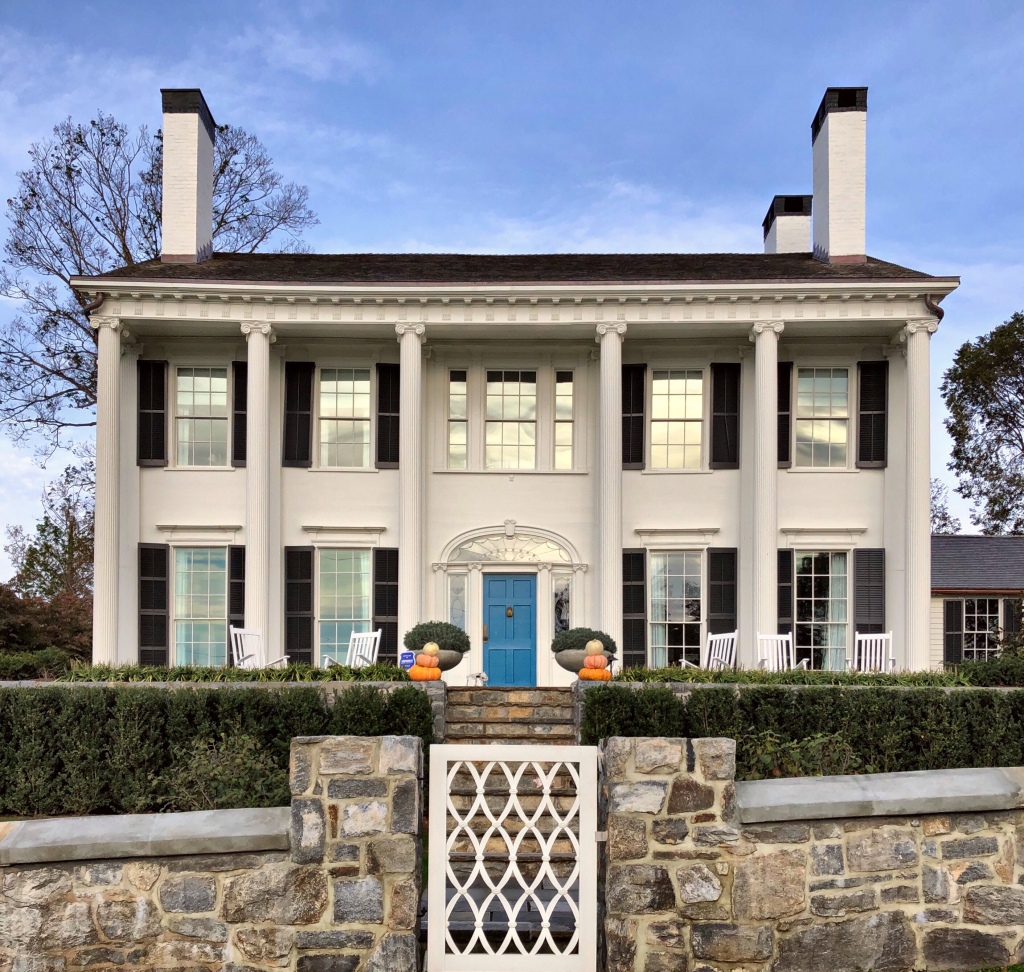
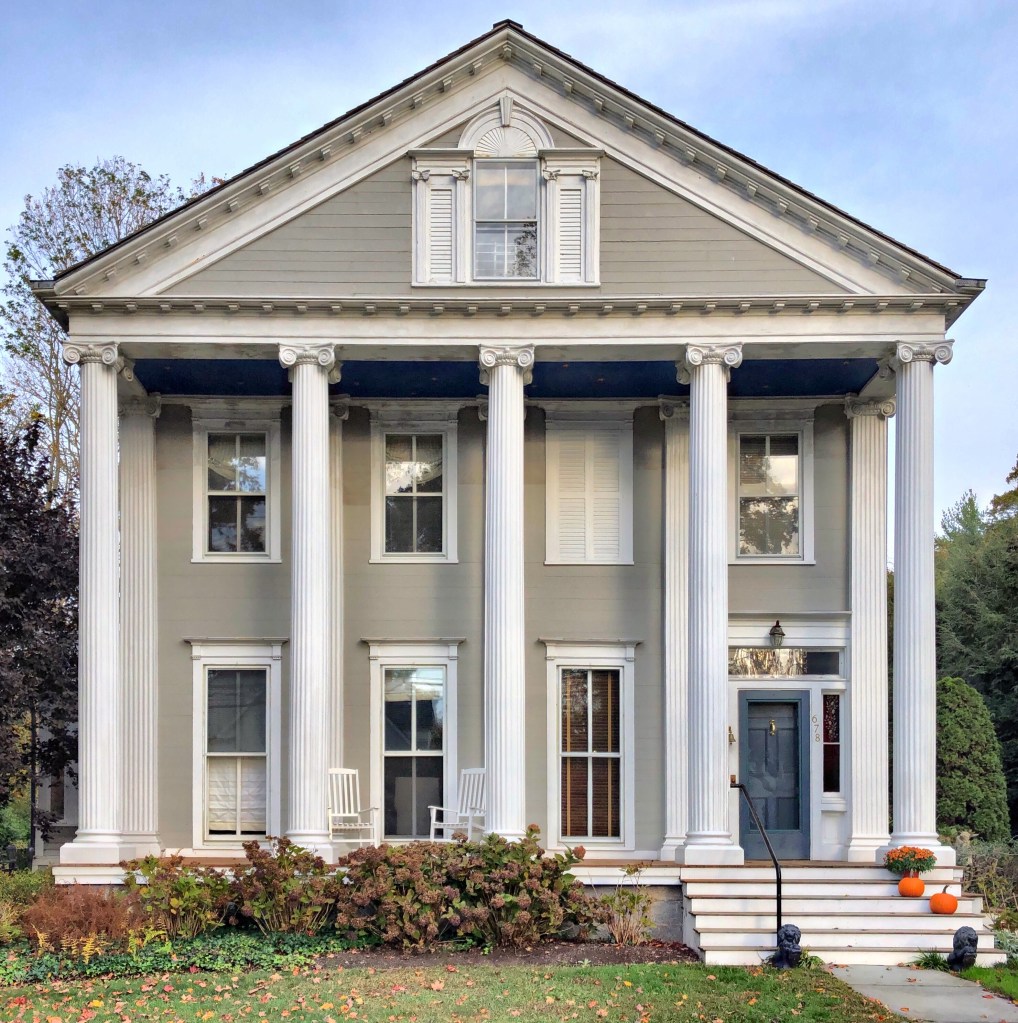
I have a thing for temple-front Greek Revival homes, and this is no exception. This marvelous home was built in 1832 for Francis Dimon Perry (1809-1884), who inherited some of his father’s wealth and became President of Southport National Bank in town. He was a devoted member of Trinity Church throughout his life. Upon Mrs. Perry‘s death in 1893, couple left their residence to the Trinity Church to be used as the parish rectory.
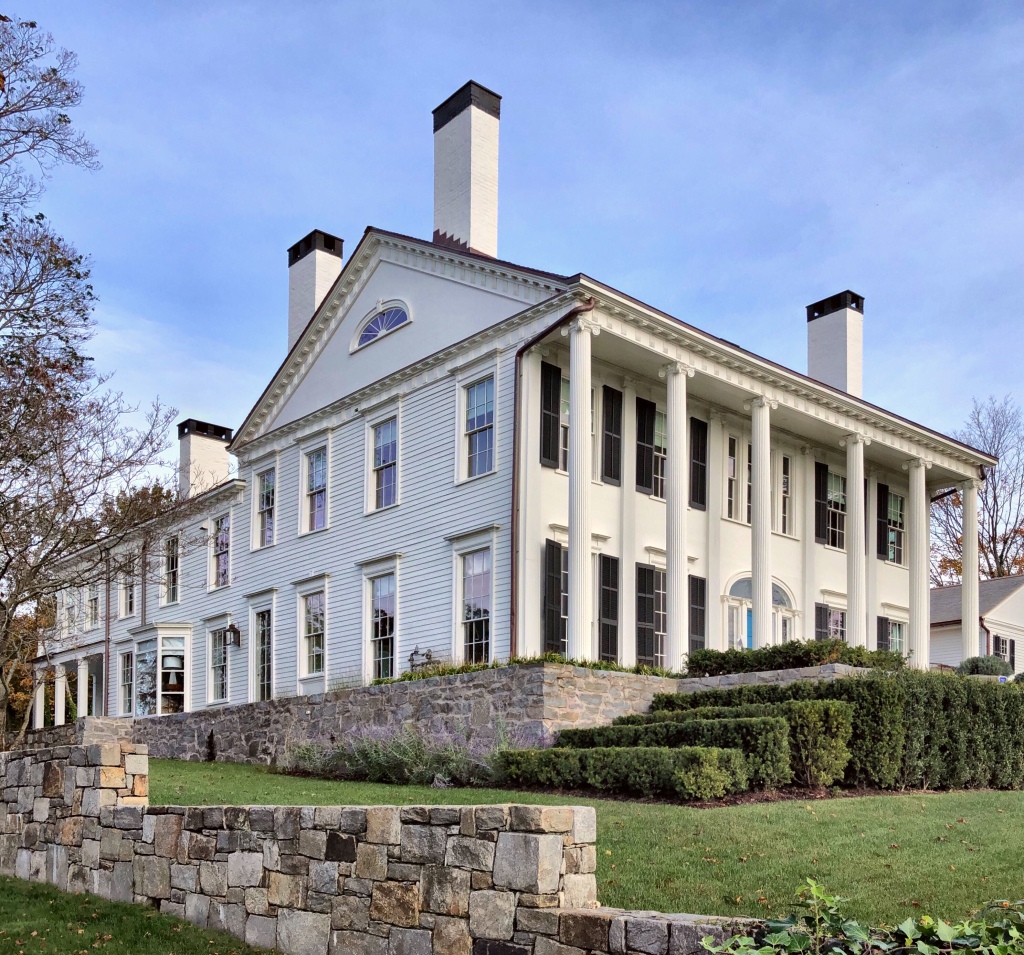
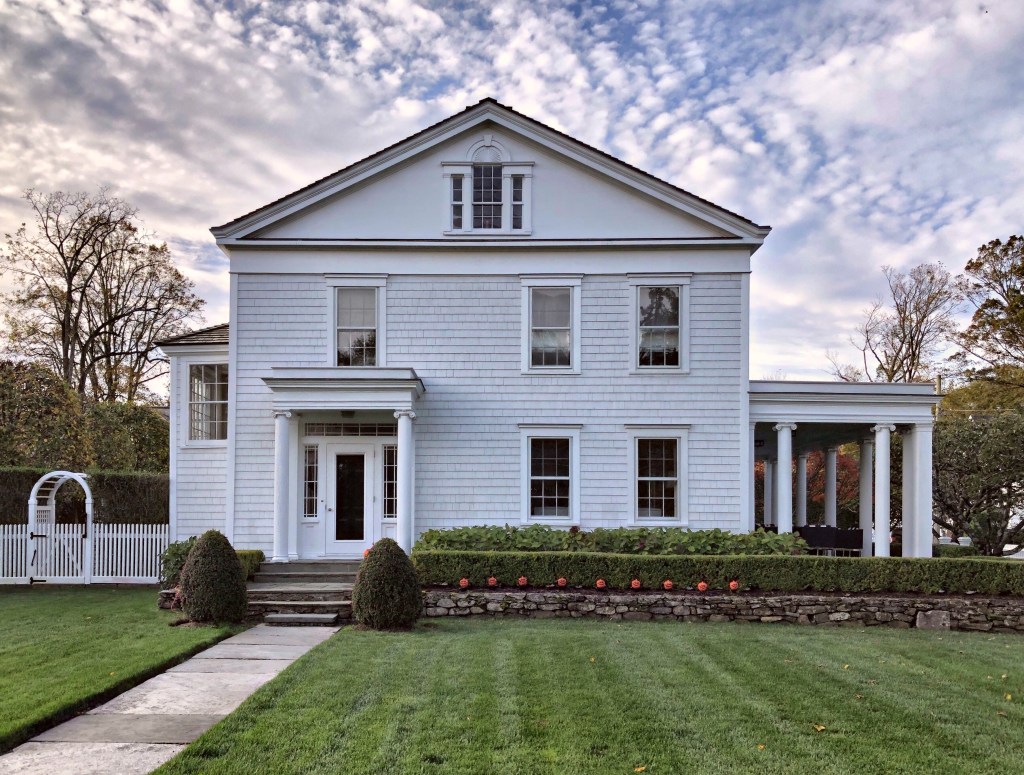
Located next to his son’s house, the Edwin Sherwood House in Southport, Connecticut is an excellent example of Greek Revival residential architecture in New England. The home was built in 1837 for Edwin Sherwood, a sea captain who traded between New York and Savannah with his two ships “America” and “Georgia”. From this wealth, he became President of the Southport Savings Bank and Director of the Danbury-Norwalk Railroad. The home was renovated in 2017 with a modern interior by Ken Gemes, an interior designer.
Originally built in 1775, the first iteration of the Burr Homestead, home of Thaddeus and Eunice Burr, which actually saw the marriage of John Hancock, President of the Continental Congress, to Dorothy Quincy. Thaddeus was the cousin of the famous Aaron Burr, Jr., who was the 3rd vice-president of the United States alongside Thomas Jefferson as President. Aaron Burr Jr. is best-known today through his portrayal in the popular play “Hamilton,” where he shoots Alexander Hamilton in a duel. The house was rebuilt in 1794 in its former location in Fairfield, Connecticut after a fire by the British in Fairfield destroyed the first. The home was willed to Thaddeus’ son General Gershom Burr, who eventually sold the mansion to Obadiah Jones. Mr. Jones updated the home by, ““taking out the dormer windows and lifting the roof, taking away the porch and building the broad veranda with its lofty massive fluted columns”. The home was eventually gifted to the Town of Fairfield and is presently maintained by the Fairfield Museum and History Center.
Located in North Pomfret, Vermont, the North Pomfret Congregational Church is one of many white clapboard church buildings constructed in the mid 19th century. Built in 1847 by the Church of Christian Brothers and the Congregationalists, the church was used by the two religious societies as a joint meeting house, each society holding services in the church on alternating Sundays. The Greek Revival style church features a prominent tiered, boxed bell tower with louvered lancet openings and a slender octagonal spire.
Located across the street from the Congregationalist Church (now Town Hall) in Pomfret Center, the Methodists in Pomfret Vermont built this church building just a couple years after their neighbor was completed. Replicating the Greek Revival style seen across the street, the building showcases a templed form with projecting portico, as an excellent vernacular example of the style. Similar to its neighbor, this church was sold to the Town of Pomfret in the 1880s, modernized in the early 20th century, and converted to a district schoolhouse.
The quaint town of Pomfret, Vermont sees flocks of “leaf-peepers” and Instagrammers every Fall who are in awe of the natural scenery and historic farms seen there. The town was first settled in 1770 when Bartholomew Durkee travelled from Pomfret, Connecticut, along with his family and friends and named the town “New Pomfret” at first to show their roots in Connecticut. The tiny town grew to its peak population in 1830 at just under 1,900 residents, declining steadily over time to roughly 900 today, greatly adding to the rural character of the town.
In Pomfret Center, the local Congregationalists sought a new place of worship and had this structure constructed as their church in 1845. Local builder Eli Buch constructed the Greek Revival edifice with its projecting portico, doric columns, and corner pilasters. As nearby Woodstock Vermont grew, many families moved there and the church sold their building to the Town of Pomfret in 1872 and the building has since been used as Pomfret’s Town Hall.
Located on the west bank of Mascoma Lake in Enfield, New Hampshire, an architecturally and historically significant collection of Shaker buildings can be found, all very well maintained. Founded in 1793, this village was the ninth Shaker community to be established in this country. At its peak in the mid 19th century, the community was home to three “Families” of Shakers. Here, they practiced equality of the sexes and races, celibacy, pacifism, and communal ownership of property. There were 132 members of the village by 1803, and by 1840 there were nearly 300 people.
Within the village was the largest Shaker dwelling ever built in the country and the largest residential dwelling north of Boston, the Great Stone Dwelling. The Shakers here hired leading Greek Revival Architect Ammi Young to design the building. Ammi had experience in larger building projects having designed the current Vermont State House and several structures at nearby Dartmouth College. Young would later go on to be the Supervising Architect for the United States Department of the Treasury.
The Enfield Center Meeting House was built in 1843 in the center of town. The meeting house’s location was soon after viewed as “out of the way” as both Enfield Village and Shaker Village began to develop, seeing massive population increases. The meetinghouse in the 20th century began to deteriorate slightly and by the early 21st century, its future was unclear. The town rallied to save the building, which included structural repairs. It was restored and placed on the National Register of Historic Places by 2017.
Located in the Post Mills Village of Thetford, Vermont, the Peabody Library is one of the cutest library buildings ever! The library was a gift to the community of Post Mills by George Peabody, one of the first great American philanthropists. Peabody spent some time in Post Mills as a teenager, where his maternal grandfather lived. Peabody’s grant of $5,000 paid for purchase of the land, construction of the building, and acquisition of 1,100 volumes. He also donated funds for other libraries including the Peabody Institute Library in Danvers. The library exhibits a unique blend of characteristics from both the Greek Revival and Italianate Revival styles, being an outstanding representative of the mid nineteenth-century transition in architectural fashion. Oh to see inside this little library!
Josiah Hosford of Thetford, Vermont built this stone house for his family in about 1835. Hosford was a stone mason who built a series of stone houses in town, using stone quarried in nearby Lyme, New Hampshire. Josiah Hosford (1802-1883), was the grandson of Aaron Hosford, one of the earliest settlers in the North Thetford area. The distinguished family contributed resided and contributed to the town’s vibrant history, as ministers, teachers, artists, farmers, and tradespeople. A fire at the home in the early 1900s gutted the interior, and the owner at the time, a carpenter, reconstructed the interiors, shingled the side gables, and added on the porches.