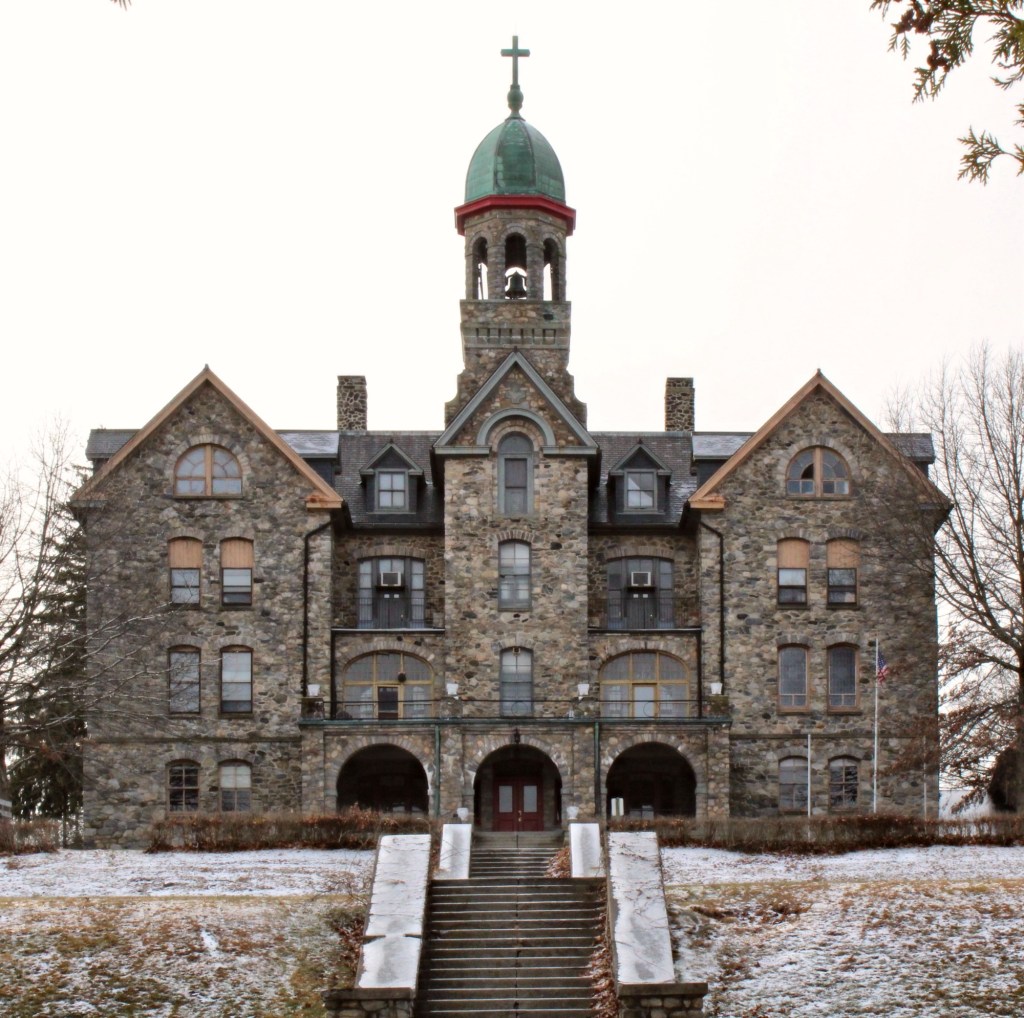
Mount Saint John School // 1908

The former Mount Saint John School in Deep River, Connecticut, sits atop a hill on the western banks of the Connecticut River and is a visual landmark in every sense of the word. The school was founded by the Diocese of Hartford, who acquired the site in Deep River and began construction on the present building in 1907. Completed by 1908, the stone building (architect not known at this time), served as an industrial school for 100 boys in the Hartford region aged 8-16. The school, led by the Xaverian Brothers, was intended to educate troubled young men in the Catholic faith and learn working skills for a profession. The use changed numerous times throughout the 20th century, and ended up becoming the Mount Saint John School. Then under the Norwich Diocese, the school became known as the Mt. Saint John School. The school closed years ago and the historic building and surrounding campus’ future are uncertain.
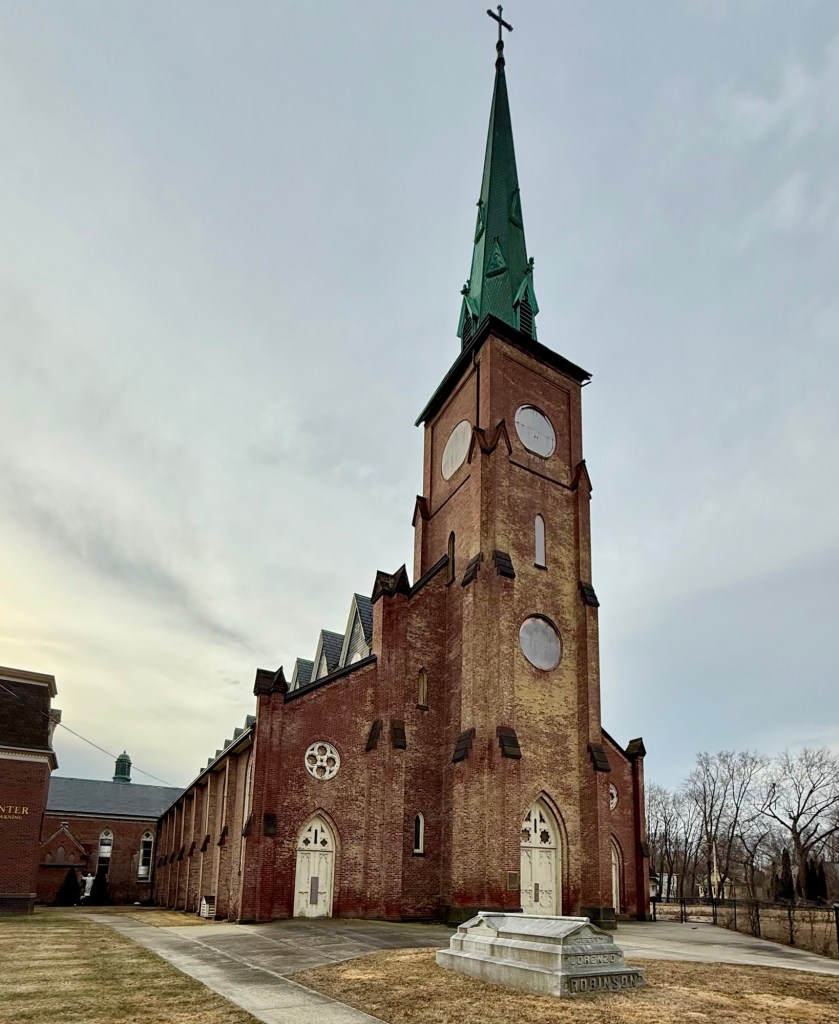
Church of the Holy Name of Jesus, Chicopee // 1857

With crop failure a common occurrence in 1830s Ireland, immigration from Irish to New England surged with workers and families looking for a better life. Labor opportunities were abundant in the newly established mill town of Chicopee, with the Irish flocking here to dig canals, build dams and mills and later work in those same buildings. Their wives and daughters would work as cooks and maids, but later as operatives in those same mills. As many Irish were Catholic, it became apparent that a Catholic congregation should be established, St. Matthew’s was first organized in Chicopee in 1838. An earlier wood-frame church was built and used for a number of years until a large site on South Street was purchased by the Diocese for a new campus. Irish-born ecclesiastical architect Patrick Keely designed the church building which was constructed between 1857-1859 in the Gothic Revival style. The church was dedicated the “Holy Name of Jesus” church and exhibited sandstone-topped buttresses, rows of pointed dormers running down the clerestory on the sides, and a prominent central steeple. In 1910, the present copper spire replaced the original steeple which was damaged and burned in a lightning strike. The complex grew throughout the 19th and 20th centuries, with a rectory, schools, convent and monastery built on the site. Sadly, due to dwindling membership and fiscal considerations, many of these buildings were demolished in the past decades. The church appears now to be closed and is still owned by the Archdiocese of Springfield. I hope something can be done to preserve this landmark structure and the remaining buildings on the site.

Mary Immaculate of Lourdes Catholic Church // 1909

One of the grandest churches around Boston, Mary Immaculate of Lourdes R.C. Church, is in Upper Falls Newton, a working class village which developed around industrial mills in the 19th century. The church, built in 1909, towers above the workers cottages and smaller frame homes in the neighborhood showing the wealth and importance of the Catholic Church to Irish immigrants who worked and lived nearby. This parish was the first in the town of Newton and it comprised of multiple villages along with parts of Wellesley and Needham. The parish was formed in the 1840s and eventually grew so much it petitioned the Archdiocese to construct a new house of worship worthy of the population. In the early 20th century, a site was secured, and the house on the lot was moved for the erection of a new church. Edward T. P. Graham was selected as the architect, who designed this Renaissance Revival church. The commanding monumental columned portico rises over two stories and supports a projecting pediment which has decorative modillion blocks, cast figures within depicting religious figures. A campanile (bell tower) is located at the rear corner and is of Italian Renaissance design. In 2004, the Archdiocese had put Mary Immaculate on the closing list of churches; however, in 2006, the Cardinal had reconsidered his plan to close the church and decided to close a church in nearby Waban Village instead.