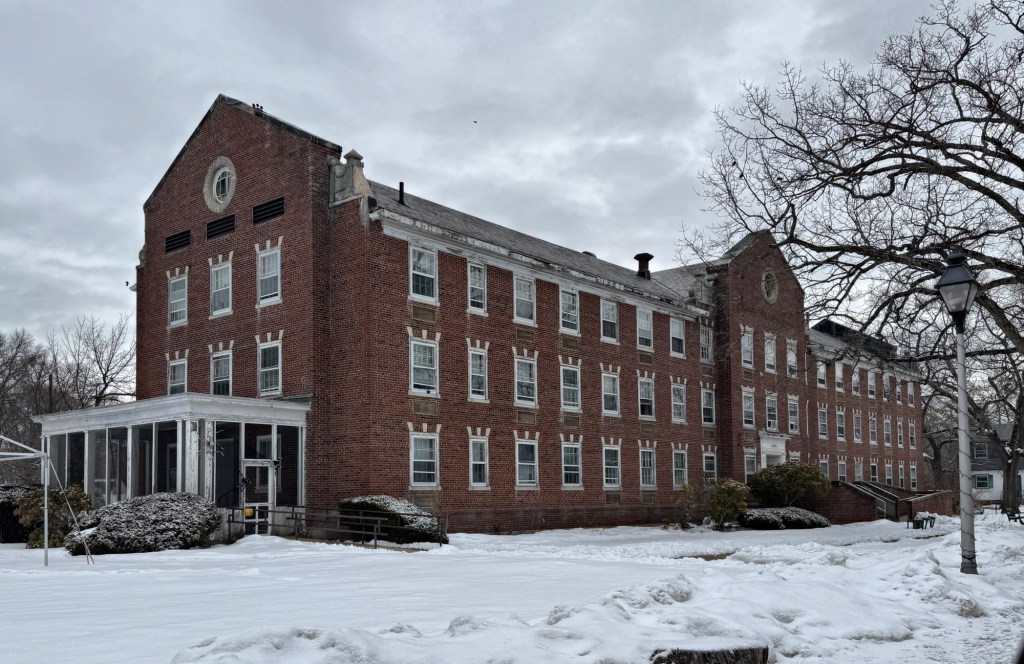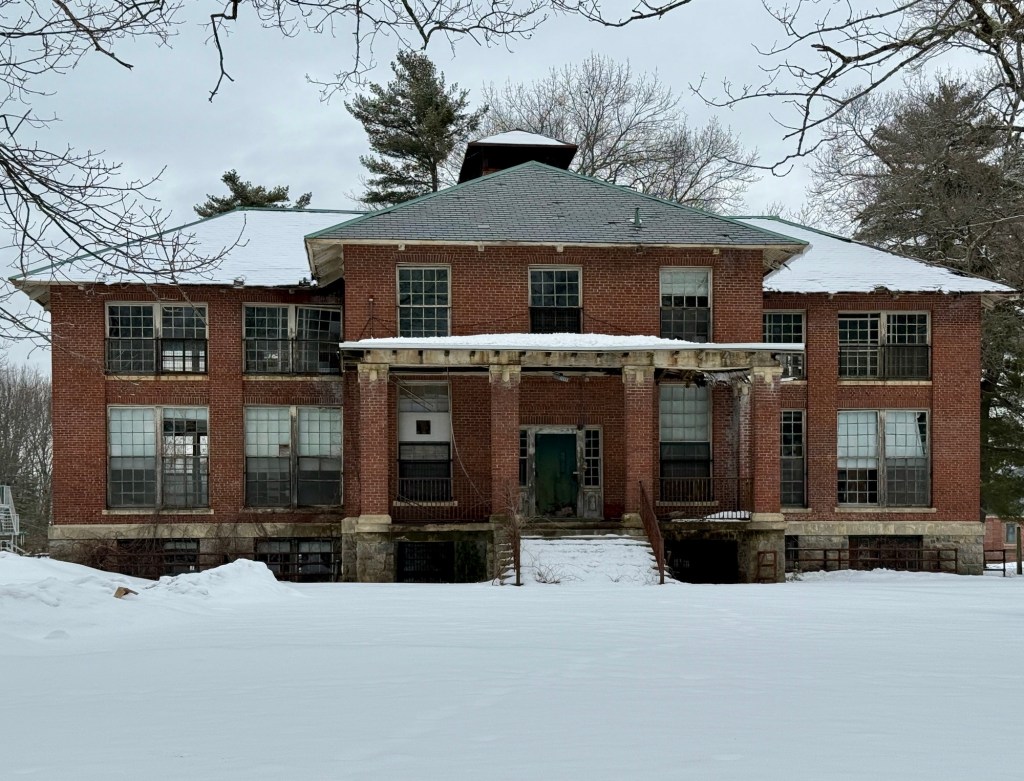
Former Vermont State Hospital // 1890

The former Vermont State Hospital campus in Waterbury, Vermont, is a 36.3-acre campus of institutional buildings that have been converted for use as state government offices. A sprawling array of more than 17 structures, the hospital, which historically treated mental disorders, was first funded by the Vermont State Legislature in 1888. Construction began on the plans by the Boston architectural firm of Rand & Taylor in 1890. The architects designed the landmark main administration and auditorium building at the core, which is built of brick on a rusticated stone foundation and under a steep hipped slate roof. The building is connected by single-story links to two-and-a-half-story wings, which are attached to clustered two-story cylindrical wards. In planning the hospital, Rand & Taylor stressed the isolation of patients and stressed the importance of light and air in each room and restricted height of the building to facilitate egress from upper floors in the event of fire or emergency. The asylum has a dark history in that Dr. Eugene A. Stanley, the Superintendent from 1918–1936, was an advocate of eugenics and espoused forced sterilization and advised the Eugenics Society based on his patients records. From this, the word, “Waterbury,” became used in a derogatory sense, and did harm to the town for years. The hospital was closed in 2011 due to flooding in the aftermath of Tropical Storm Irene, and after a thorough renovation by architects Freeman French Freeman and Goody Clancy, the complex re-opened in 2015 as State Offices with renovated historic assets and modern, contextual new buildings.

Seaside Sanatorium – Nurse’s Residence // 1935

Next to the Maher Building at Seaside Sanatorium, the Nurse’s Residence building (1935) sits in the same sad state but retains a lot of its architectural character and charm. The Nurse’s Residence was built for… you guessed it, housing for the nurses who worked at the Seaside Sanatorium and treated the young children with Tuberculosis. Like the main building, this structure was designed by famed architect Cass Gilbert in the Tudor Revival style. In designing the buildings, Gilbert met the requirements of the sanatorium to have a self-contained hospital for the children and a large separate dormitory for the nursing staff, but adapted an essentially domestic architectural
style to de-institutionalize their appearance through the use of applied, decorative detail and an extraordinary wealth of materials. The Nurse’s Residence is constructed of brick and is capped with a polychrome slate roof which is lined by 15 dormers on each slope, alternating in size. The end gables, which are similar to those of the main building and in surprisingly decent condition given the circumstances, are covered with decorative tile and add a punch of architectural intrigue. Oh too see these buildings restored one day…