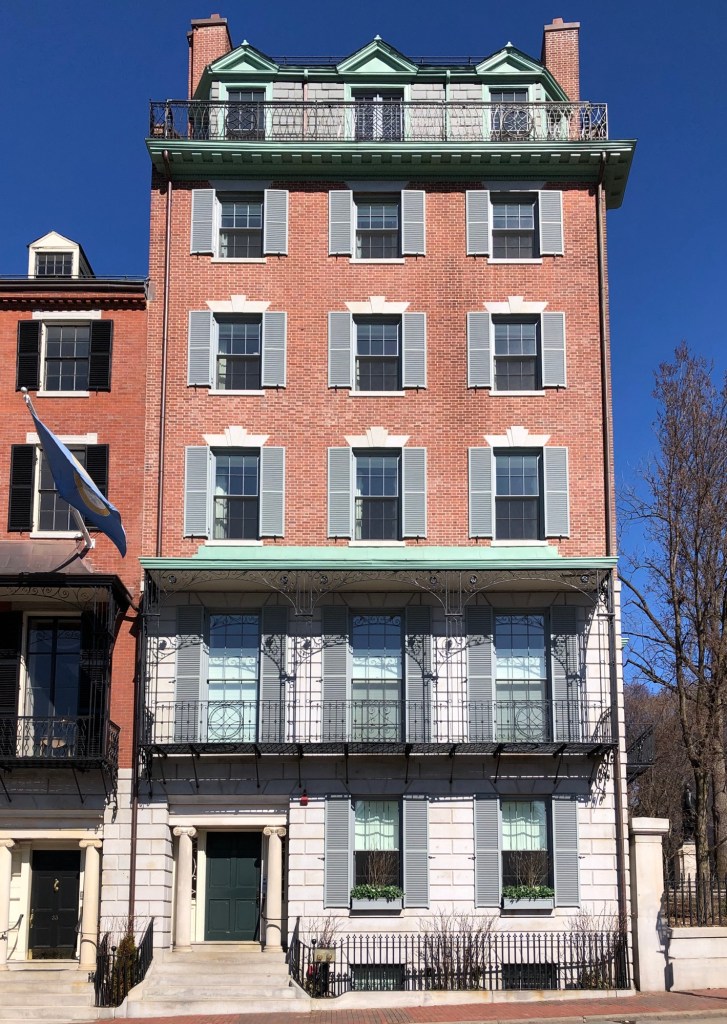
Unitarian Universalist Association Headquarters // 1926

The American Unitarian Association (AUA) opened its first headquarters in Boston in 1865, forty years after the organization was founded. Since its founding in 1825, the AUA occupied several locations but eventually took residence in a Richardsonian Romanesque style building constructed in 1886 at the corner of Beacon and Bowdoin streets. The handsome structure, designed by Robert Swain Peabody of the firm, Peabody and Stearns, served as the headquarters for the association until it was demolished in the 1920s for the expansion of the Hotel Bellevue. In 1926, the AUA purchased an 1840s townhouse and demolished it, replacing the former residence with their new building to serve as a church headquarters office building. The American Unitarian Association hired the Boston architectural firm of Putnam and Cox to design their building, which employed architectural similarities to the adjacent 1820s townhouses designed by Cornelius Coolidge. The six-story building is constructed of red brick with a two-story granite base with piano nobile with a balcony, all under a mansard roof with dormers. The American Unitarian Association sold their Beacon Street building and relocated to a new headquarters on Farnsworth Street in the Seaport/Fort Point area of Boston in 2014. The 1926 building was converted to high-end luxury condominiums.
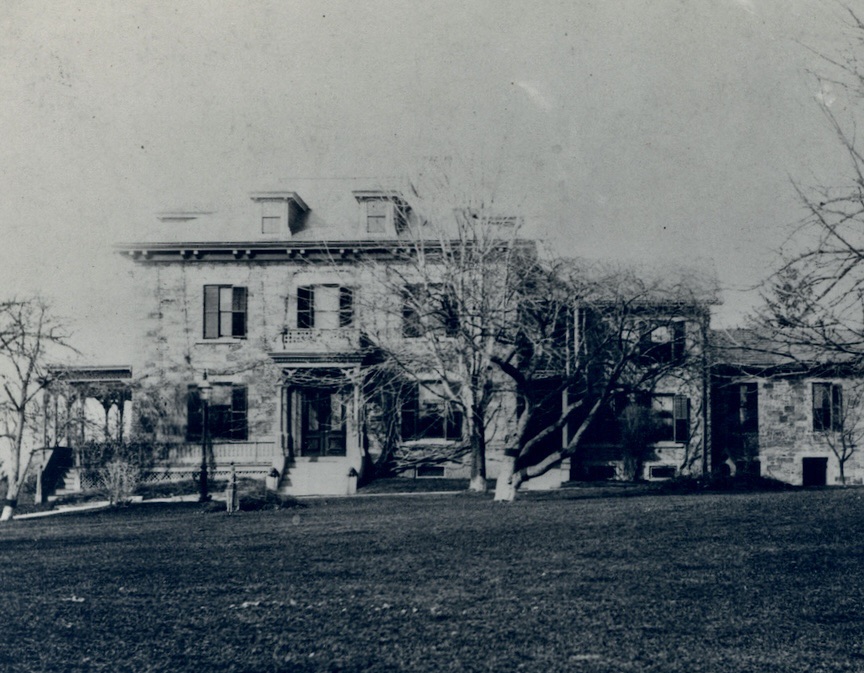
Hutchings-Pfaff Mansion // c.1865

In the mid-19th century, Roxbury was seen as a country retreat for wealthy Bostonians. Many purchased large estates of land and built mansions where they would find peace and solitude from the polluted Downtown areas. As the need increased for more workers, old farms and estates were subdivided, and single family homes, row houses, and multi-family homes sprang up to accommodate the growing population with the advent of trolley service in 1887. This is one of those estates that were demolished. This house was seemingly built for Colonel William Vinson Hutchings after the conclusion of the American Civil War. The stone mansion featured ample porches and a large stone stable amongst winding dirt paths and mature trees. The property was eventually purchased by Henry and Agnes Pfaff, of the Pfaff Brewing Company nearby. The lot was subdivided by 1895 with houselots carved out of the larger estate. By the 1930s, the stone mansion and stable were demolished, leaving just the stone gatehouse (next post) as the last survivor of this once great Roxbury estate.

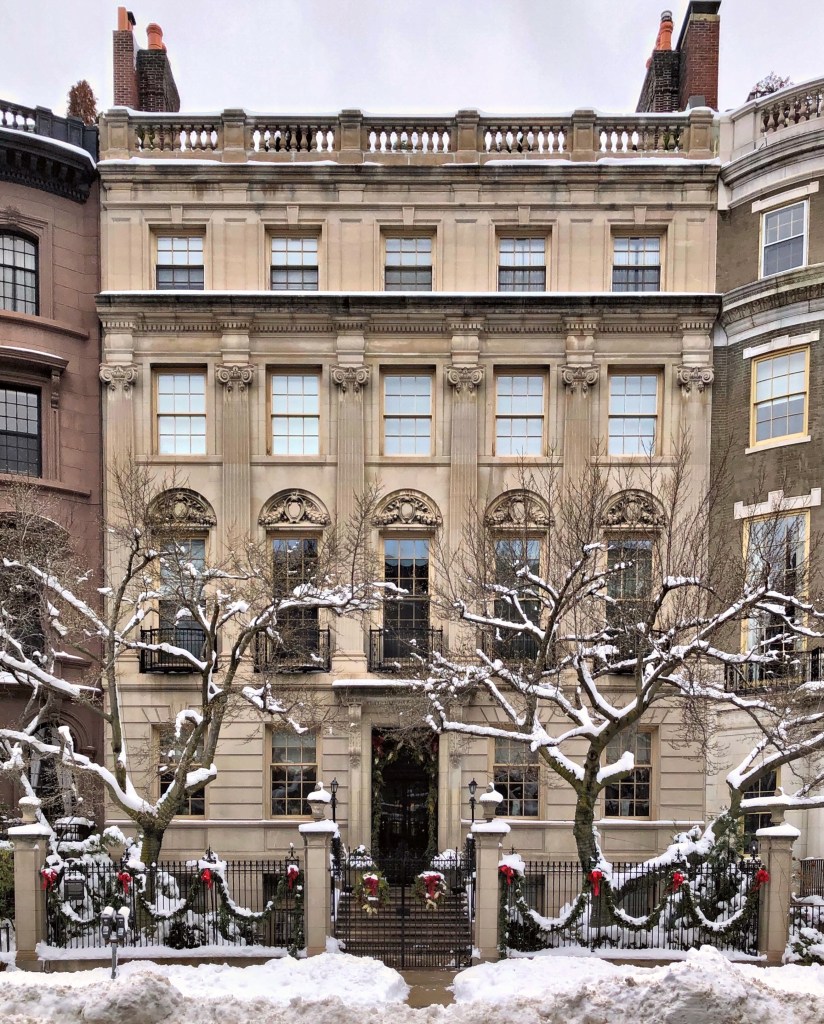
Governor Draper Mansion // 1905

Adjacent to the Warren House (last post) on Beacon Street in Boston’s Back Bay neighborhood, this massive mansion is one of my favorites on the street. Built in 1905, and designed by architect Alexander Wadsworth Longfellow, Jr. an amazing local architect, and nephew of poet Henry Wadsworth Longfellow. The grand mansion was the home of Eben Sumner Draper and his wife, Nancy. Eben Draper was a manufacturer of cotton machinery in the Draper Corporation, founded by his father in Hopedale, MA. Draper graduated from MIT and entered his fathers business, which upon the time of his graduation, was the largest plant for manufacturing cotton machinery in the world. In 1905, Draper was nominated and elected as Lieutenant Governor of Massachusetts, the same year he had this mansion constructed. In 1908, Draper was elected Governor, and served two terms under the Republican Party, pushing a pro-business, and anti-reform agenda, a bill legalizing the merger of the Boston and Maine Railroad with the New York, New Haven and Hartford Railroad, signaling approval of what was seen as monopolistic business practices, something the Draper Corporation was known for in Hopedale. The former single-family home was converted to six condominium units in 2000. Fun fact: the Draper Mansion replaced the 1860 home David Stewart, a merchant from New York, built as a wedding present for his daughter, Isabella Stewart, and John (Jack) Lowell Gardner. Isabella would later create the beloved and iconic Isabella Stewart Gardner Museum. The couple purchased the adjacent townhome in 1880 to store their growing art collection.