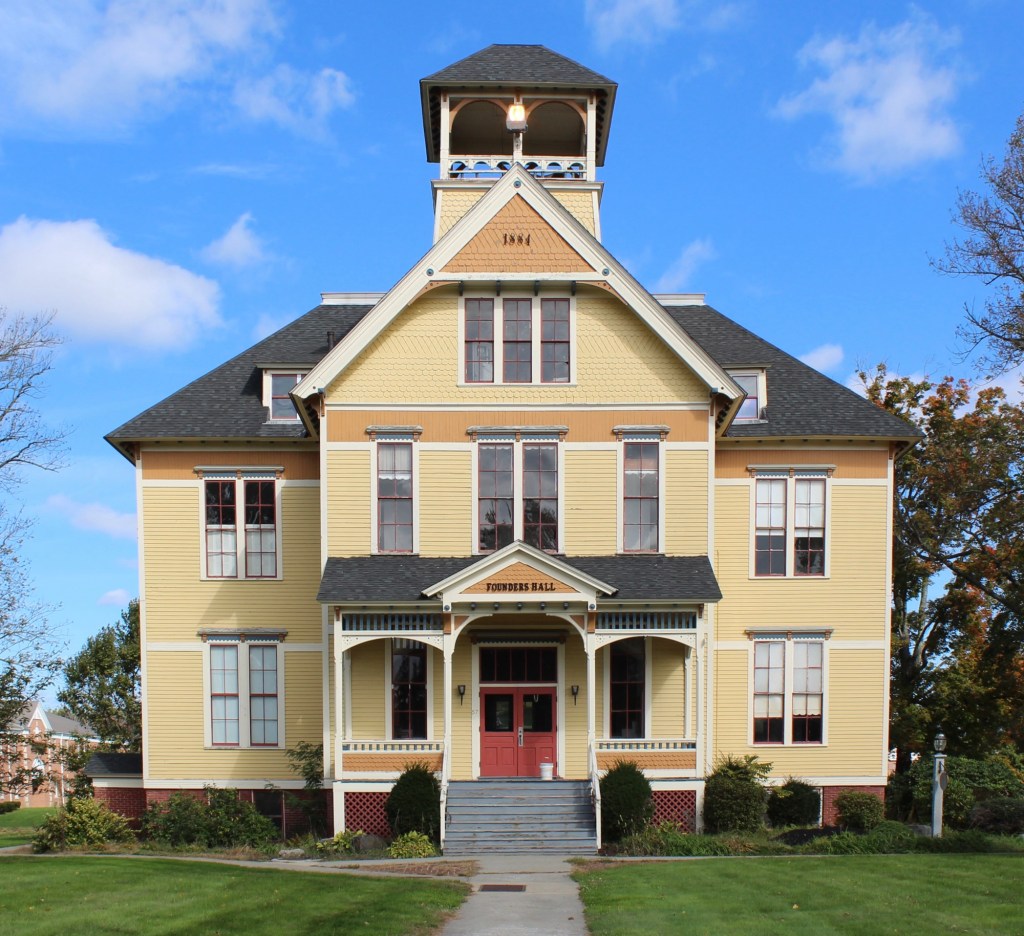
Founder’s Hall // 1884

Completed in 1884, Founder’s Hall is the oldest building on the campus of Atlantic Union College, a now defunct college in Lancaster, Massachusetts. The handsome Queen Anne style building was constructed for the school, originally known as South Lancaster Academy by Stephen N. Haskell, an elder of the Seventh-day Adventist (SDA) church. The building was designed by Worcester-based architects Barker & Nourse, and is the oldest educational SDA facility standing. The institution changed names, first to Lancaster Junior College, and then to Atlantic Union College, before the institution closed in 2018. The building and nearby campus buildings were sold in 2021, but the future is uncertain at this time.

Alumnae Memorial Library – Elms College // 1973

Located just north of and in stark contrast to the ornate Neo-Gothic 1932 Administration Building of Elms College, the school’s main library building showcases how much architecture styles changed in just 40 years. The college’s library was long in the main Administration building, but was outgrown in the latter half of the 20th century. The two-story steel and cast-concrete library building was built in 1973 with exterior details in red brick and concrete, a nod to the historic materials of the older campus buildings. Unapologetically Modern, and somewhat Brutalist, the building has complex geometry of sunken voids and solid sections, broken up by a horizontal band of windows with concrete fins to mitigate sunlight. The building was designed by Boston architects, Carroll & Greenfield, and recently celebrated its 50th anniversary.

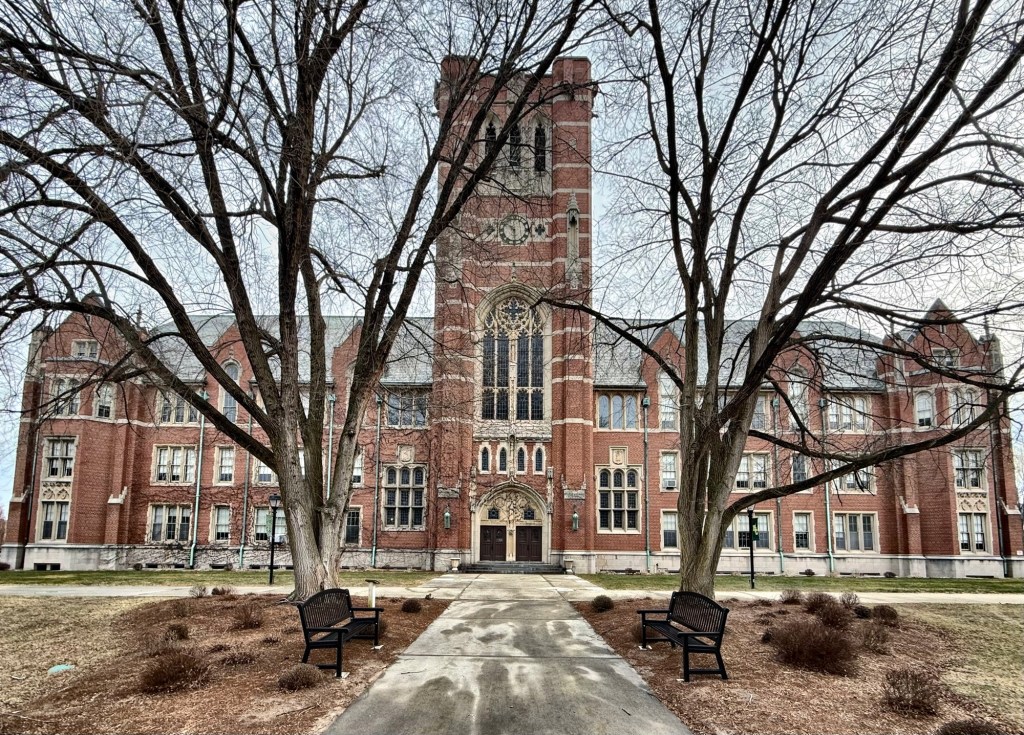
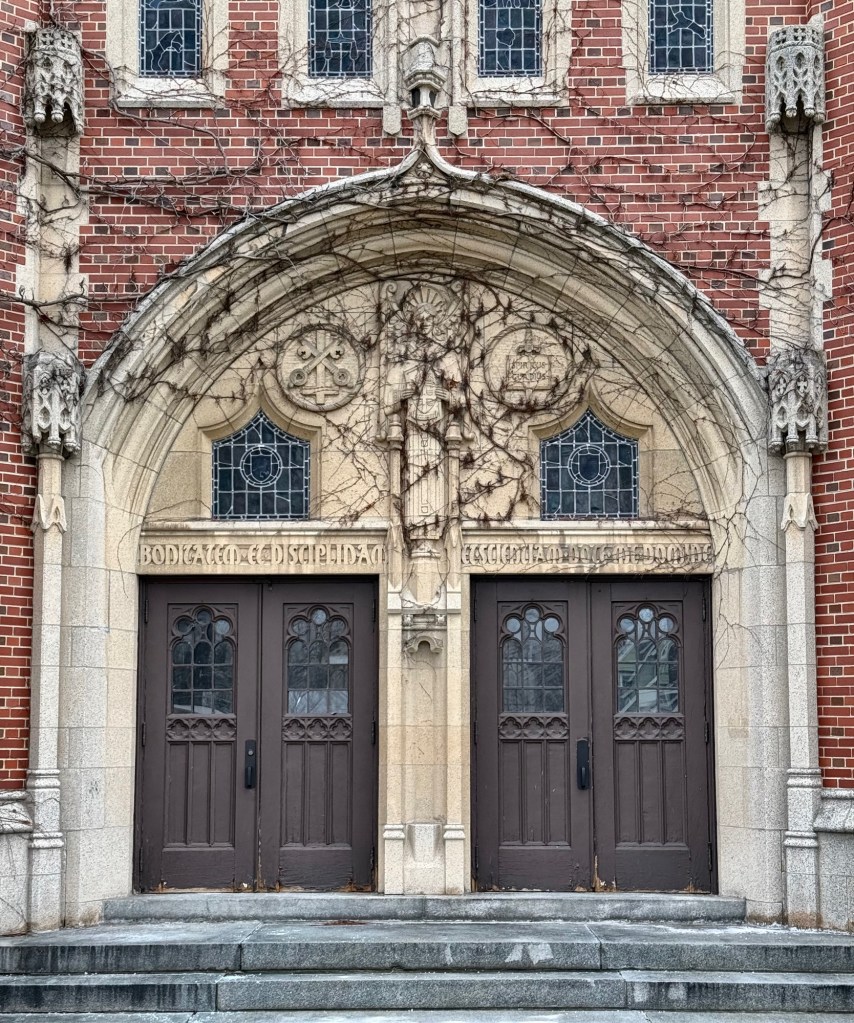
Administration Building – Elms College // 1932

Elms College in Chicopee, Massachusetts began as the Academy of Our Lady of the Elms, a Catholic boarding school for girls established in Pittsfield by the Sisters of Saint Joseph in 1897. The academy was relocated to Springfield Street in Chicopee through the efforts of Bishop Thomas D. Beaven in 1899. The Academy provided elementary and secondary education with a Normal School component that prepared young women for careers in teaching. In 1924, Bishop O’Leary announced the intention to expand the school into higher education, creating a women’s college. The college charter was approved in 1928 and the Academy became the College of Our Lady of the Elms. Planning and construction of the Administration Building (later renamed Berchmans Hall in 1983) began immediately after the incorporation of the College in 1928. Designed by John W. Donahue, the official architect of the Diocese of Springfield at the time, Berchmans Hall is a landmark example of the Collegiate Gothic/Neo-Gothic style that proliferated higher education and ecclesiastical buildings in the early decades of the 20th century. Completed in 1932, the new building included offices, modern classrooms and laboratories. The back section contained a gymnasium in the basement and an auditorium on the main floor. The building remains the main building on the Elms College campus and serves as an important visual anchor to the school.

Yale University – Connecticut Hall // 1752

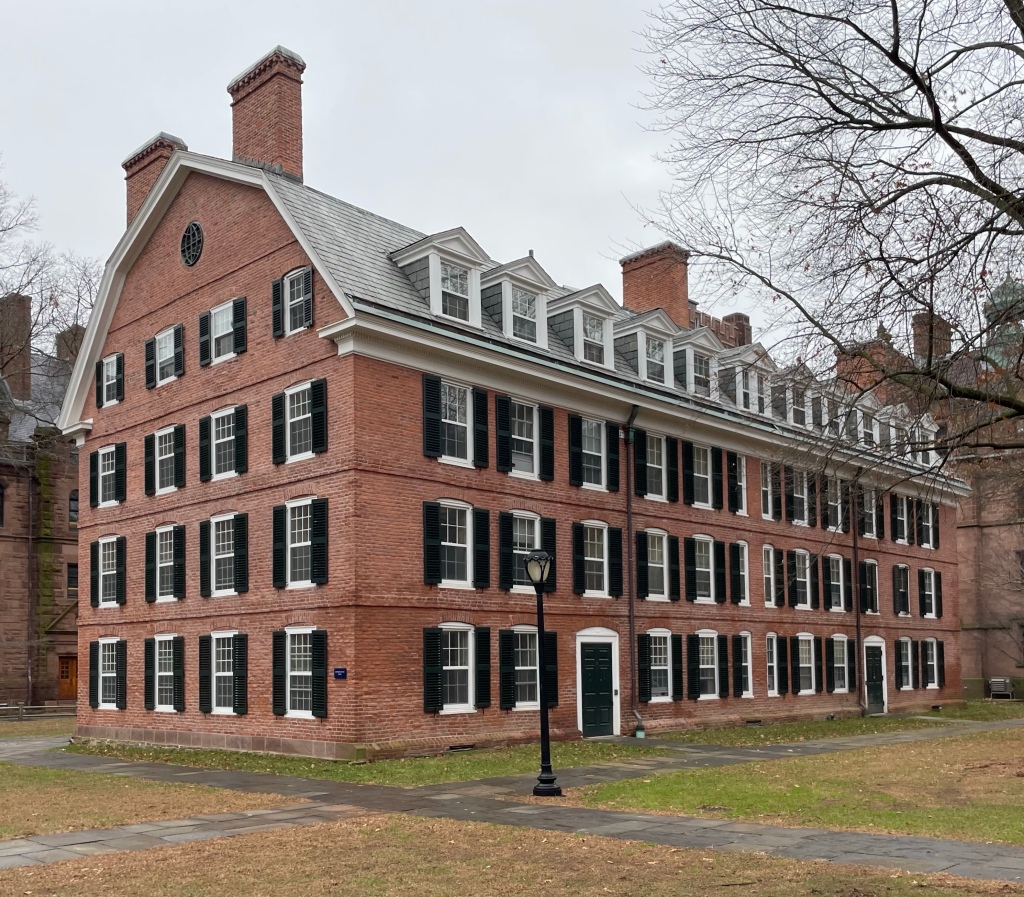
Welcome to Yale! When Yale College, one of the nine Colonial Colleges moved to New Haven in 1718, a wooden building was soon constructed and known as the College House. By 1747, the College House held less than half of the college’s enrolled students, and college president Thomas Clap announced that funds would be raised from the Colony of Connecticut for a “new College House” of three stories. The design followed the traditional Georgian appearance of Harvard College’s Massachusetts Hall, but by the 1790s, it was already outdated. The building was threatened with demolition, but Connecticut Hall was instead given an additional story and a new gambrel roof by 1820, being incorporated into the Brick Row, fronting the Green along College Street. But by the middle of the century the Brick Row was out of style and Connecticut Hall was being described as “dilapidated, scabby and malodorous.” After the Civil War Yale decided to raze all its old Georgian architecture and redevelop the West side of the Green with larger and more modern buildings. Luckily for us, by the 1890’s the Colonial Revival style was booming in popularity and before Connecticut Hall could be demolished, a group of alumni organized to save and restore it. Connecticut Hall stands today as the third-oldest of only seven surviving American colonial-era college buildings, and the second-oldest structure built for Yale College in New Haven (the oldest exant). It was built, in part, by at least five enslaved Africans, including one of whom was owned by Yale president Thomas Clap.

Pembroke Hall – Brown University // 1896

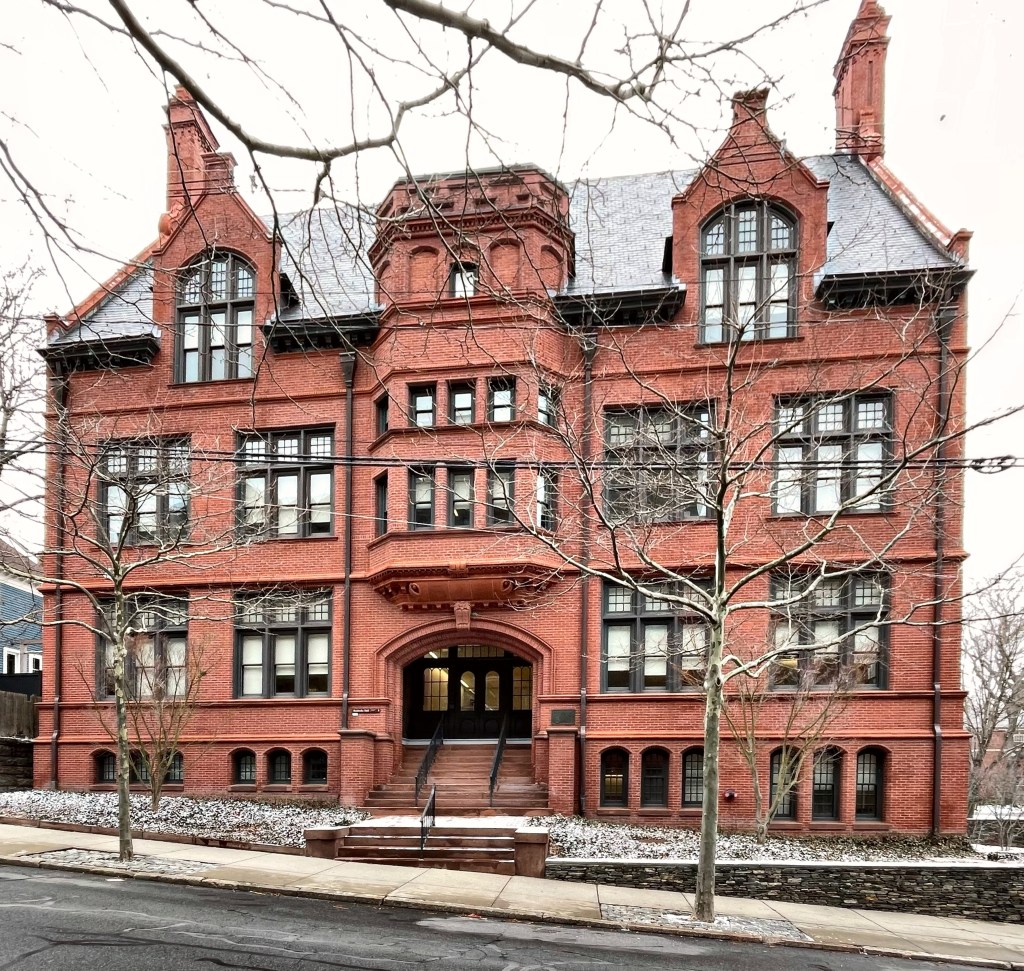
Brown University from its founding in 1764 until 1891 never admitted women. Brown’s all-male student body was first challenged in 1874, when the university received an application from a woman (who to this day is still unnamed). The Advisory and Executive committees decided that admitting women at the time was not a good proposal, but they continued to revisit the matter annually until 1888, when they began work to establish a separate women’s college affiliated with Brown. After similar institutions like Radcliffe (affiliated with Harvard) and Barnard College (affiliated with Columbia) were established in 1879 and 1889 respectively, Brown had a blueprint for how to operated the new women’s college. Professors at Brown would work alongside women educators and taught many of the the same courses to men as they did for female students. Pembroke Hall was the first building for Pembroke College and was built in 1896 from plans by local firm Stone, Carpenter and Willson in the Elizabethan Revival style. The building was designed to be multi-purpose with administrative offices, classrooms, reception rooms, and a library in the attic. Pembroke College was officially merged with Brown University in 1971, which was long overdue. The building is one of the finest on Brown’s now co-educational Ivy-league campus.

Mumford-Brown House // 1847

Incredible triple-decker vibes with this beauty on Providence’s College Hill neighborhood. In 1847, this home was built as a single-family, Greek Revival style home for Henry G. Mumford, who worked as a City Marshal for the City of Providence at City Hall. The house was likely originally a one-story or two-story Greek Revival cottage which was upgraded in a BIG way after Mumford’s death! His heirs sold the family house in 1859 it was owned by John A. Brown and his wife, Ellen. It was likely Ellen who had the property converted to a triple-decker with three units in the home. It was modernized with Italianate detailing, including the elaborate window hoods, front portico and side porch, round arched windows, and extra floor for additional rental unit. The property was later owned by Governor and member of the Taft Political family Royal C. Taft as an income-producing property.

Thompson Hall – University of New Hampshire // 1892

The centerpiece of the University of New Hampshire (UNH) campus in Durham, is Thompson Hall, a stunning example of Romanesque Revival architecture. Thompson Hall was the first building to be built on the new campus of the New Hampshire College of Agricultural and Mechanical Arts, which had been founded in 1866 as a land grant college and was previously located near Dartmouth in Hanover. Benjamin Thompson, a Durham farmer, died 1890, leaving an estate worth $400,000, with 253 acres (102 ha) of land, to the state for use as an agricultural school. The state accepted his gift, and construction of Thompson Hall began in 1891, with a landscape plan for the campus developed by the great Charles Eliot. The bold Romanesque building was designed by Concord, NH architects Dow & Randlett, who were among the most prestigious architectural firms in the state at the end of the 19th century. The building remains as a significant piece of UNH’s ever-growing campus.