Academy of the Holy Family // 1914

Built adjacent to and just a few years after the St. Mary of the Immaculate Conception Church in Baltic (last post), the Academy of the Holy Family stands as a high-style Colonial Revival building in the town. The building stands four full floors with a raised basement and attic story, and is symmetrical in its design. A large fan-light transom and stone trimmings add much depth to the buildings large massing. The structure was built in 1914, and has housed the Academy of the Holy Family, a private, Roman-Catholic all-girls prep school, which is still active today.

Baltic Mill Warehouse // c.1890

Situated along the Shetucket River in Sprague, Connecticut, lies the remains of what was once the nation’s largest textile mill. At its peak, over 1,000 employees operated 1,750 looms and 70,000 spindles to produce some of the country’s finest cotton. The Baltic Mill (as it became known) not only helped reshape Connecticut’s economic and cultural landscape, but its geographic one as well, giving rise to the founding of an entirely new village. The Baltic Mill did very well until the economic Panic of 1873 set in, decimating the company’s finances. The mill was forced to scale back their operations. Then, in 1877, a fire destroyed the interior of the mill, bringing an end to the complex for decades. At the turn of the 20th century, a businessman from Pawtucket, Rhode Island, named Frederick Sayles purchased the property with an eye toward revitalizing the local textile industry. He founded the Baltic Mills Company and set about making extensive repairs and upgrades to the property, including this c.1890 storage building for materials and finished textiles. Unfortunately for Sayles, the New England textile industry had already begun to decline and it wasn’t long before the company’s depleted finances forced Sayles to sell off much of its assets. The company did survive long enough to produce uniforms, parachutes, and life rafts for soldiers in World War II, but the mill’s operations ultimately came to a halt in 1966. The large 19th century mill would eventually be demolished, but this old Warehouse (a fraction of the size of the mill) is one of the last industrial pieces of the former sprawling complex and is now occupied by local businesses.

Cote Block // c.1910

The population of Sprague, Connecticut nearly doubled between 1900 and 1910 from 1,300 to 2,500. As a result, the town needed a new town hall and commercial buildings to service the new residents. A member of the Cote Family in Sprague took this as a good opportunity to erect this three-story mixed-use building on Main Street, renting out space for retail, a confectioner, and a clubhouse with residences above. The building is constructed of concrete block, a building material that surged in popularity after concrete block machines allowed these blocks to be manufactured quickly off molds of uniform style and dimension. The building also features inset center and corner porches off the street and a projecting cornice. The storefronts have since been enclosed, but the building remains one of the finest in town (even with its original windows!)

Sprague Former Town Hall and Fire Station // 1911

At the turn of the 20th century, the town of Sprague (including Baltic Village), had 1,300 residents. Just ten years later, in 1910, the population doubled, largely due to Frederick Sayles‘ purchase of the Sprague Mill and re-investment in the village’s housing and buildings. The need for new town offices and a fire station was evident, and this building in the village was constructed in 1911 to serve both needs. The old Town Hall and Fire Station is a late example of Romanesque Revival style architecture with the arched windows at the second floor and in the dormer. The space was outgrown again and the town offices relocated to a Modern building down the street after WWII.

Giddings Homestead // c.1800

This old gambrel-roofed home sits on the beginning of Pautipaug Hill Road just outside the industrial village of Baltic, in Sprague, Connecticut. The house’s history is a little unclear, but it shows up on historic maps as being owned by W. Giddings. This appears to have been Walter Giddings (1788-1854). Walter may have built or inherited this property from his father Nathaniel, who died in 1809. Walter married Laura Lucretia Fillmore in 1811 and they had four children. Laura died in 1827 at just 37 years old and Walter remarried within a year to Lydia Lathrop Ladd. The property remained in the Giddings Family at least into the second half of the 19th century. It was later “Victorianized” with two-over-two windows, side and front porches, and a octagonal bay window. The home has been suffering from deferred maintenance for over 15 years (as far back as Google maps goes) and was listed for sale, so here’s to hoping this old beauty survives!

Smith’s Corner Store // c.1865

One of the largest and most stunning buildings in the town of Franklin, Connecticut is this Italianate style structure along the Hartford-Norwich Turnpike. The building appears to have been built soon after the conclusion of the American Civil War by brothers John Owen Smith (1819-1896) and Prentice Orrin Smith (1817-1898) who possibly operated the building as a tavern or inn along the route between Hartford and Norwich. The three-story, five-bay facade structure featured round arched windows at the top floor, a raised belvedere at the roof, bracketed cornice with overhanging eaves, and later storefronts at the facade. The building is occupied today by Victorian House, a furniture store.

Colonel Jacob Kingsbury House // pre-1815

Jacob Kingsbury was born in Norwich, Connecticut on July 6, 1756, to Nathaniel and Sarah Hill Kingsbury. On July 11, 1775, at the age of 19, he enlisted in the 8th Connecticut Regiment, which was part of the Continental Army in the Siege of Boston. Kingsbury remained in the Continental Army when it was reorganized in 1776, and he was promoted to sergeant and then was commissioned an ensign in Webb’s Additional Continental Regiment on April 26, 1780. He served until the Continental Army was disbanded on November 3, 1783. At this time, Jacob moved back home and appears to have had this house built, or moved back into his father’s home. He would later serve with the United States military on campaigns against British allies and Native tribes. During the War of 1812, Kingsbury was appointed to command the defenses of Newport, Rhode Island. He served as Inspector General for Military District No. 2 (comprising the states of Connecticut and Rhode Island) from April 8, 1813, to October 31, 1814. He was discharged in 1815, and moved back to Franklin to live out his final days. The original vintage of this house in unclear, but it appears to have been built before or shortly after his return to Franklin in 1815. After his death in 1837, the property was inherited by his son, Col Thomas Humphrey Cushing Kingsbury, who updated the old homestead with Italianate detailing including the replacement double doorway, bracketed and dentilled cornice, tripartite window in the gable, and 2/2 windows. What a cool blending of styles here!

Dr. Ashbel Woodward House // 1835

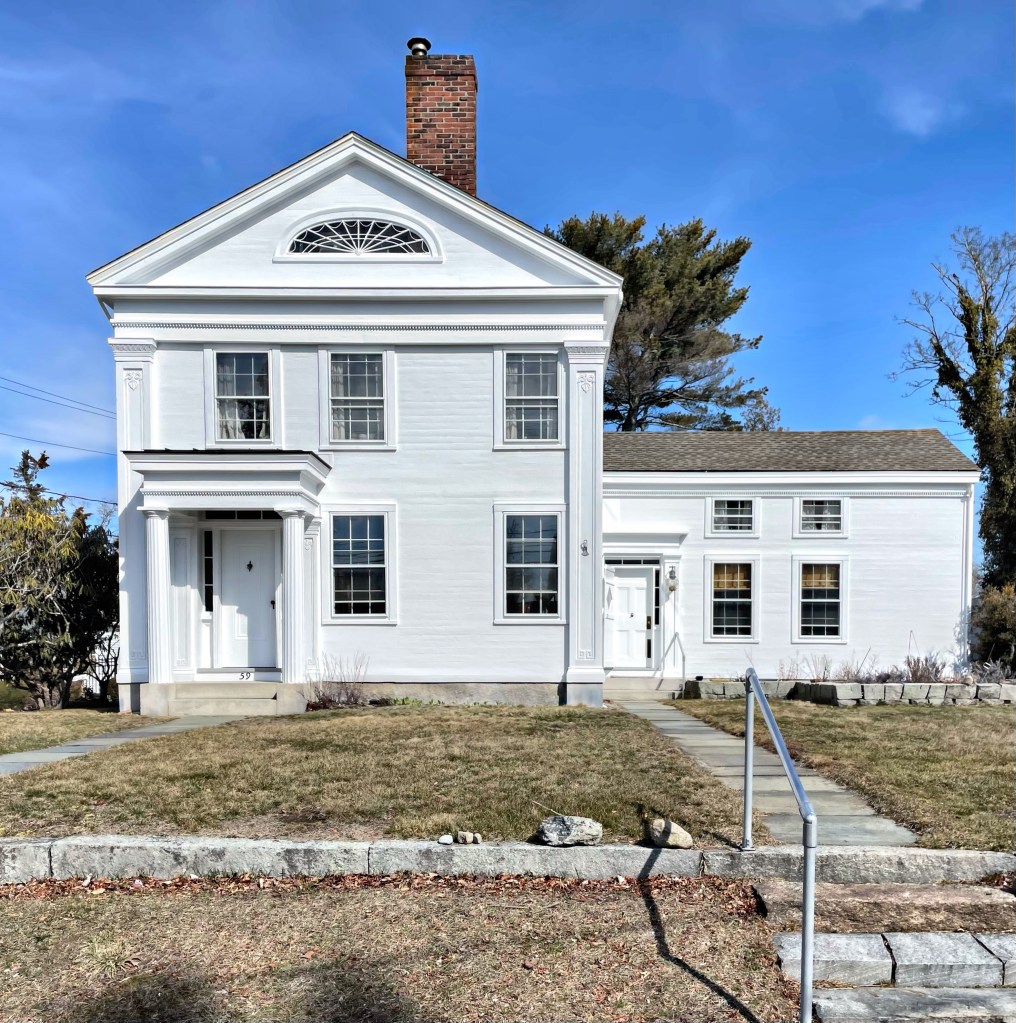
The Ashbel Woodward House in Franklin, Connecticut was built in 1835, on land purchased by Doctor Ashbel Woodward, a prominent local physician, a year prior. Woodward, was a graduate of Bowdoin College, and he began practice in Franklin in 1829, serving as the town’s primary medical practitioner until his death in 1885. Though in his 60s at the outbreak of the Civil War, Woodward perhaps lent his greatest service to his country when he served as a battlefield surgeon and medical facilities inspector for the Union army. Besides his work in medicine, Woodward collected literature and numerous artifacts pertaining to Franklin’s past and eventually wrote a book detailing the town’s history. The Ashbel Woodward House is an excellent example of the Greek Revival architectural style in a five-bay form. Interestingly, there are semi-elliptical windows in the pediment gable ends on the side elevations, seemingly a nod to the Federal style that was waning out of style at the time. The property is in use today as a museum, documenting the life of Dr. Woodward and the people of Franklin, Connecticut.

Oliver Johnson House // 1905

Prairie style architecture is not nearly as common in New England as it is in the Mid-western United States. The style was almost always seen in early 20th century residential designs and is characterized by horizontality, low slope roofs, overhanging eaves, and open interior floor plans. This New England vernacular version of the Prairie style employs some Arts and Crafts influence with Tuscan columned porch and wood frame construction, rather than the more bulky and bold use of brick and stone. This residence sits on a busy state route in the sleepy town of Franklin, Connecticut. This house appears to have been built for Oliver Johnson who was about seventy by the time the house was built. Do you know of any other Prairie Style houses in New England?

Rev. Samuel Nott House // 1784

Reverend Samuel Nott (1754-1852) was born in Saybrook, Connecticut and did not have an easy beginning. When he was young, the family home burned, destroying all family possessions. Some years later on a business trip, he was beaten and robbed. At twelve years old, he began working for his father, later becoming a blacksmith by 16. For a while, young Nott lived with a Rev. Dr. Welsh of Mansfield. The older man had a profound religious influence on the young lad. At age 23, Nott entered Yale, but the college closed when British troops entered New Haven. In 1782, he married Lucretia Taylor and passed his examination for the ministry. A year before his marriage, he was invited to serve a parish in West Farms, now Franklin. He was apparently anxious to accept the position at the rural village, as the farmers attending the congregational church had fired their previous two pastors, he accepted the call regardless. During his tenure, he prepared more than 40 young men for college and schooled as many as 300 boys and girls in his home, some as boarding students. He was regarded as one of the most successful educators of the day. Education ran in his family as Samuel’s brother, Eliphalet Nott, would become President of Union College in Schenectady, NY for 62 years, from 1804-1866. Towards the end of Samuel’s life, in his 70s, his wife Lucretia, became an invalid, requiring care and finally passed in 1834. Three of his children also died. Nott passed away at 98 years old in this house, as a result of burns sustained from his own fireplace.