Castle House // 1964

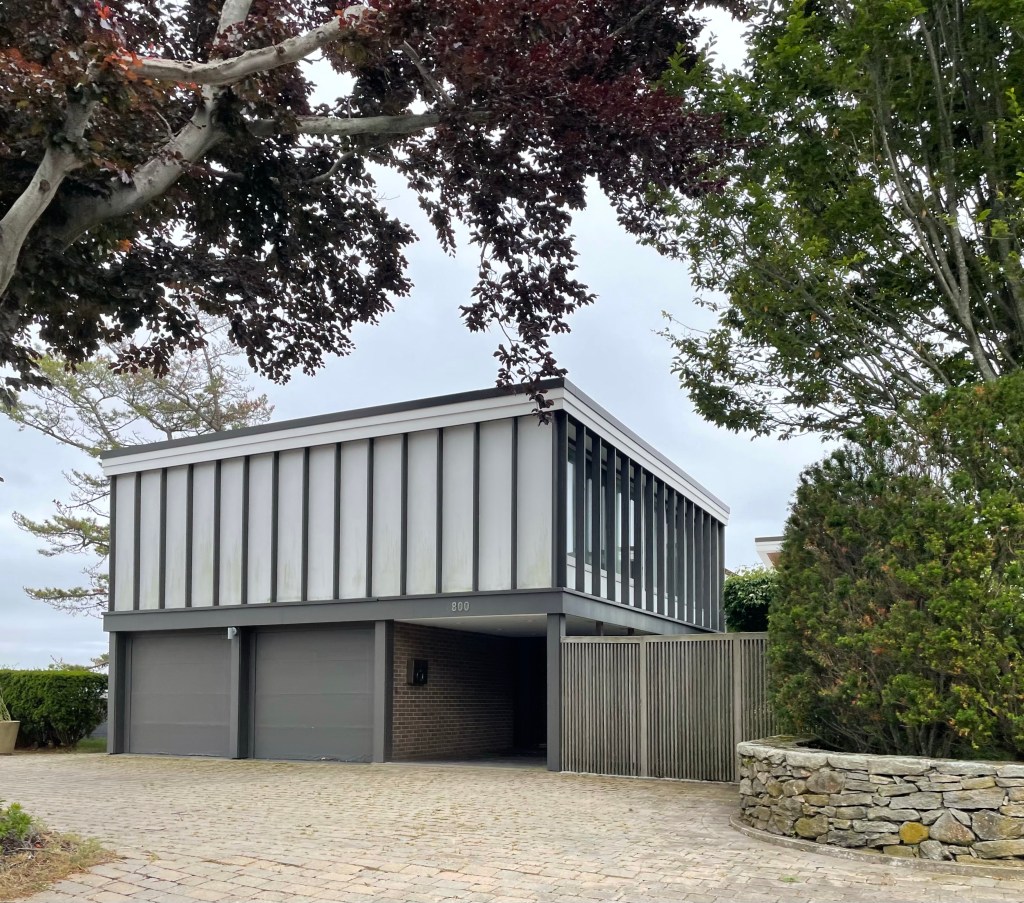
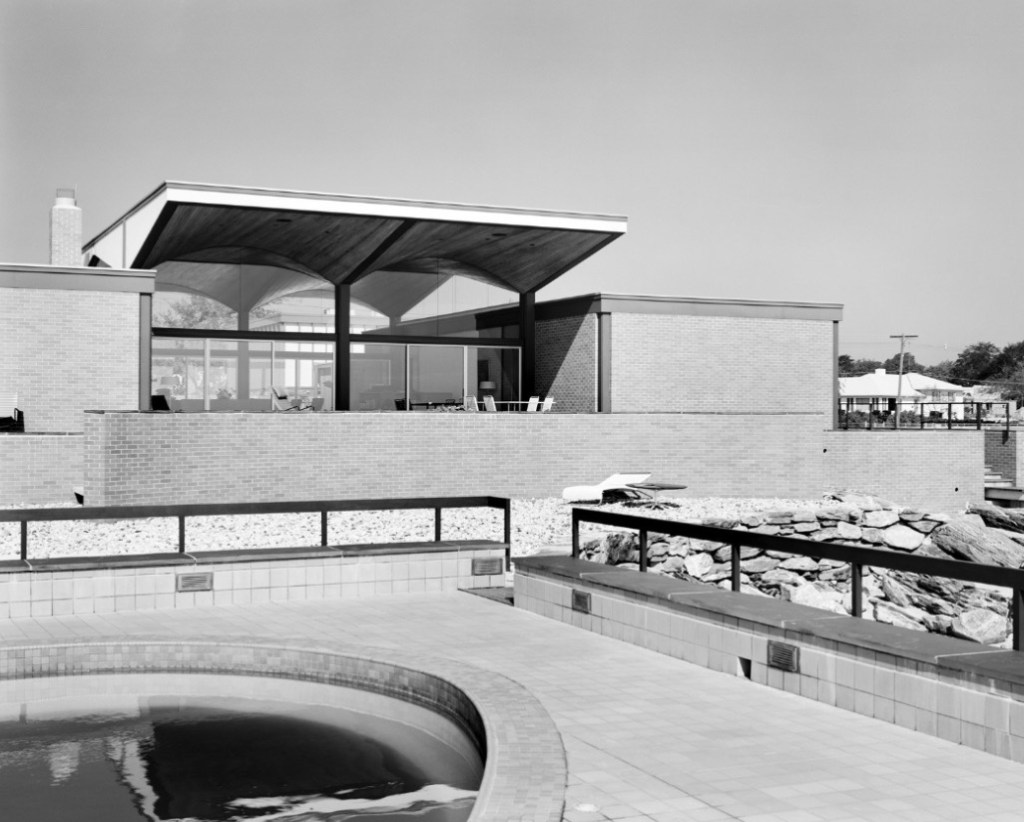
Perched atop the rocky coast of New London, CT, and seemingly at the base of the iconic New London Harbor Light, the “Castle House” stands as one of the most significant examples of 1960s residential design in a state known for such homes. The Castle House was completed in 1964 from plans by German-born American architect Ulrich Franzen (1921-2012), who attended Harvard’s Graduate School of Design after his service in WWII. After graduating, Franzen worked under I.M. Pei, until he formed his own firm, Ulrich Franzen & Associates, in 1955. The home’s signature element is its dramatic free-floating glass living room pavilion with cantilevered paraboloid vaults and flanking service wings, with a jaw-dropping cypress butterfly ceiling. Additionally, the oval pool sits over the harbor water and provides the best possible views of the 1801 lighthouse towering above. The house was recently updated by SchappacherWhite, a design firm who are known for their thoughtful Mid-Century Modern house preservation projects.
New London Harbor Light // 1801

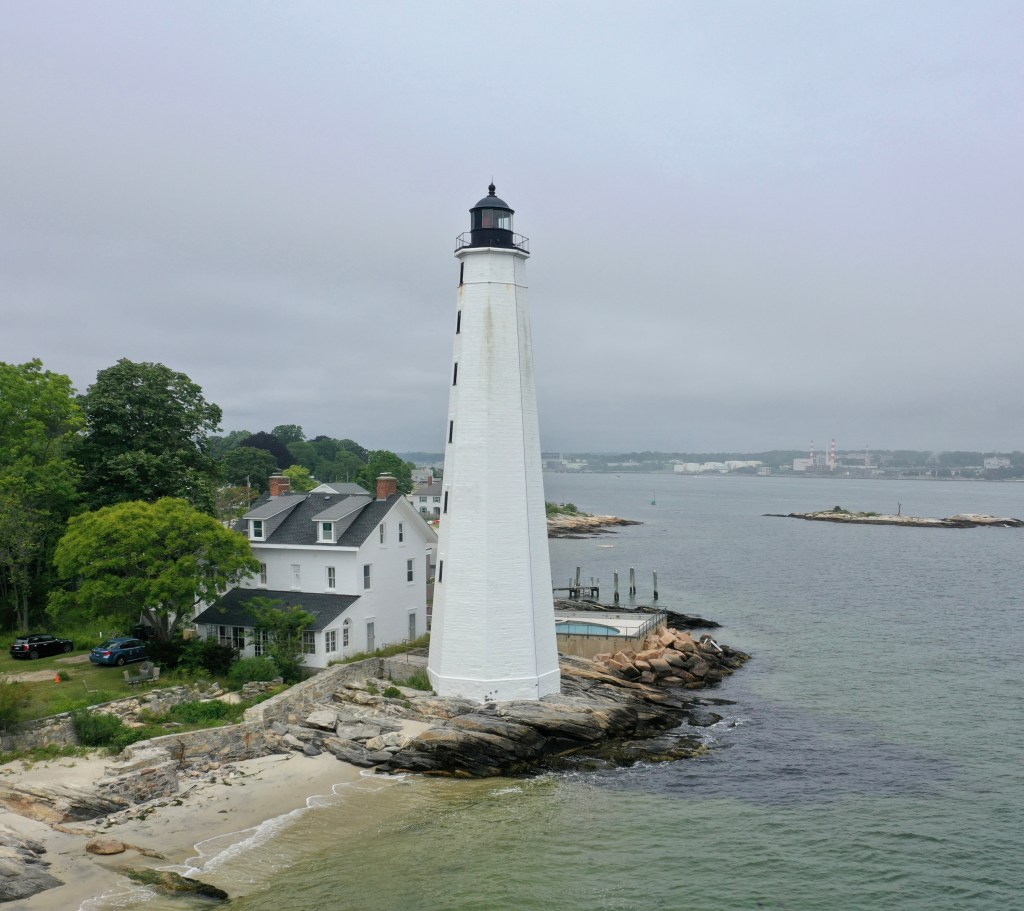
In 1760, the colonial legislature of Connecticut passed an act creating a committee to pursue the funding, construction, and staffing of a new lighthouse for the harbor entrance at New London. The following year, thousands of lottery tickets were sold to raise £500 for the lighthouse (a popular method of raising funds for construction projects in those days). The lighthouse, a sixty-four-foot-tall stone tower with a wooden lantern at the top, was finished that same year at the west side of the harbor entrance. By 1799, issues began to pile-up, including a crack in the structure compromised the integrity of the tower, compounded by the fact the light was so dim as to often be indistinguishable from the lights of the surrounding homes. These challenges led the charge for a new lighthouse. Congress allocated $15,700 for a replacement lighthouse on May 7, 1800, and New Londoner, Abisha Woodward began construction on the current octagonal, tapered, eighty-foot-tall tower. The present light was completed the next year and is constructed of smooth-hammered freestone which are lined with brick inside. The current gable-roofed, two-and-a-half-story keeper’s residence was built in 1863, and in 1900 it was expanded to provide quarters for the assistant keeper and their families. Today, the keeper’s house is privately owned and the light tower is owned by the New London Maritime Society, who offer tours of the light on occasion.

Mary English Cottage // 1911

This shingled beach cottage on the southern tip of New London, Connecticut sits in the Neptune Park community, which was laid out by real estate speculators as summer homes, primarily for local families. The Post Hill Improvement Company made up of professionals, purchased the beach and the surrounding land for $25,000 and began selling off the land adjacent to the beach. Then, once developable lots were sold and many cottages were built, they sold the beach alone back to the City for the same sum of $25,000. Like many such developments, deed restrictions were placed on properties, and ensured that only a dwelling house, with a minimum value of $2,500 if not waterfront and $3,000 if waterfront, could be constructed on the lots. This formerly Colonial Revival cottage was built in 1911 for Mary R. English, and would have cost at least $3,000. The shingled home was later given the tower and other details, but retains much of its charm.

Moses Bulkley House // 1861

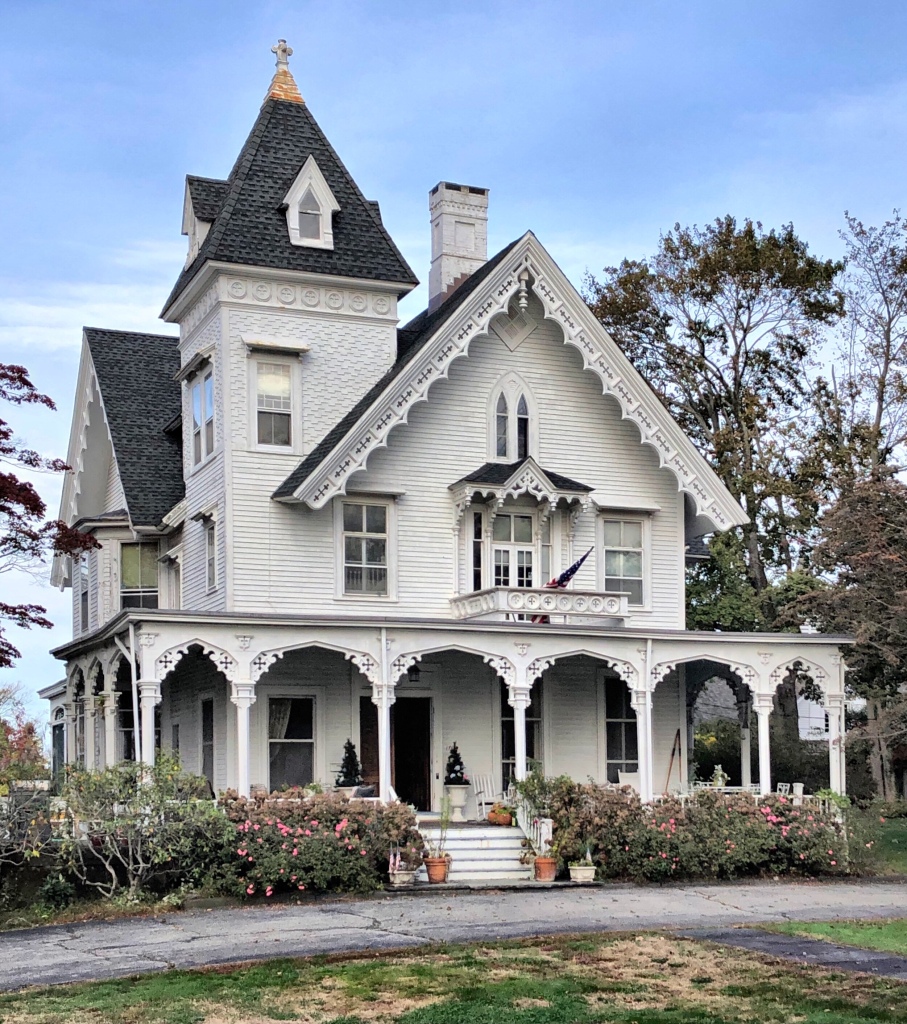
Constructed in 1861, this Victorian Gothic mansion in Southport, Connecticut, stands out amongst the many Classically inspired homes nearby. Designed by Bridgeport architects Lambert & Bunnell for Moses Bulkley (1796-1868), the house is designed on a cruciform plan, synonymous with the Gothic style. Expansive pointed gables trimmed with a gingerbread bargeboards, pointed arched windows, ogee arches trimmed with jigsaw tracery on the verandah, and a tall square tower topped with a steeply-pitched pyramidal roof are all seen in this beauty. If only it had a historically appropriate paint scheme to really make those details pop!

Mary Pomeroy House // 1868

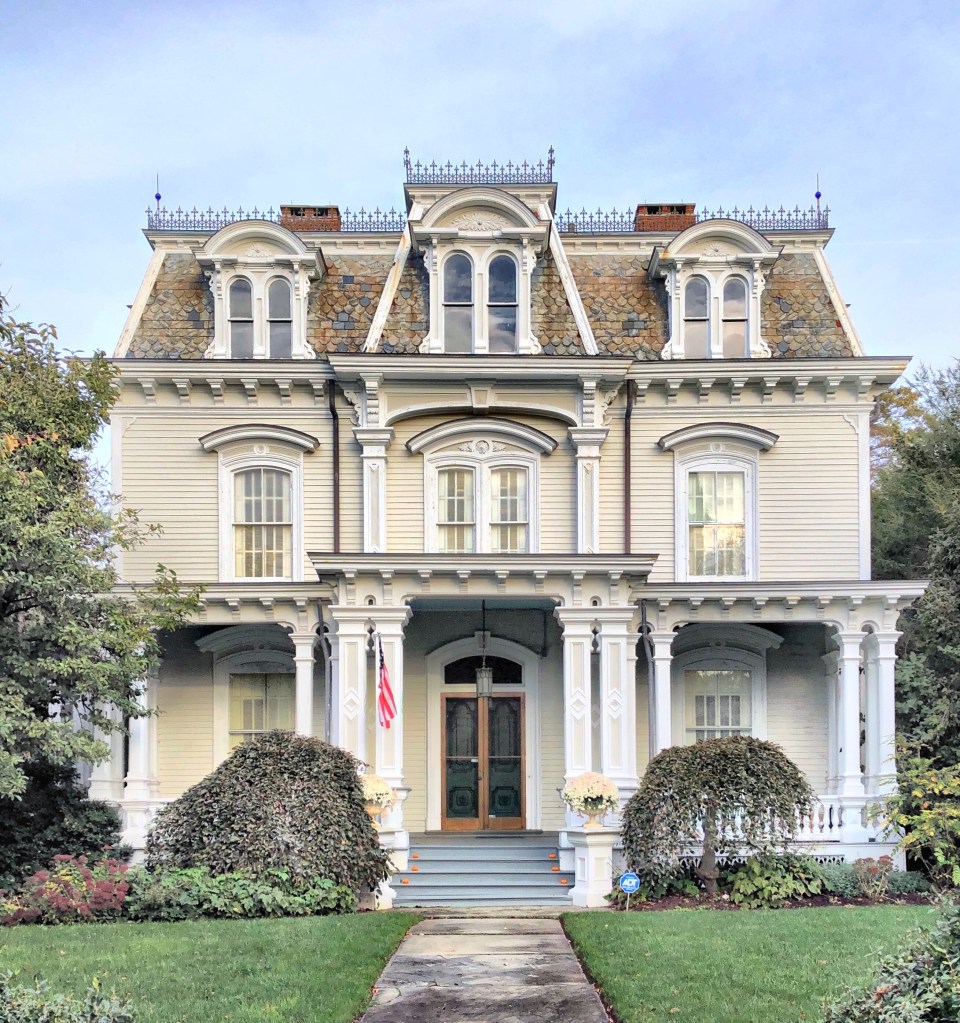
Mrs. Mary Pomeroy, the widow of one of Southport’s industrious and wealthy shipping merchants, Benjamin Pomeroy, built this large residence for herself and her daughters, soon after her husband’s death. Mr. Pomeroy was a merchant who also served as a Senator. In 1866 with ailing health, he took a doctor on a private ship to try various remedies in the West Indies, to no avail, he died at 48 years old. Ms. Pomeroy appears to have taken the money her and her husband had saved and built a large mansion to cement her position in town as the most eligible bachelorette in town. While she never remarried, she sure showed the town what good taste looks like! The facade of the Pomeroy house is symmetrical with a projecting three-story central pavilion, all surmounted by a mansard roof with cresting. Rounded dormers with twin round-headed windows pierce the roof’s multicolored slate surface, making this Second Empire house one of the nicest in a town full of historic homes!

Edwin Sherwood House // 1837

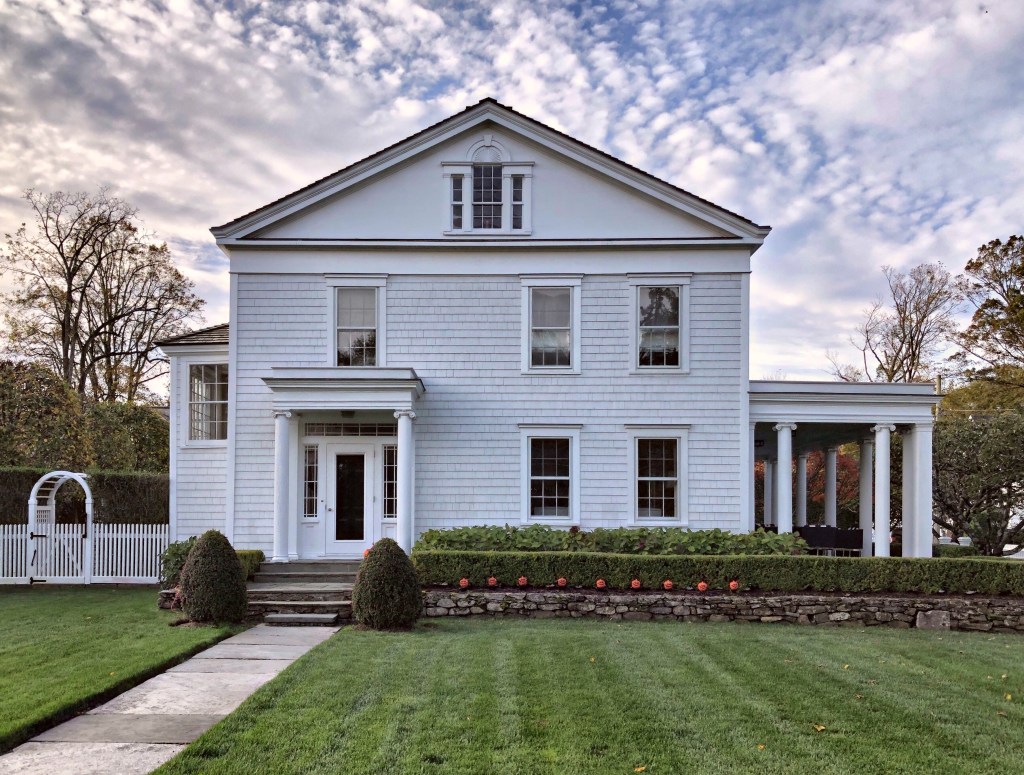
Located next to his son’s house, the Edwin Sherwood House in Southport, Connecticut is an excellent example of Greek Revival residential architecture in New England. The home was built in 1837 for Edwin Sherwood, a sea captain who traded between New York and Savannah with his two ships “America” and “Georgia”. From this wealth, he became President of the Southport Savings Bank and Director of the Danbury-Norwalk Railroad. The home was renovated in 2017 with a modern interior by Ken Gemes, an interior designer.

Augustus Jennings House // c.1830

Walking around Southport Village in the town of Fairfield, Connecticut, transports you to an early-mid 19th century town with large Federal and Greek Revival homes overlooking Southport Harbor and the Long Island Sound. This home on Westway Road was built around 1830 for Augustus Jennings (1814-1886), the son of Captain Abraham Gould Jennings. Augustus became a carriage maker in Southport before founding Jennings Brothers, a paper manufacturing company; which in 1867, began to produce Japanese paper products. The Jennings House was originally located near the Pequot Library, but was relocated in 1899, which was likely when the central shingled gable at the roof with Palladian window was added.

Osborn House // 1772

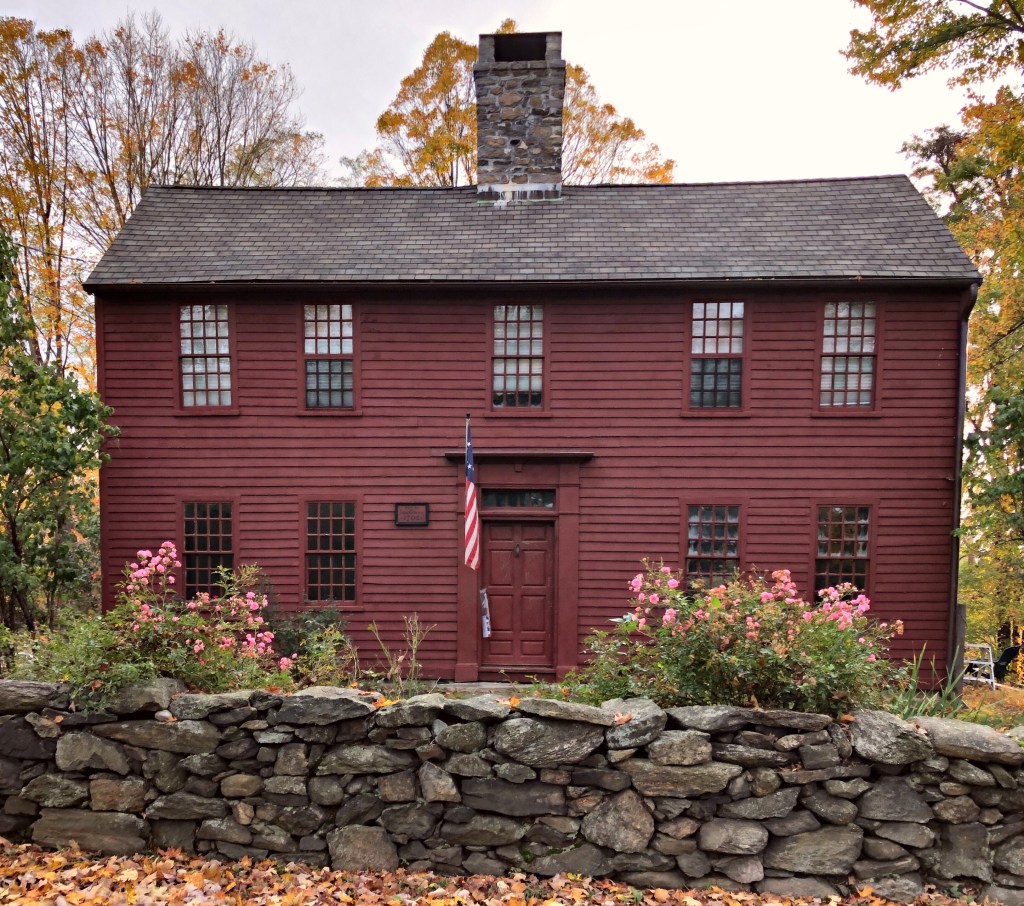
This homestead in Fairfield, Connecticut is situated on the edge of what was formerly called Pequot Swamp, and was originally built by Stephen Osborn in 1772. It is said to be the third Colonial dwelling erected in this part of the town and was left undisturbed by the British when they burned Fairfield in 1779 and raided various sections of the country along the shore. The home was originally located a few blocks away, but was moved in the 1950s when the highway (I-95) was routed through this part of Fairfield. The saltbox Georgian home was documented prior to the move by the Historic American Buildings Survey (HABS).

David Ogden House // c.1750

This saltbox house was built by 1750 for David Ogden at the time of his marriage to Jane Sturges. For the next 125 years it was home for the Ogden family in the farming and coastal shipping town of Fairfield. The home was sold out of the family in 1839 to Henry W. Banks, who continued to farm on the nearly 75 acres of farmland. By the 1920s, the home was suffering from deferred maintenance and was at risk of demolition. Luckily, Annie Burr Jennings (1855-1939), a philanthropist who was born into a wealthy family, sought to give back to her town. Jennings was instrumental in establishing and supporting a number of important community institutions, including the Fairfield Historical Society (now the Fairfield Museum) and the Fairfield Public Library. In 1931, she purchased the old Ogden Farmhouse from absentee owners and helped fund its restoration. The early saltbox vernacular Georgian home today is maintained by the Fairfield Museum and the Greenfield Hill Village Improvement Society.

Verna Farm // 1892

In Fairfield, Connecticut, land owned by Timothy Dwight, a minister and eighth President of Yale, a large farm once stood. The year after he was appointed to his position at Yale, he sold his farm Verna Farm, in 1796 to Isaac Bronson. The farm was eventually inherited by his grandson, Frederic Bronson. Dwight’s eighteenth-century house was eventually torn down in 1891 by Frederic’s son, Frederic Bronson, a wealthy New York City lawyer and socialite, who was included in Ward McAllister‘s “Four Hundred“, purported to be an index of New York’s best families, published in The New York Times. In 1892, Bronson hired starchitect Richard Morris Hunt, one of the greatest American architects of all time, to design a new country estate here. In 1933, the Bronson estate was acquired by W. A. Morschhauser, who had the house remodeled and made smaller in 1900; removing the third story and reducing the number of rooms from 42 to 13! Since 1949, the property has been occupied by the Fairfield Country Day School. The windmill as part of the estate was eventually gifted to the Town of Fairfield.