Maple Shade Cottage // 1871

“Maple Shade” is a historic, Second Empire style summer cottage located at 1 Red Cross Avenue in Newport, Rhode Island. The house was built in 1871 from plans by George C. Mason, a prominent local architect who designed many summer homes for summer residents in the late 19th century. He even lived in a home adjacent to this house! Maple Shade was built for John Doughty Ogden and his second wife, Mary C. Moore. John originally married Mary’s older sister Margaret, but remarried after Margaret’s death in 1845. The house gained attention again in 1934, when it served as the venue for the wedding reception of John Jacob Astor VI and Ellen Tuck French, then owned by Donald O. Macrae. The house, like many other former estates in Newport, has since been converted into condominiums, but retains its architectural grandeur and presence in town.

Rosevale // 1876

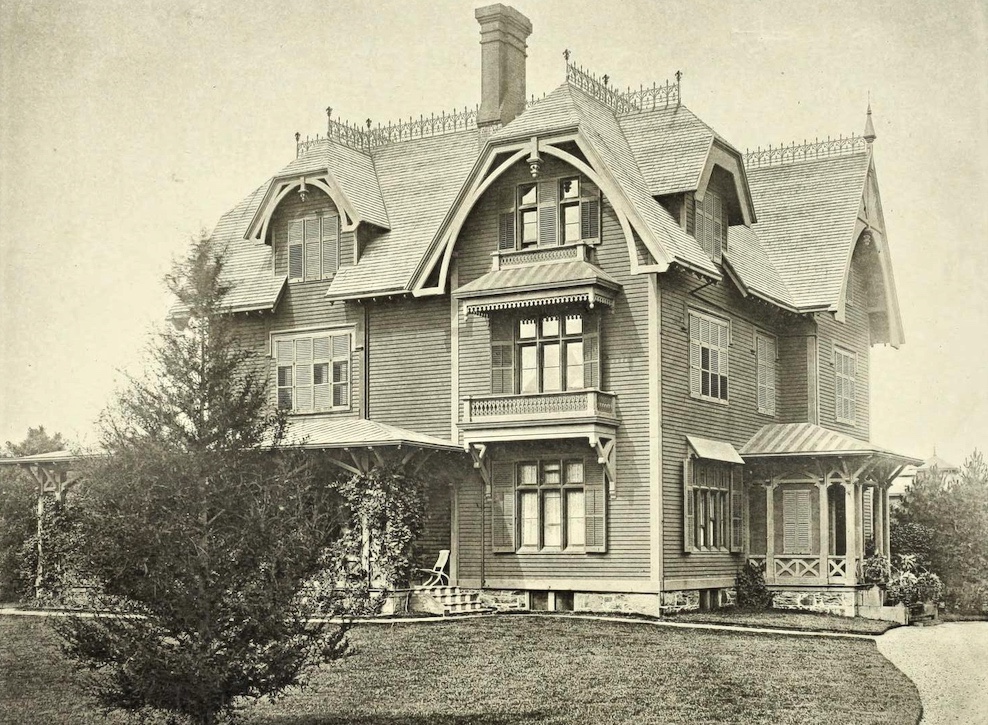
“Rosevale” was built in 1876 as a summer residence in Newport, Rhode Island, for couple, Grace Sears Rives and William Cabell Rives. Grace was the daughter of David Sears of Boston, who developed the Longwood neighborhood of Brookline; and William was the son of William C. Rives Sr., a Virginia congressman and Senator. The High Victorian Gothic mansion was designed by the Boston architectural firm of Peabody & Stearns who formed their practice just years earlier. The house was enlarged in 1881 by architect George Champlin Mason, Sr. The stonework of the lancet windows, the large octagonal tower, and the carved moldings give the relatively boxy home a more ecclesiastical feeling. The estate retains its original siting, at the middle of a large lot between Red Cross and Rhode Island avenues, which has thus far resisted infill housing on the estate. For years, Rosevale has been occupied as a funeral home, but it appears to have sold a couple years ago.

Edgar-Wolfe-Moore House // 1864

At the head of Touro Park, this large home has stood since it was built in 1864 for Daniel Edgar of New York, who made it his summer home for eight seasons. It was designed by noted local architect, George Champlin Mason in the Italianate style and included a broad veranda, brackets, and other intricate details. In 1872, Edgar sold the property to Catherine Lorillard Wolfe, who occupied the house until 1883 when her property “Vinland” was completed on Ochre Point Avenue. In 1948, the house was purchased by Cornelius C. Moore, who remodeled the exterior in 1949-1950, removing its Italianate trim and replacing it with Neo-Federal detail we see today. The house was most-recently in use as the Touro Park Inn, but was recently purchased and is a single-family home.

“Park Gate” Cottage // 1879

“Park Gate” Cottage sits on Bellevue Avenue near Touro Park in Newport, Rhode Island and is one of many summer “cottages” for wealthy summer residents. The home replaced the Atlantic House, a large summer hotel formerly on the site. The wood-frame dwelling was designed by Newport architect George Champlin Mason for Seth Bunker Stitt of Philadelphia and constructed in 1879. Mason’s design for “Park Gate” includes many features typical of the Queen Anne style including the asymmetrical facades, wrap-around front porch, tower, and even the small details like dentils, spindle work and balustrades. The house was later purchased by Newport Lodge #104 of the Benevolent and Protective Order of the Elks in 1920, who own the building to this day.

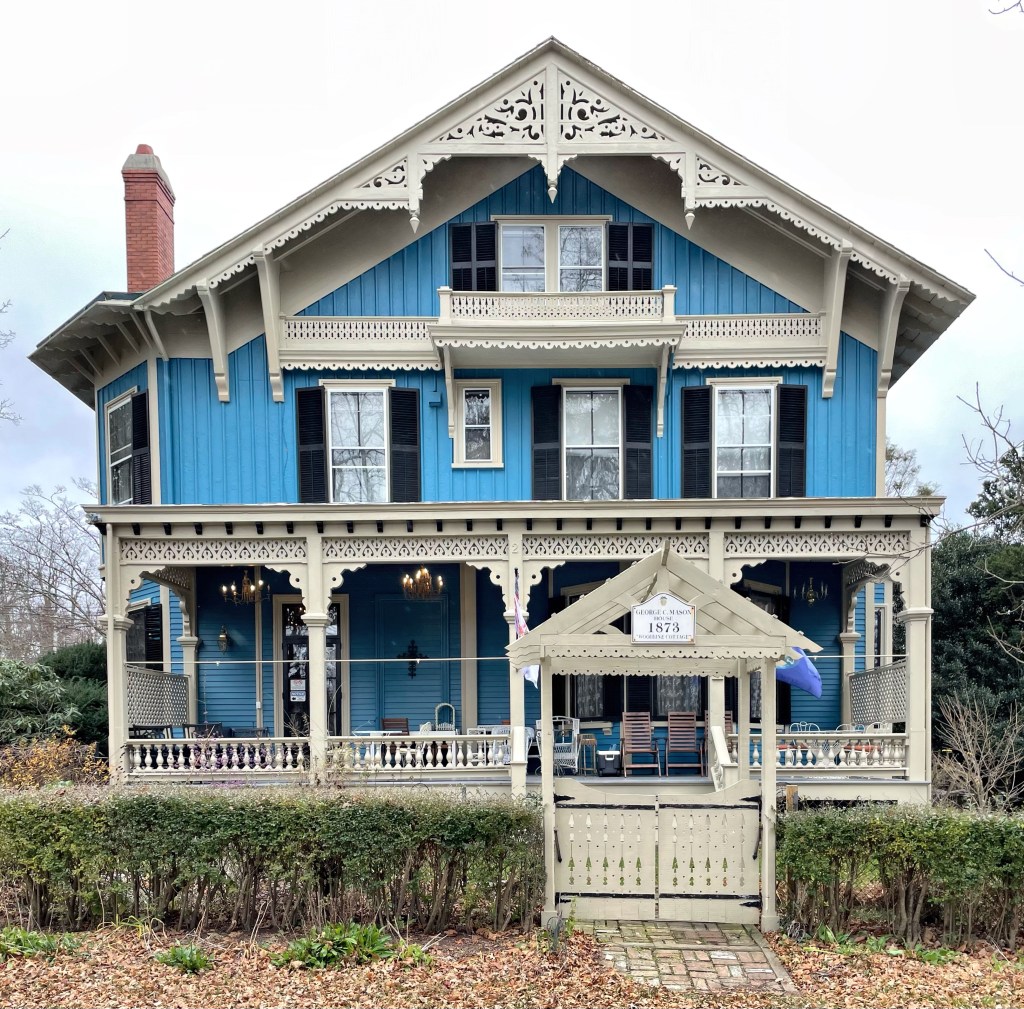
Woodbine Cottage // 1873

George Champlin Mason (1820-1894) can be credited as one of the most influential people who helped make Newport what it is today. He was born in the old Colonial town in 1820 and after a brief period working in New York City in dry goods, he traveled to Europe in his twenties to study art in Rome, Paris, and Florence, specializing in landscape paintings. Mason spent the 1840s trying unsuccessfully to make a living as landscape painter and published Newport and Its Environs, a collection of 11 engravings of his landscape views of Newport that is one of the earliest books about Newport to showcase its potential as a vacation destination. In 1851, Mason switched professions and became part owner and editor of the Newport Mercury newspaper. He often wrote on architectural subjects. In around 1858, he took his love for art and architecture and became an architect/developer, just as Newport was seeing early stages of development as a summer colony. He was hired by some early summer residents to design their homes, and did not disappoint, gaining notoriety all over the northeast. His son George C. Mason, Jr. (1849-1924), followed in his father’s footsteps and is said to have been the first professional architectural preservationist in the United States. George Sr., built this house as his primary residence in 1873, a stunning and rare example of Swiss Chalet architecture in New England, notable for the use of pierced bargeboards, board-and-batten sheathing, and cut-out railings. The property also included a charming stone English Revival tower in the rear yard, built in the 21st century as a workshop for the previous owners. How cool!

Ms. Rebecca Jones Cottage // c.1870-1899

Formerly located adjacent to “The Lodge” (last post) on Newport’s iconic Bellevue Avenue, this mansion once stood and today, would be one of the finest in town, but it suffered a similar fate as its neighbor. The home was built for Rebecca Mason Jones (1803-1879), a widow (who married her first cousin) and daughter of wealthy New York banker and developer, John Mason. Rebecca made money from her late father’s estate, developing some parts of Manhattan. For her summer residence, she hired local society architect, George Champlin Mason to design the cottage. The cottage (originally thought to have been razed) was moved to 28 Narragansett Avenue to make room for Rose Villa, which also necessitated the demolition of the two neighboring mansions (more on that tomorrow).

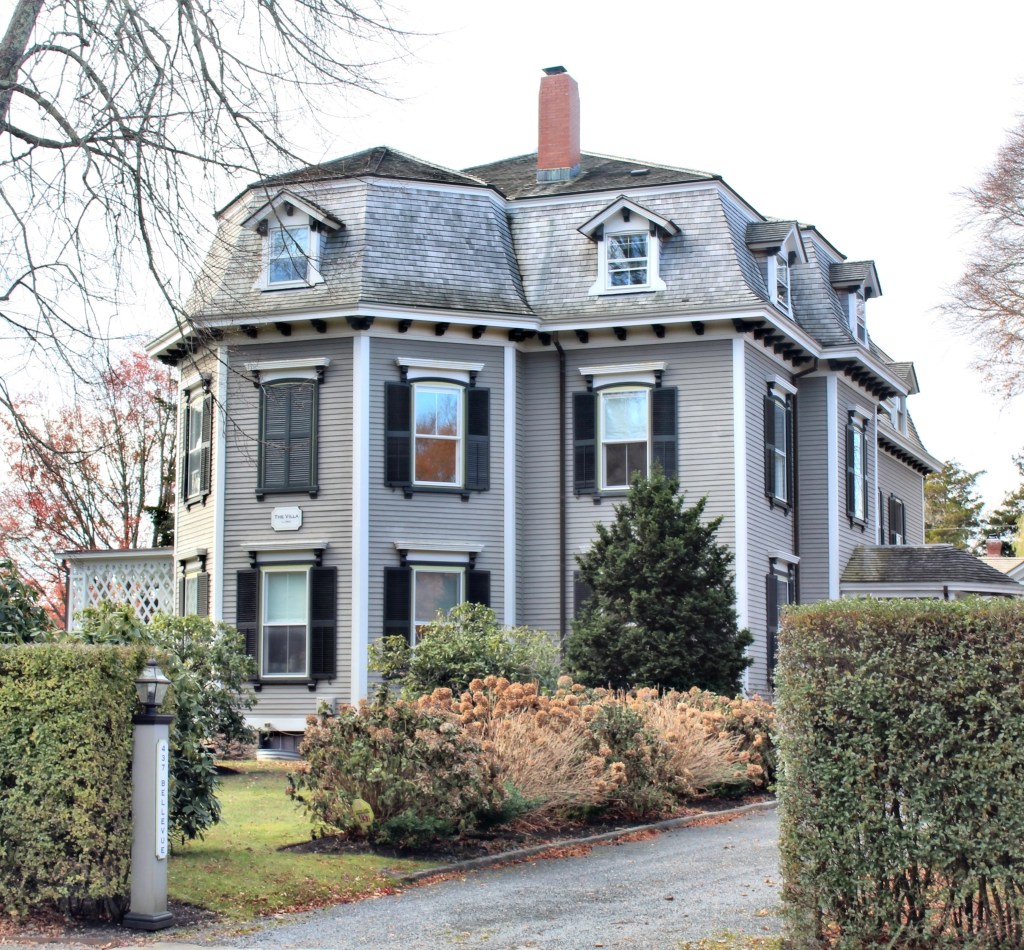
The Villa – Sigourney House // 1864

Margaret Barker Sigourney was the wife of Boston lawyer Henry Sigourney (1783–1849). In 1864, just as the Civil War was coming to a close, Sigourney purchased a piece of land on Bellevue Avenue in Newport soon after the time that Newport had been rediscovered as a tourist destination for the elite class. Sigourney wanted to make a splash as a single woman summering in Newport, so she hired local architect George Champlin Mason to design her cottage in the fashionable Second Empire style. The refined facade is more academic, while the rear and side facades exhibit porches with delicate bargeboards and trim. Sigourney spent summers at her cottage with her only son until 1873 when he and his family perished and were lost at sea aboard the Ville du Havre, when it collided in the Atlantic with another ship, killing a total of 226 aboard the ships, many of which drowned and their bodies never recovered. Alone, Margaret Sigourney continued to spend her summers in Newport until her own death in 1885.

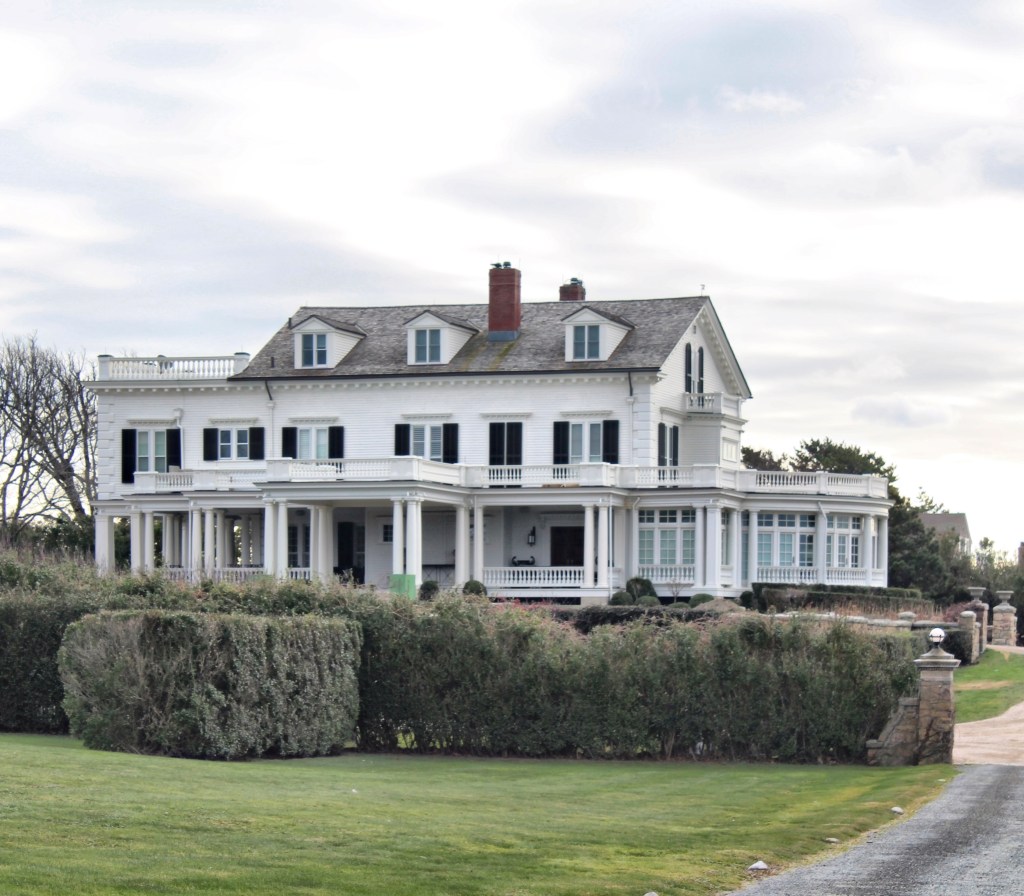
“Seaweed” Cottage // 1860

“Seaweed” is a spectacular oceanfront estate situated on Newport’s famed Cliff Walk and overlooking Bailey’s Beach. This home is three-stories with an enormous enclosed porch that offers sweeping views of the Atlantic from all windows. The house consists of 16 rooms including an inviting foyer, nine bedrooms, seven bathrooms, dining room, and living room, all with original fireplaces, flooring, and detail throughout. Views of the sea are from nearly every room. “Seaweed” was originally built and owned by Mr. Henry Howard in 1860-61. It was altered in 1867 by renowned architect George Champlin Mason. Within a decade it was sold to Mr. C. Davis who passed it on to George T. M. Davis. In the 1880’s the property became a rental property owned by Alfred Smith, a real estate agent who lived near the center of town. In the early 1900’s it was purchased by Thomas Dolan of Philadelphia who re-baptized the home “Seaweed” after having architect Horace Trumbauer bring it to its present Colonial Revival style. The name is one of my favorites! What do you think of the name Seaweed for a home?

Codman Place // 1870

In 1870, unmarried sisters of the esteemed and respected Codman Family of Boston, Catherine Elizabeth and Maria Potter, commissioned this house from the Newport Rhode Island architect George Champlin Mason. Like many who built in Bristol after the Civil War, the sisters seemed to view the location as a kind of suburb of fashionable Newport. In 1875 they were joined by their brother Henry Codman, who was given a large tower addition to dwell in, preserving the architectural significance to the Second Empire style home. Henry died in 1879, only four years after his tower was constructed, Catherine died in 1898, and Maria died in 1902 and the house was sold soon after her death. The home was converted to seven condominium units in the 1980s, yet retains its architectural grandeur from the delicate iron cresting at the roofs, down to the historic 2-over-2 windows.