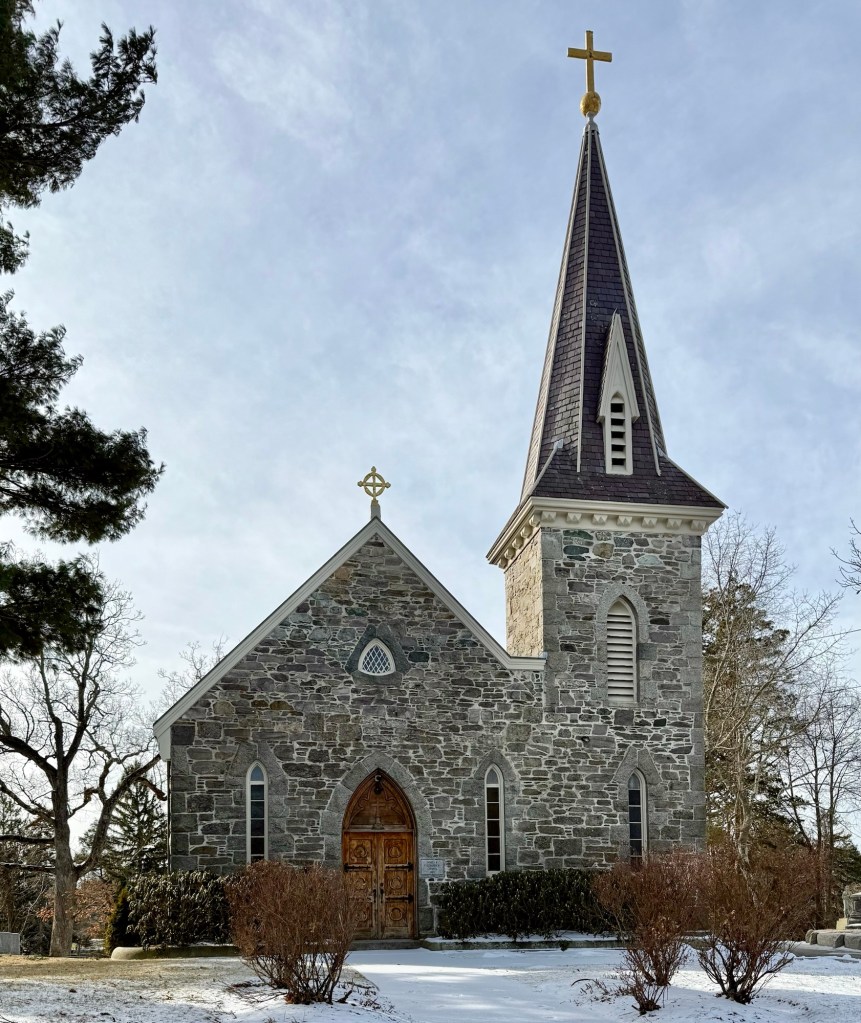
Holyhood Cemetery in Brookline, Massachusetts, was laid out in 1857 under the direction of Father Joseph M. Finotti, pastor of Assumption Parish , which included Brookline and Brighton. The cemetery reflects the mid-19th century influence of the Rural Cemetery movement and the romantic landscape cemetery planning begun at Cambridge’s Mount Auburn Cemetery in the 1830’s. A plan of the cemetery was drawn up by Shedd & Edson and published in August 1857. It shows curvilinear avenues and paths named after former bishops of Boston and Biblical figures. All were welcome to be buried except those who “died in a state of Drunkenness, Duel, or by self-destruction, unbaptized, non-Catholic, or otherwise opposed to the Catholic Church.” In the 1857 Shedd & Edson plan for Holyhood Catholic Cemetery, a chapel was located at the center on the hill shown in a small drawing on the edge of the plan. Known as St. Joseph’s Chapel, the stone building was designed by Patrick Keely, the successful and influential New York architect of many mid-19th century Catholic churches. The chapel would be dedicated in 1862. Decades later, a cemetery office was planned and built across Heath Street from the cemetery gates, but was demolished sometime in the 20th century. The cemetery grew and it along with the mid-19th century chapel, has been lovingly maintained to this day.
 Buildings of New England