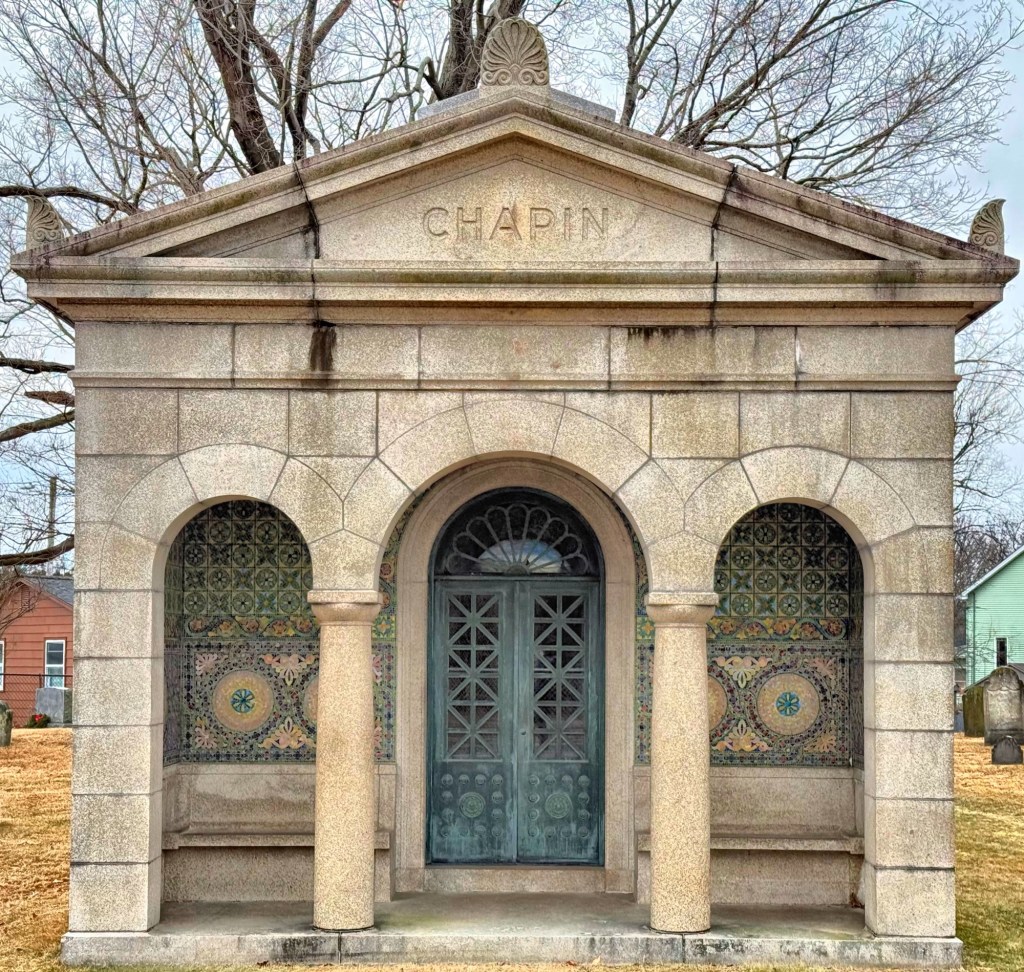
Chapin Mausoleum // 1914

The Chapin Mausoleum was built as a memorial to Chester and Dorcas Chapin by their son, Chester W. Chapin Jr. Located in the Chicopee Street Cemetery in Chicopee, Massachusetts, the otherwise ordinary burial ground is adorned by this stately mausoleum, which was designed by none other than Louis Comfort Tiffany. Chester W. Chapin, the father of the mausoleum builder, was one of the Connecticut Valley’ s most important 19th century businessmen. After more humble beginnings operating a store, Chapin operated a business for coaches and steamboats, and later, he became president and director of the Western Railroad Corporation (1854 to 1867), and president of the Boston and Albany Railroad Company (1868 to 1878). He was elected as a Democrat to the US House of Representatives and served from 1875 to March 3, 1877. His son, Chester Williams Chapin (1842-1922), followed his father’s footsteps and serves as president of the New York & New Haven Steamship Company and one of the organizers of the Central New England Railroad. Chapin Jr. hired Louis Comfort Tiffany to design and decorate this mausoleum as a memorial to his parents, in the cemetery where hundreds of family members are buried in Chicopee. The mausoleum is constructed of “Tiffany granite”, from a granite quarry in Cohasset that Tiffany Studios purchased in 1914. The entrance to the mausoleum is through a Romanesque portico complete with round arches, stocky columns, and Favrile glass mosaics on the sides. Two marble benches flank a specially designed Tiffany bronze door. Inside, it is said that there are 12 catacombs of richly veined white marble under a Favrile glass mosaic ceiling.

Yale University – Chittenden Hall // 1889

As Yale’s 1842 Old Library was outgrown by larger class sizes and a growing college library collection, overseers began planning for a new library annex which could support the programming. Architect J. Cleaveland Cady was commissioned to design the Chittenden Memorial Library, this underappreciated structure, which is today hemmed into a cramped space in the yard between a later addition (Linsly Hall) and McClennan Hall. The Chittenden Memorial Library was a gift to the college by U.S. Representative Simeon Baldwin Chittenden in memory of his only daughter, Mary Chittenden Lusk (1840-1871) nearly two decades following her untimely death. The handsome Richardsonian Romanesque style library building also retains its original stained glass window titled, “Education” by Louis Tiffany which today is in the building’s former reading room, now a large classroom. When the library moved to a new building in the 1930s, Chittenden Memorial Library became Chittenden Hall and is classroom space.

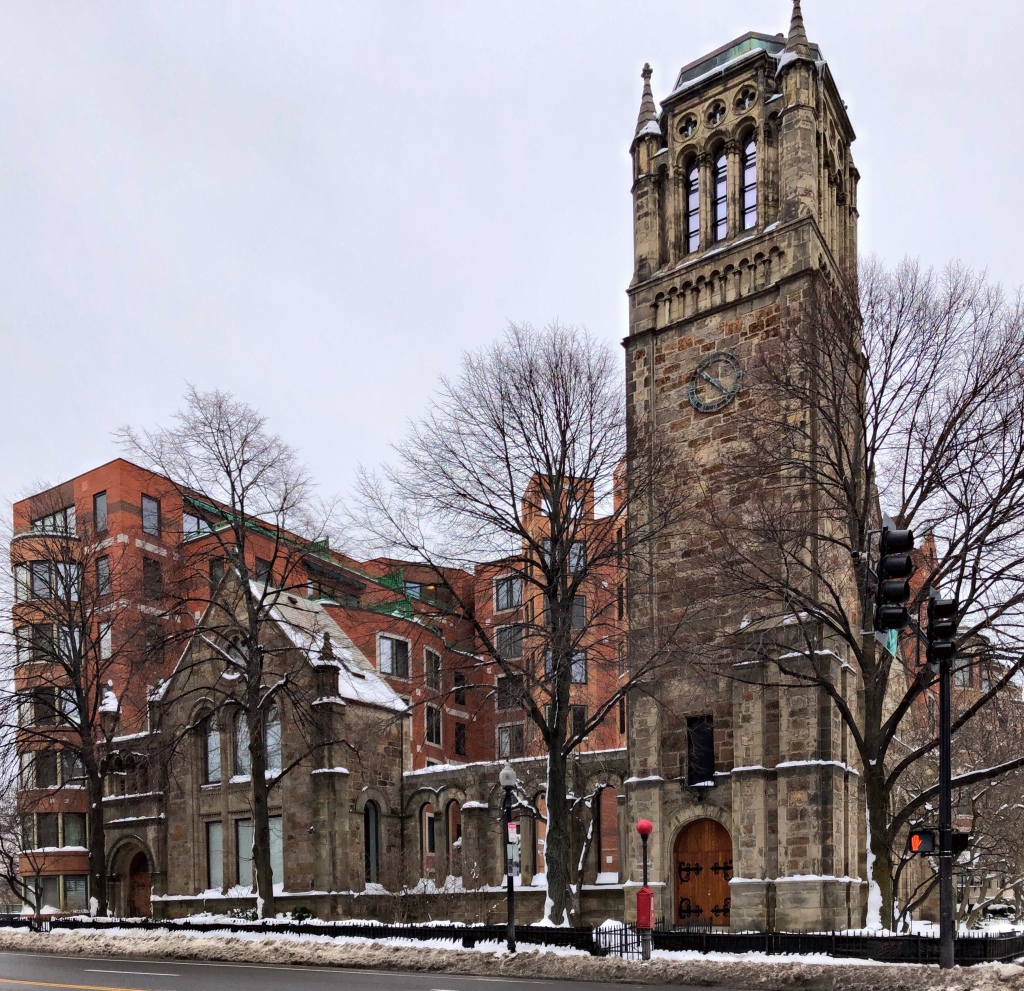
Mount Vernon Congregational Church // 1892 & 1984

The Mount Vernon Congregation Church was founded in 1842 and originally was located in Ashburton Place on Beacon Hill (which I featured previously). As its members moved to the Back Bay, the congregation decided to build a new church in the western portion of the neighborhood. They hired architect C. Howard Walker to design the new church building, with stained glass windows by John LaFarge and Louis Comfort Tiffany added as memorials to several members of the congregation over subsequent years. As originally designed, the church had a 45-foot high steeple on top of its 85-foot square tower, but over the years it became structurally unsound, and it was removed just before the Hurricane of 1938, which toppled many steeples all over the region. In 1970, the church merged with the Old South Church in the Back Bay. In 1977, developers proposed to remodel the church building into retail and office space. The proposal was approved by the Boston Redevelopment Authority in January of 1978. Before work could commence, a fire destroyed much of the church building leaving a shell of Roxbury Puddingstone walls and the tower, the developer pulled its funding and the building’s future was uncertain. One year later, architect Graham Gund purchased the building. Gund was familiar with adaptive reuse projects, like his restoration of the Middlesex County Courthouse in Cambridge for his own office in Cambridge in the 1970s. Gund redesigned the building into 43 condominium units called Church Court. What are your thoughts on the architecture?