Doris Bunte Apartment Tower // 1967

In the second half of the 20th century, parts of Boston saw disinvestment by private property owners as well as local and state government. With people leaving Boston for the suburbs, the hemorrhaging of tax revenue led urban planners to go big and institute ‘Urban Renewal‘ policies and planning to demolish what they believed to be substandard housing and invest in Modern apartments and car-oriented developments. The triangular shaped new community was as comprehensive as any urban renewal district in the region; indeed of the ten General Neighborhood Renewal Plans created by the BRA in 1961, Washington Park was the most self contained Urban Renewal District in the city. It included new police and fire stations, a courthouse, two public libraries, a shopping mall, a health center, elementary school and five garden style housing developments totaling almost 2000 apartments or townhouses. At its completion in 1975, $70.4 million had been invested to build the new community of which $31. 3 million came from the federal government. Part of this massive undertaking was the construction of elderly housing, which resulted in this 20-story cylindrical tower at the southernmost edge of the Urban Renewal area. The tower was constructed between 1967 and 1970 and was designed by Boston-based architectural firm Richmond & Goldberg, led by Isidor Richmond and Carney Goldberg. Apartments were “integrated” with with 70% Black and 30% White residents, all with private balconies and an emergency pull-chain system in kitchens and bedrooms for the elderly residents. As far as mid-century apartment towers go, this one is pretty interesting and unique. The building was renovated a few years ago and renamed the Doris Bunte Apartments. In 1969, Buntè was nominated to the Boston Housing Authority board, making her the first female public housing tenant to serve. In 1972, she was elected to the Massachusetts House of Representatives, becoming the first woman of color to serve in the Massachusetts legislature, and the first female to serve in the House leadership in 68 years. While there, Buntè helped found the Black Legislative Caucus and the Caucus of Women Legislators.

Everett City Hall // 1960

Welcome to Everett, Massachusetts, a diverse, vibrant community of roughly 50,000 residents just north of Boston. Present-day Everett was originally part of Charlestown, which separated and became Malden. In 1870, the Town of Everett separated from Malden and was so-named after former Charlestown resident Edward Everett (1794-1865) who served as U.S. Representative, Senator, the 15th Governor of Massachusetts, U.S. Secretary of State and as President of Harvard University. From 1894, the Town (later City) Hall was located in the Hapgood Building, but was outgrown after WWII. In 1960, ground was broken for a new, Modern City Hall for Everett, with Harold Michael Turiello (1910-2001) of Revere, as architect. Everett City Hall (love it or hate it) is a testament to Mid-Century Modern/International style design with curtain wall construction originally included bright blue panels which were recently replaced with a bland white panel color.

424 Massachusetts Avenue // 2002

Modern architecture can often compliment and blend into the context of historic neighborhoods, and this example in Boston’s South End neighborhood is one of the best examples locally. In 2002, developers eyed a long-vacant lot on the busy Mass. Ave corridor through the South End and began designs of a contextual addition to the streetscape. Dolezal Architecture was tasked with designing a modern residential building that would comply with local historic district regulations, a balance that can be difficult to accomplish. Employing traditional masonry, solid-to-void ratios, massing, and bays, but in a modern context, the building blends in with its surroundings yet is architecturally interesting. The building contains ten condos in a single building which reads more like two distinct structures.

Christensen Hall – University of New Hampshire // 1970

Christensen Hall at the University of New Hampshire in Durham is a rare example of the much-maligned Brutalist style of architecture in the state. In the late 1960s, the university needed more housing and a dining hall for new students of the growing campus, but a very low budget to accomplish this. They hired Ulrich Franzen, a German-born architect (featured on here previously) who attended school at Harvard, learning Modernist principles there that would shape his career. The boxy buildings feature deep recessions to provide each student an identifiable corner and windows. The concrete frame building and engineering provide breezeways and forms that conventional buildings would not be able to accomplish. The building was completed in 1970 and was immediately applauded by architects and was featured numerous architectural publications.

Stoke Hall – University of New Hampshire // 1965

One of the most recognizable buildings (largely due to height) on the University of New Hampshire campus in Durham is Stoke Hall, a large dormitory on the outskirts of campus. The building was designed by Leo Provost, a New Hampshire-based architect, who actually graduated from UNH in 1936. Stoke Hall is named for Dr. Harold Walter Stoke, President of the University of New Hampshire from 1944-1947 during an enrollment surge that more than tripled enrollment and the beginning of a massive building program that continued for decades. The surge began with the conclusion of WWII, and the increase in young men going to college thanks to the GI Bill. Mr. Stoke got around as a President, as after three years at New Hampshire, he became President of Louisiana State University (LSU) until 1951. He later served as President at Queens College, New York, for six years. The Y-shaped building was constructed in two phases, the two wings facing the street were built in 1965, with the rear wing added the summer later. The design blends mid-20th century styles from New Formalism to Mid-Century Modern in a graceful way, especially for a college dormitory, though, I cannot speak for the interiors.

Castle House // 1964

Perched atop the rocky coast of New London, CT, and seemingly at the base of the iconic New London Harbor Light, the “Castle House” stands as one of the most significant examples of 1960s residential design in a state known for such homes. The Castle House was completed in 1964 from plans by German-born American architect Ulrich Franzen (1921-2012), who attended Harvard’s Graduate School of Design after his service in WWII. After graduating, Franzen worked under I.M. Pei, until he formed his own firm, Ulrich Franzen & Associates, in 1955. The home’s signature element is its dramatic free-floating glass living room pavilion with cantilevered paraboloid vaults and flanking service wings, with a jaw-dropping cypress butterfly ceiling. Additionally, the oval pool sits over the harbor water and provides the best possible views of the 1801 lighthouse towering above. The house was recently updated by SchappacherWhite, a design firm who are known for their thoughtful Mid-Century Modern house preservation projects.

George Kaplan House // 1946

The George Kaplan House, erected in 1946, is an excellent and exceptionally well preserved example of the International Style in the Boston area. The home is located on a suburban road in Oak Hill, Newton, and displays characteristics such as strong geometric forms, a flat roof, banded windows interspersed with expanses of blank walls and absence of ornament. The Kaplan House was designed by Walter Gropius‘ firm ‘The Architect’s Collaborative’ (TAC) of Cambridge, which was founded just one year prior, and this home was their first completed project. The home was built for George and Ethel Kaplan, a young couple who moved here from Brookline. Kaplan worked in design himself and manufactured shoe fabrics.

Baldpate Road House // 1959

Occupying the highest elevation (315 feet) in Newton, Massachusetts Baldpate Hill and its residential development encompasses perhaps the largest concentration of architect-designed custom homes from the 1940-1960 period
in the city. Newton realtor Arnold Hartmann purchased large land holdings in the minimally developed Oak Hill village, developed some land into the Newton Country Club and other areas for suburban neighborhoods. He laid out building lots on Baldpate Hill from 1926 to the late 1950s, and many of the homes were built after WWII. One of the later homes built is this house, built in 1959 from plans by the architectural firm of Hoover & Hill of Cambridge. The home features a low-slung roof with the home in a Ranch form, yet extends to two stories as the hill drops off at the rear of the home. A small garden is located in the front yard, and terraced yard is located at the rear.
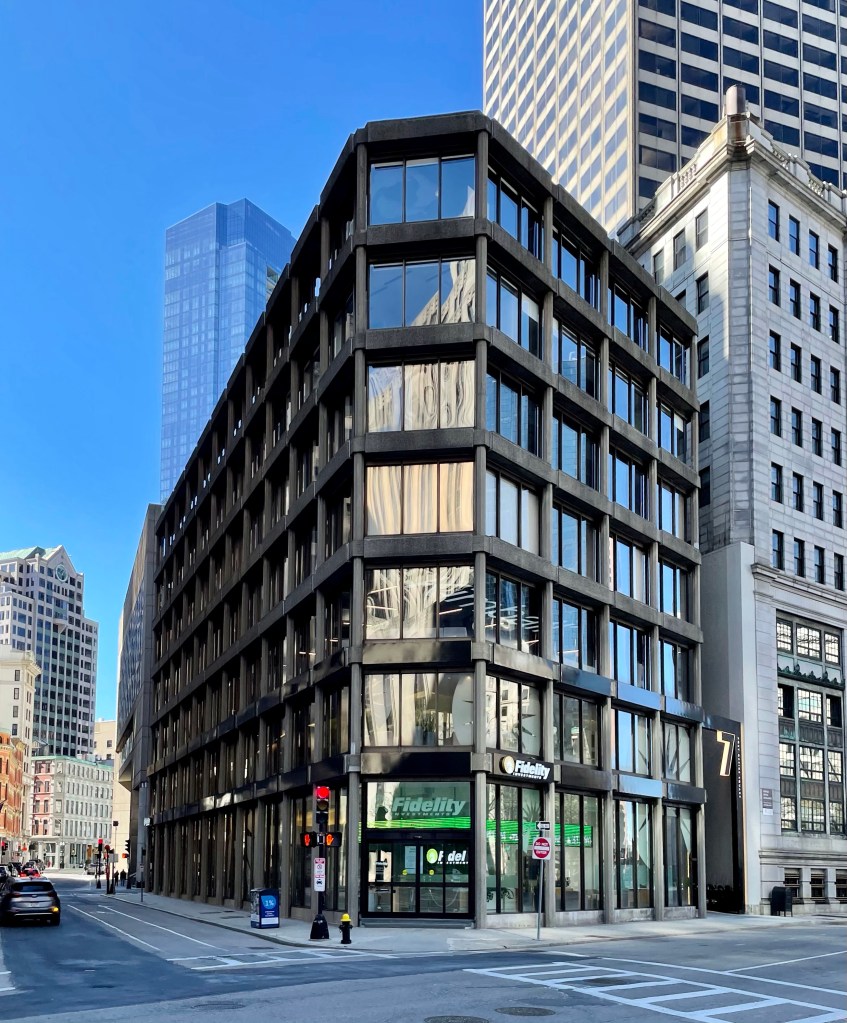
Massachusetts General Life Building // 1965

One of the lesser-known and written about examples of Brutalism in Boston is this refined, elegant take on the style, found in Downtown Boston. While many of you may dislike or even despise Brutalism, this building is a lighter version of the strong mass that we all know. The Massachusetts General Life Building was designed by Boston architect Frederick A. Stahl, who was trained in architecture locally at Harvard’s Graduate School of Design and MIT. Frederick Stahl was a perfect architect for Boston, he often worked on preservation projects including the rehabilitation of the Old South Meeting House, but showcased how 1960s architecture could compliment historic forms in a big way. For this building, he re-envisioned the historic granite commercial blocks found scattered around Boston, but showcased the ability of concrete to do more for much less massing. One of the key features of the design is that the two entrances are somewhat hidden, and are recessed in 14′ wide slots where the building is connected to the adjacent historic building. This was the aim to make this structure recess and not try and command the prominent corner. In the Mass. General Life Building, tenants also included the Loeb, Rhoades & Company, a brokerage firm based out of New York, that had offices in buildings in major financial centers all over the country. They later merged with Hornblower & Weeks, a Boston based firm, who had their own building in Boston.

Church of All Nations // 1975

One building in Boston that has always perplexed me is this round church building. It echoes Eero Saarinen’s MIT Chapel in Cambridge, but is much heavier and plain. After over an hour of researching, I finally found out some history behind it! The church was constructed in the South Cove Redevelopment area, an urban renewal program run by the Boston Redevelopment Authority (now BPDA) as a sort of “slum” clearance near Chinatown. The Church of All Nations was founded in the South End in 1917, housed in a Gothic Revival chapel that was seized by eminent domain for the Massachusetts Turnpike Extension and demolished in 1963. The congregation met in temporary quarters on Arlington Street until the new church was constructed in 1975. Records show that the congregation hired famed Modernist architect Bertram Goldberg as early as 1967 to design a new chapel, set in a new public park. The original plans called for a square building with a massive “steeple” incorporated as the entire roof. For some reason (possibly funding and changing demands for the church), the final design was a little more mundane. The cylindrical church is clad in dark glazed brick with a cross raised in the brickwork. The church suffered from a dwindling congregation in its location, and now appear to rent out the building. One of my favorite local architecture firms Touloukian Touloukian, Inc., re-imagined the site as a new residential tower. It would be one of the few beautiful new buildings in Boston in the past decade or two. Can we please make this happen?!