Nott Memorial Hall // 1858

The 16-sided Nott Memorial Hall is one of America’s most dramatic High Victorian buildings, is the centerpiece of the Union College campus (and a major reason for my stop in Schenectady when driving through New York). Union was the first non-denominational institution of higher education in the United States, and the second college established in the State of New York. Eliphalet Nott became college president in 1804, and envisioned an expanding campus to accommodate a growing school. In 1806 a large tract of land was acquired to the east of the Downtown Schenectady, on a gentle slope up from the Mohawk River. In 1812 French architect Joseph-Jacques Ramée, equally skilled in landscapes and structures, was then hired to draw up a comprehensive plan for the new campus. Ramée worked on drawings for about a year, and construction of two of the college buildings proceeded quickly enough to permit occupation in 1814. The Union College campus thus became the first comprehensively planned college campus in the United States! As part of Remee’s plan for the campus, a round, Neo-Classic “pantheon” building was proposed at the center of campus (a prescendent for Thomas Jefferson’s plans for the University of Virginia just four years later). The building never materialized in Unions early days. Construction finally began on the building in 1858, based on designs by Edward Tuckerman Potter, grandson of President Nott, but apparently took nearly 20 years to complete due to the Civil War and funding issues. The Nott Memorial as completed, is 89 feet in diameter and capped with a ribbed dome. The dome is sprinkled with 709 small colored glass windows, making it one of the finest buildings on a college campus in the United States!
St. John the Evangelist Church // 1900

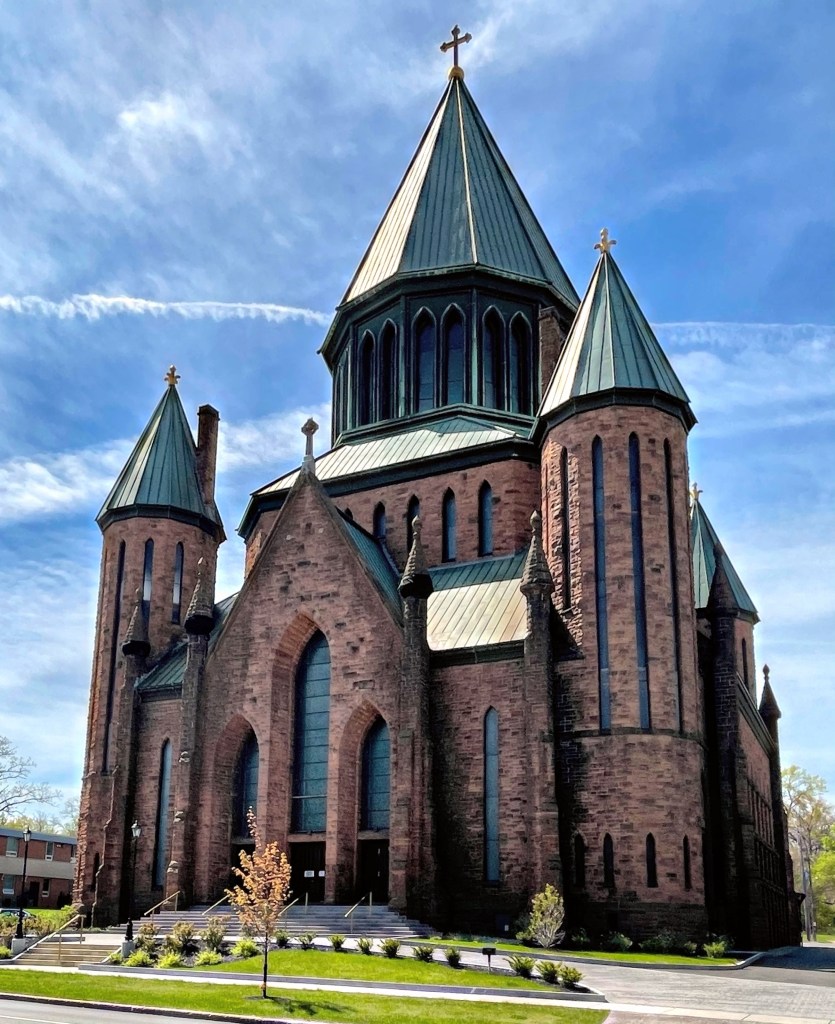
St. John the Evangelist Church in Schenectady, NY is probably the most imposing church I have ever seen (outside of European cathedrals). The church began in 1898 when Monsignor John L. Reilly purchased land across from Union College’s campus to erect a new church. He began collecting donations to fund a church suitable for Schenectady, and visited Europe to seek inspiration for the design. He worked with architect Edward Loth of nearby Troy, NY on the design which resulted in this massive 120’x130′ structure. The stone church has a small tower at each of its four corners with a central spire reaching 230′ high. The center spire was constructed of steel and glass to cast light onto the sanctuary below (sadly has been replaced with a metal roof). This is definitely one of the more memorable churches I have ever seen! What do you think of it?

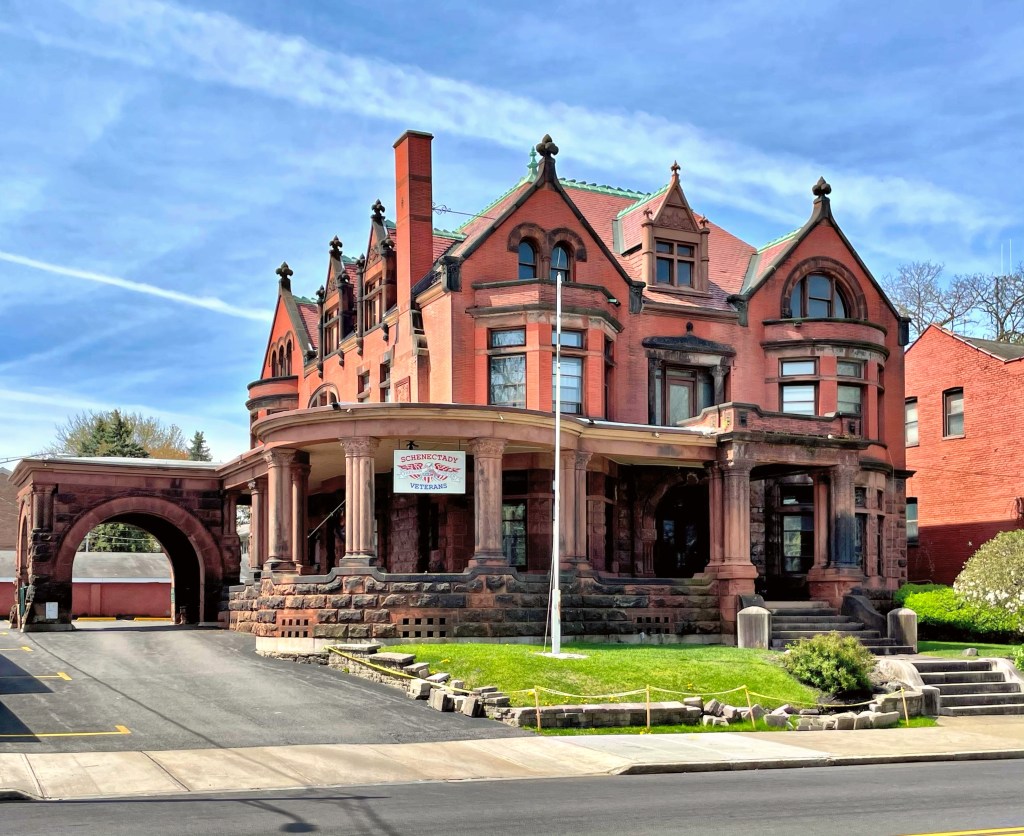
Henry S. DeForest Mansion // c.1890

Henry Schermerhorn DeForest (1847-1917) was born in Schenectady, New York and became a leading citizen of the bustling upstate city. He attended school in his hometown before leaving to study at Eastman Business College in Poughkeepsie. He returned to Schenectady and married Lucie Van Epps, soon after gaining employment by her brother at his broom manufacturing company as a clerk and bookkeeper. He began using his earnings to buy and develop property in the city, eventually making him the city’s largest landlord. He was also a building contractor, with his company constructing more than 1,000 homes in the Schenectady area. He served as Mayor, in a role that he successfully advocated for General Electric to locate in Schenectady when it was formed from the mergers of several other companies, including Edison Machine Works, which had moved to Schenectady in 1886, creating a huge boom in development and growth for the city. After this, he has this large stone mansion constructed to showcase his wealth and success as a developer and Mayor. After his death in 1917, the home remained in the family for some time until it was acquired by the Schenectady Veterans Association not long after WWII, who maintain the building to this day.

Mary King House // 1901

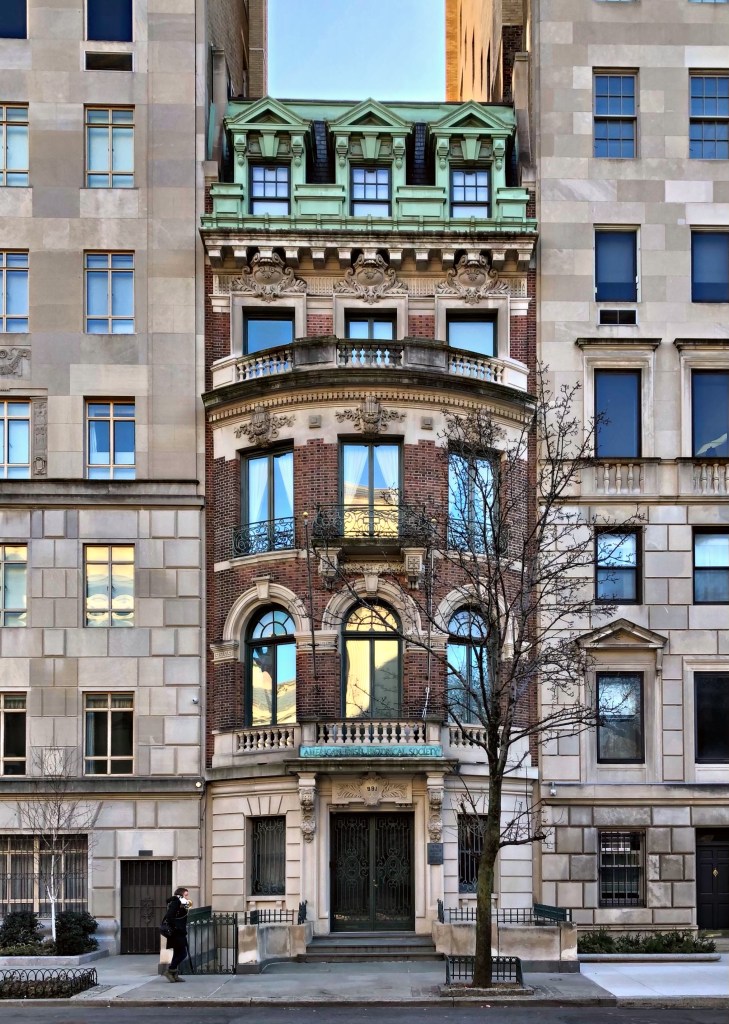
A lasting remnant of the grand homes which once dominated 5th Avenue in Manhattan in the Upper East Side, the Mary King House remains an architecturally and historically significant townhome in New York. Mary Augusta King was the granddaughter of late New York Governor John A. King, and widow of Edward King who had died in September 1875 leaving an estate of around $5 million–in the neighborhood of $113 million today. At the tail end of the Gilded Age of old New York, developers hired architectural firm Turner and Killian to design a new home across from the Met Museum at Central Park, away from the large hotels and towers being built in Midtown. Just before the home was completed, it was purchased by Ms. King for her new residence. She resided there a couple years before her death in 1905. The home was sold a couple more times and was eventually acquired by the American Irish Historical Society in 1939. The AIHS was founded in 1897 to ‘inform the world of the achievements of the Irish in America’, and is today a national center of scholarship and culture holding events and allowing researchers.

NYC Police Headquarters Building // 1909

Grand architecture in New York is not just limited to commercial buildings, churches and offices, even civic buildings here can go toe-to-toe architecturally with any in the world! On the border of the SoHo neighborhood, the former New York City Police Headquarters showcases the unity of the five boroughs into the City of New York in 1898, a city in need of a large and centrally located Police HQ. The firm of Hoppin & Koen was hired to design a large structure, fitting to represent the largest police force in the country and the five boroughs it represents. The grand Beaux-Arts building makes a statement with its perfect proportions, expanses of rusticated limestone and granite, and the massive central dome at the roof. The New York City Police Department relocated in 1973 to the larger One Police Plaza building, and the former headquarters was vacant for a decade until the early 1980s when the property was purchased by developers and converted to condominiums.

Socony-Mobil Building // 1956

One of the unsung heroes of Modernist architecture in New York City is one of my personal favorites, the Socony-Mobil Building at 150 E 42nd Street in Manhattan. Completed in 1956 from plans by Wallace Harrison of the iconic firm of Harrison & Abramowitz, the development stands out amongst the competing masonry buildings and glass skyscrapers in the area. At the time of its completion, the Socony–Mobil Building was the first skyscraper to have its exterior wall entirely clad with stainless steel, as well as being the largest air-conditioned building in the world! The base is clad with opaque blue glass panels framed with stainless steel moldings; above, the tower and wings are clad in over 7,000 embossed stainless steel panels. The firm reviewed over 100 different designs until they settled upon the four raised relief panels: a rosette-like motif for above and below the windows; a large and small rosette to flank the windows, and two variants displaying a design of interlocking pyramids. The panels were likely designed by or inspired by Oskar Nitzchke (1900-91), a German-born designer who worked at the firm and worked on the similar style Alcoa Building (1953) in Pittsburgh. The building was developed as a speculative project, but the largest tenant, the Socony-Mobil Oil Company, later renamed Mobil, helped to give way to the naming rights. The building was landmarked by the City of New York in 2003.

Macy’s Department Store – Herald Square // 1902

Thanksgiving in the days of Covid-19 will be different in more ways than one. A notable loss will be the absence of the annual Macy’s Thanksgiving Day Parade in New York, which has been a national pastime broadcast on televisions for millions of Americans every year. The six-mile route through the city, giant balloons and all, would end at Macy’s Herald Square, the flagship store of the department store chain. The building (one of the largest stores in the world) was completed in 1902 and its 2.5 million square feet of space, occupy an entire city block. The building was designed by Interestingly, in 1900, a small five-story building on the corner of 35th and Seventh was purchased by Robert H. Smith in 1900 for $375,000 ($11.5 million today). The idea had been to obstruct Macy’s from becoming the largest store in the world. It is largely supposed that Smith, was acting on behalf of Siegel-Cooper, which had built what they thought was the world’s largest store nearby in 1896. Macy’s ignored the tactic and built around the building, which now carries Macy’s “shopping bag” sign by lease arrangement! Oh, and Macy’s even hired the same architect for their department store that Siegel-Cooper used for their building, Theodore de Lemos, adding insult to injury. A great example of a spite building!

1908 image of Macy’s Herald Square courtesy of LOC.

New York Appellate Courthouse // 1899

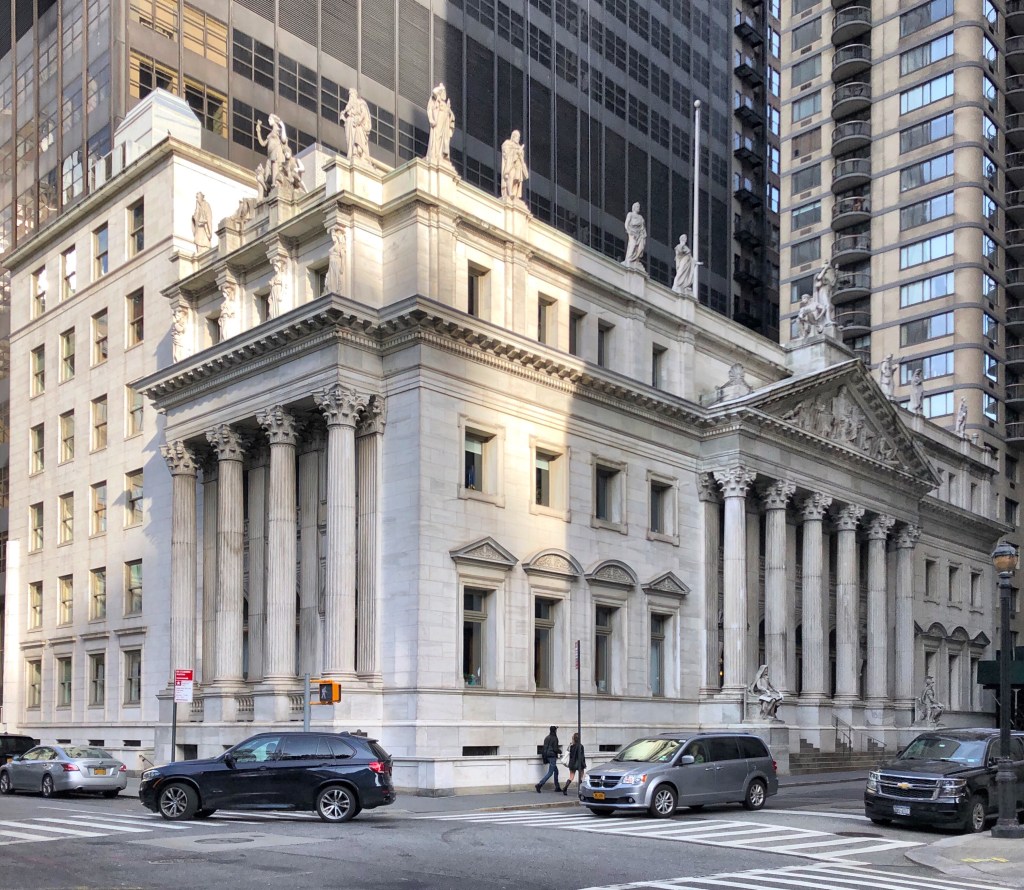
Distinguished for its classic beauty, this small marble courthouse expresses the best of Classical tradition, in its columned portico and fine sculptures adorning it. Located at the edge of Madison Square Park, the building was constructed between 1896 and 1899 to serve as a courthouse for the Appellate Division of the New York State Supreme Court. The marble Classically inspired Beaux-Arts courthouse, was designed by James Brown Lord and is considered to be an excellent example of the City Beautiful movement, which sought to introduce monuments and beautification to American cities. Of the nearly $650,000 spent on the building, 25 percent was spent on sculpture, a huge sum at the time. Sixteen sculptors – sponsored by the National Sculpture Society and among of the most esteemed of the day – worked on the thirty 12-foot marble statues on the facade, the most ever to work on a single building in the United States. Sculptures by Daniel Chester French, Charles Henry Niehaus, Karl Bitter, and more adorn the balustrade and entrance steps. Additionally, four caryatids sculpted by Thomas Shields Clarke on the Madison Avenue front, showcase a rare feature not typically seen in American architecture, representing the four seasons.

In 1953 a $1.2 million restoration of the facade was undertaken by the Department of Public Works during which the huge marble statues were removed and cleaned. It was at this time that the general public first realized one of the lawgivers was Mohammed. Representatives from Pakistan, Egypt and Indonesia petitioned the State Department to destroy the statue rather than restore it, citing Islamic canon that forbids the depiction of human beings in painting or sculpture. When the statues were replaced in 1955, each was moved over one spot to fill in the void where Mohammed had stood. Today one empty pedestal remains.

Firemen’s Hall // 1854

In the early 19th century, firefighting in New York was done by an assortment of volunteer groups with no centralized director. This hall was built as a headquarters for two of these groups—a move toward cooperation amongst competitors. Each company split the ground floor, divided into three rooms. The front room for the apparatus, the centre room for their meetings and the room in the rear for sitting and reading. The upper stories held meeting rooms and a library. The building was occupied as a fire headquarters until it relocated in 1887. The City of New York closed the station in the 1970s and it was rented as a mosque and theater company, losing much of its architectural detailing over the years. The Italianate style building, faced with Connecticut brownstone was restored close to the original design based on historic photos and converted to retail use, now housing Dolce & Gabbana.

10 Sullivan // 2016

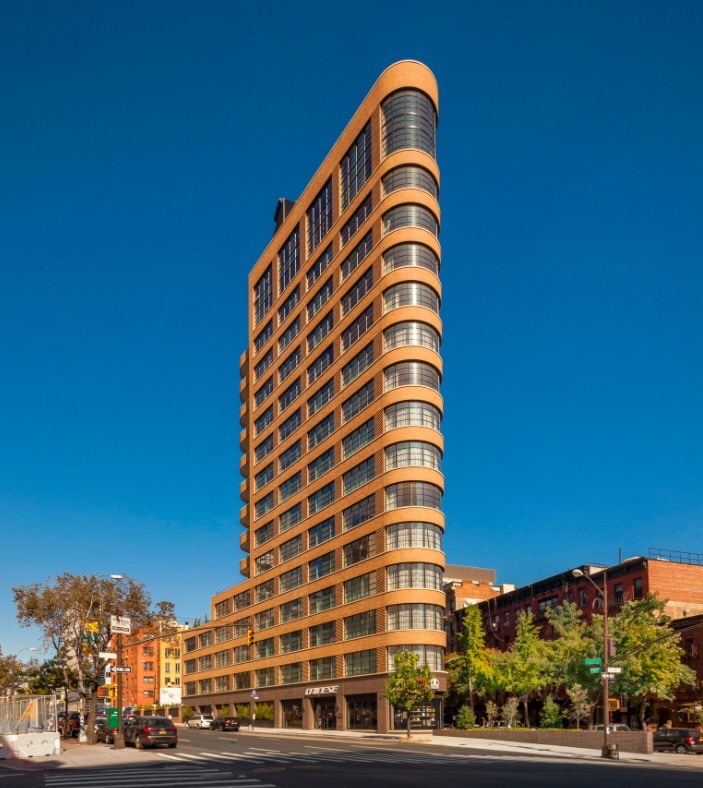
The Flatiron Building in New York is an excellent example of how New Yorkers maximize any piece of land, no matter how small or what shape, to generate an amazing architectural statement. This skinny lot was previously home to a one-story car wash, serving as an unacceptable entry into the SoHo neighborhood. The tight wedge-shaped lot was envisioned for a higher use and Tamarkin Co. Architects developed one of my favorite recent projects in the city, 10 Sullivan. The innovative design gives me serious Art Moderne vibes with the curving forms and strong horizontal lines. The use of brick creates a feeling of warmth and blends the modern building in with the surrounding historic structures nearby.