Mr. Berwind drew the short straw and occupied the smaller of the two bedrooms in the Elms mansion as his wife Sarah Torrey Berwind, got the larger corner room. I was shocked to see just how small the bedroom was for one of the richest men in the country, even if it was just a summer residence that they occupied for a couple months of the year! Mr. Berwind did have a small bedroom, but he spared no expense to furnish it well. The fireplace in his bedroom is of ox-blood marble with gilt bronze mounts. The walls are covered in red silk and the carpet is a late 19th-century Khorassan. His private attached bathroom contains a sink of translucent white onyx.
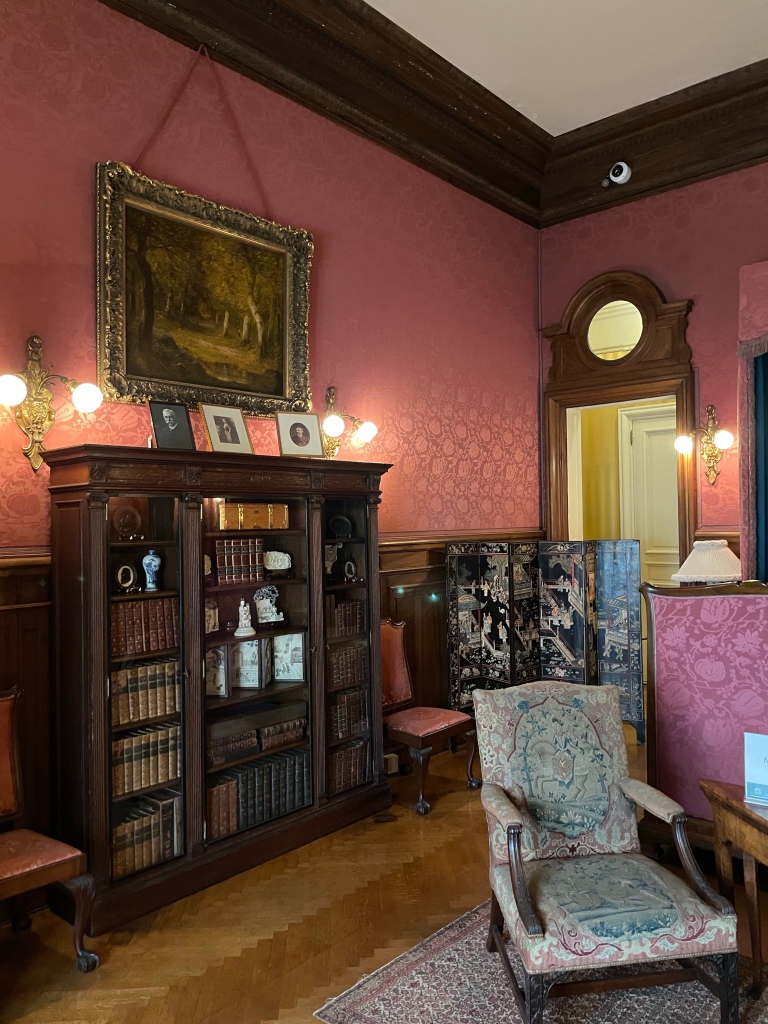
The formal Sitting Room at the Elms in Newport, Rhode Island is one of the many statement-rooms found in the Gilded Age mansion. This room is located directly above the Ballroom and is the first space seen when ascending the main staircase onto the second floor. The sitting room was used by the Berwind Family and their guests as a gathering and socializing space, a little less formal than the ballroom downstairs for more elegant events. The Preservation Society of Newport County has done an amazing job at restoring the building and purchasing furniture and fixtures that were sold off when much of the inside of the property was sold off at auction in the 1960s. The Preservation Society restored the red silk walls fabric in the 1980s, bringing the space back to its original grandeur. I cannot think of a better place to just “sit”.
The Dining Room of the Elms Mansion in Newport, Rhode Island, is represents the Gilded Age in all the best ways. The room sits just off the ballroom and like all of the other rooms in the summer residence of the Berwinds, it was designed by famed interior designer Jules Allard. The dining room was specifically to display a collection of early18th-century Venetian paintings purchased by Mr. Berwind from the Ca’ Corner estate in Venice (the Berwinds were avid collectors of 18th century French and Venetian paintings). The iconic coffered ceiling is not of wood, but of molded plaster, grained and painted to imitate oak. Each coffer is decorated with the winged lion of Saint Mark, the patron saint of Venice. Pour custom-made crystal chandeliers hang in the four corners of the room. At the end of the room is a stunning green marble, agate and onyx fireplace that is framed by a ceiling-high pediment supported by carved Ionic columns. Could you see yourself entertaining in this dining room?
To celebrate, I wanted to feature the library aka the “red room” in the Elms Mansion in Newport, Rhode Island. The library is lined with high wainscoting and walls of inlaid walnut hung with red damask/fabric. The center table, fireplace mantel, and inlaid bookcases were all designed by Jules Allard, and the table in particular displays the exaggerated proportions and classical ornament typical of 16th-century French design. The mantel piece consists of white carved stone with the upper part of richly carved walnut. The room is one of the coziest in the Elms, one of the more refined and “homey” of the Newport Mansions open for tours. From this library, owner Edward Julius Berwind, would keep up with his growing businesses while away for summers in Newport.
The Louis XV style Ballroom of the Elms Mansion in Newport sits just off the Stair and Gallery halls at the core of the building. This room was the scene of lavish parties, including the 1901 housewarming party hosted by the Berwinds to announce the formal opening of The Elms to Newport’s summer society. The large, 50’x45′ ballroom was designed by French designer Jules Allard crafted the Louis XV style paneling with plaster shell and floral ornament. The white relief decorations on the doors, paneling, and cornice are continued in an elaborate ceiling frieze and center medallion of winged cherubs. As a stark contrast from other Gilded Age mansions in Newport, the ballroom has very minimal gold gilding, besides the mirror frames on the wall. The muted cream and white colored walls with ornament show the sophistication and grandeur of the design, not gold.
Immediately upon entering the main entrance of The Elms, one of the finest Gilded Age mansions in Newport, you are enveloped in the Stair Hall or foyer. The space is stunning, with walls lined in limestone and purple Breccia marble pilasters and columns with bronze capitals and bases. The floors are of white marble bordered in green with stairs in white Italian marble. At the beginning of the stairs, there are two large urns of green marble and pink granite, each with four bronze female figures. The urns bear the name of the decorator, Allard et Fils of Paris, who was responsible for crafting the details of the period rooms for the mansion. At the top of the first set of stairs is the Gallery Hall, a long hall connecting many rooms on the first floor and also serving as a gallery of irreplaceable art including two early 18th-century oil paintings depicting episodes in the history Scipio Africanus, the ancient Roman general who conquered Carthage by Venetian artists Paolo Pagani and Giovanni Antonio Pellegrini. The space is grand, yet cozy and feels more like a home than the larger Breakers mansion.
One of my favorite things to do each holiday season is to explore Newport and the mansions all gussied up with lights, ornaments and holiday cheer. This year, I visited The Elms, one of my absolute favorite buildings in Newport, which is a house museum! Stay tuned for some room features, similar to my series last year on The Breakers mansion.
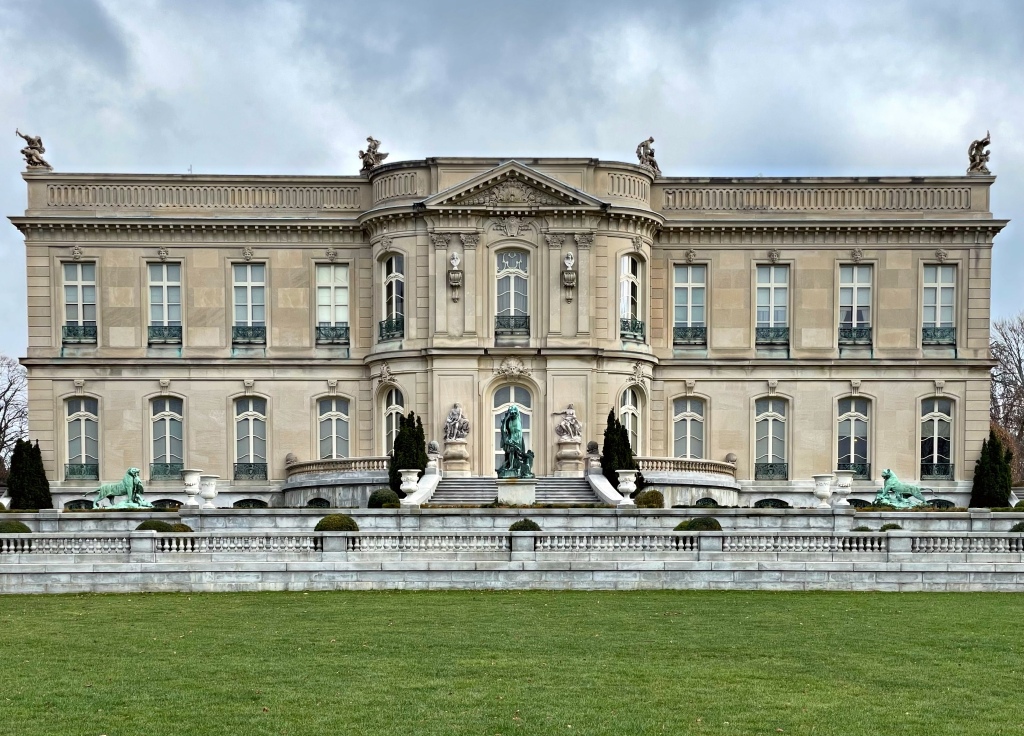
The Elms was commissioned in 1898 by coal baron Edward Julius Berwind (1848–1936) and his wife Sarah Torrey Berwind (1856-1922) as a summer cottage where the couple could escape the woes of city life for a few weeks of every year. Edward was “new money” (his parents were middle-class German immigrants); and by the 1890s, he was hailed as “one of the 58 men who rule America”, making him one of Newport’s most important summer residents. To live up to his new status, he hired Philadelphia architect Horace Trumbauer, who took inspiration from the 18th century Château d’Asnières in France. The site on the iconic Bellevue Avenue is not directly on the water, so Trumbauer sought to enhance the siting of the mansion by elaborate landscaping (more on that later). The house was built to be fireproof, after the complete loss of the original Breakers mansion in 1892 and is clad with Indiana limestone. The couple held many lavish parties in the Elms until 1922, when Mrs. Berwind died. Mr. Berwind invited his youngest sister, Julia, to become his hostess at his New York and Newport houses. Mr. Berwind died in 1936 and Julia continued to summer at The Elms until her death in 1961. Childless, Julia Berwind willed the estate to a nephew, who did not want it and fruitlessly tried to pass The Elms to someone else in the family. Finally the family auctioned off the contents of the estate and sold the property to a developer who wanted to tear it down. In 1962, just weeks before its date with the wrecking ball, The Elms was purchased by the Preservation Society of Newport County for $116,000. It remains one of the most visited house museums in the nation to this day.
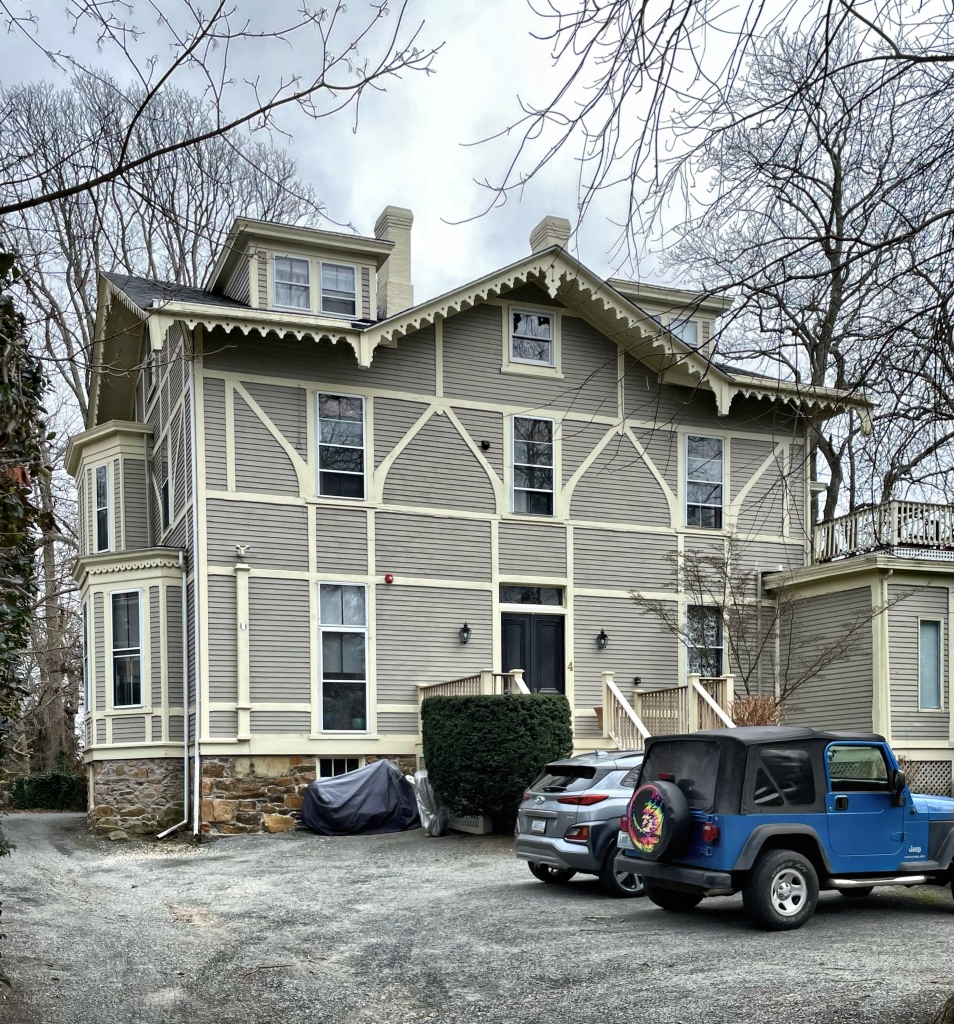
Sunnycroft in Newport was built in 1873 as the summer cottage for Philadelphia socialite couple Elizabeth K. Ashhurst Willing and her husband Richard Willing on land given to them by Elizabeth’s father William. The house is a blending of Gothic and Stick styles, with half-timbering and bracing across wall surfaces and bargeboard at the eaves. By the turn of the 20th century, the house was owned by Henry Casimir DeRham and his second wife, Georgiana. DeRham was the grandson of a wealthy New York banker of the same name. This house (while still ornate) is a more modest example of the summer cottages in Newport and shows the wide-range of tastes seen in the Gilded Age.
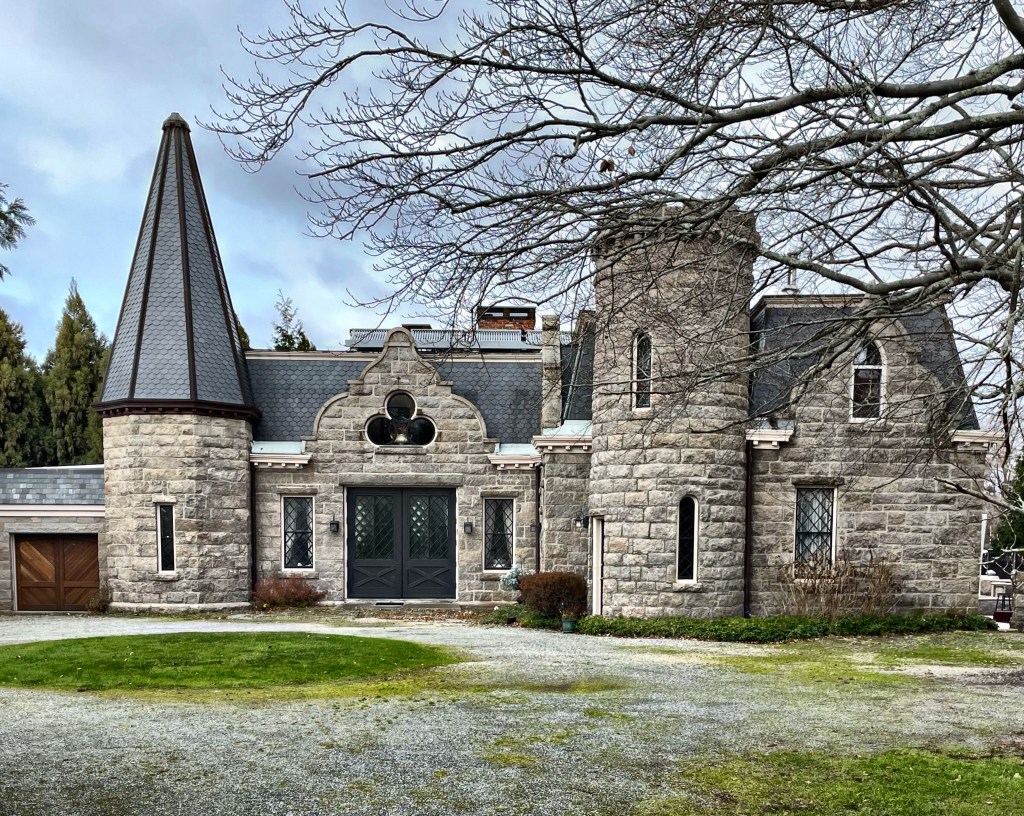
Just past the Belair Gate Lodge (1870), you w5ll find one of the most eclectic and interesting buildings in Newport, Rhode Island. This structure was built around 1875 as the stable to the larger Belair estate, just a stone’s throw away. When it was built, local papers stated the building was “probably one of the most expensive stables in the city.” It was designed by Newport architect Dudley Newton at the same time he redesigned the main mansion and furnished plans for the new gate lodge for owner George H. Norman. Architecturally, there is A LOT going on here. The 1½-story, rough-face-granite-ashlar building is capped by a hexagonal-tile slate mansard roof. On the left is an octagonal tower with an out-of-scale roof pitch and at the other side of the carriage door is a circular-plan tower with battlemented parapet. At the center is a really unique trefoil gable with trefoil window centered within. So cool to stumble upon this!! Oh, and it’s now a single-family home. Swoon.
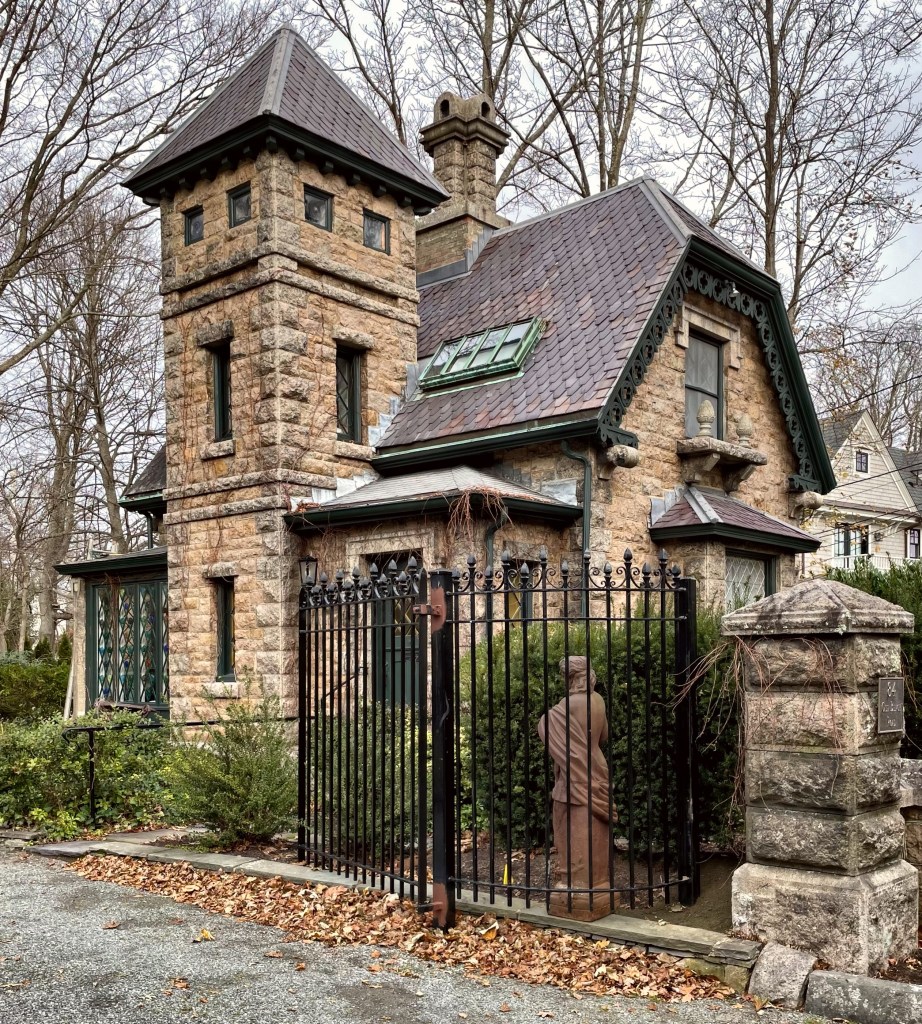
Located at the historic entry to Belair (last post), one of the largest estates in Newport, you would be greeted by this charming stone building, the Belair Gate Lodge. The building is symmetrically massed, 1½-story and built of rough-face-granite-ashlar, similar to the main house. This building can be classified as French Eclectic in style and was designed by Newport architect Dudley Newton, who also designed the 1870 Second Empire renovations to the main house at the same time for owner George Henry Norman. When the Belair estate was subdivided, the gate lodge was sold off as a separate unit, and is now a single family home, aka my dream home. There is something so enchanting about gatehouses!



 Buildings of New England