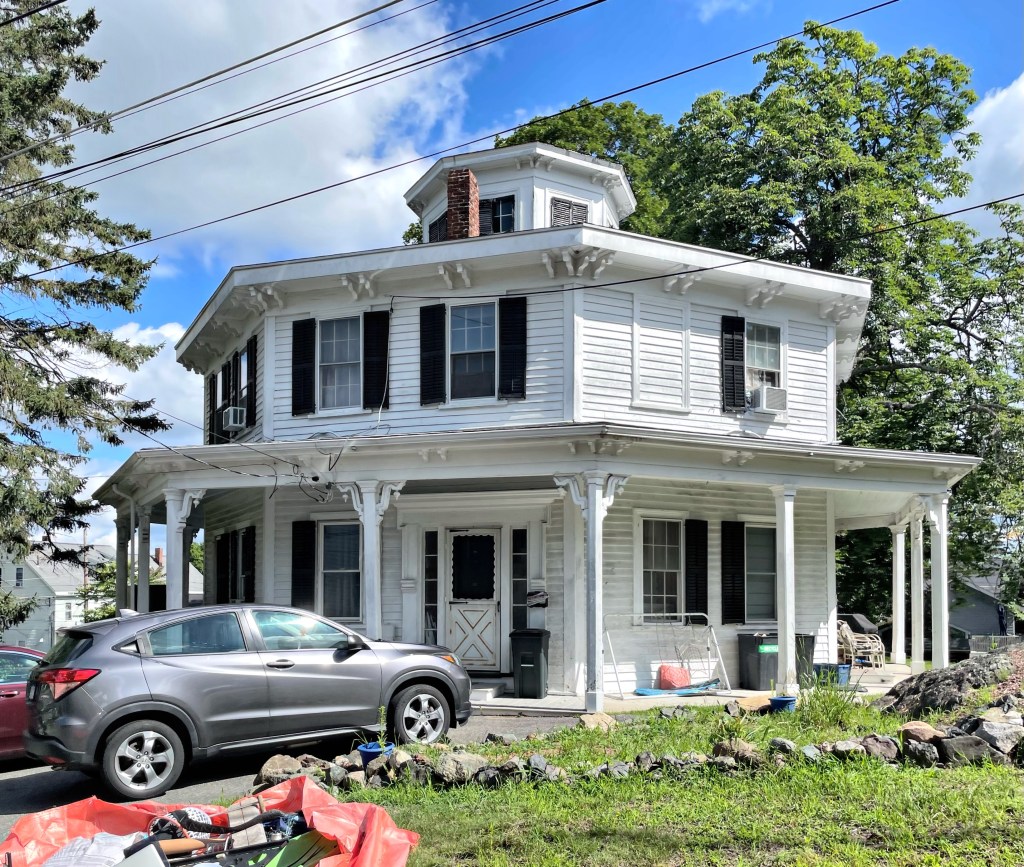
Enoch Fuller Octagon // c.1850

Oh the Octagon! The very rare Octagon house was a unique house style briefly popular in the 1850s in the United States and Canada. The style can generally be traced to the influence of one man, amateur architect and phrenologist Orson Squire Fowler. In his book, The Octagon House: A Home for All of 1848 (and reprinted with more photos in 1853), Fowler advocated for the shape’s benefits for buildings in that the octagon allowed for additional living space, received more natural light, was easier to heat, and remained cooler in the summer. These benefits all derive from the geometry of an octagon: the shape encloses space efficiently, minimizing external surface area and consequently heat loss and gain, building costs etc. Some were convinced and built Octagon houses, but the style and its brief period of popularity, died by the 1860s. This example in Stoneham, Massachusetts was built around 1850 for and by Enoch Fuller, a close personal friend of P. T. Barnum, founder of the Barnum & Bailey Circus. Fuller visited Barnum’s octagonal home in Bridgeport, Connecticut and he decided to construct an octagon house in Stoneham. The home was owned by Col. Gerrry Trowbridge not long after completion. The home was built with a fireplace in every room, a spiral, “flying” staircase, and a sweeping veranda.

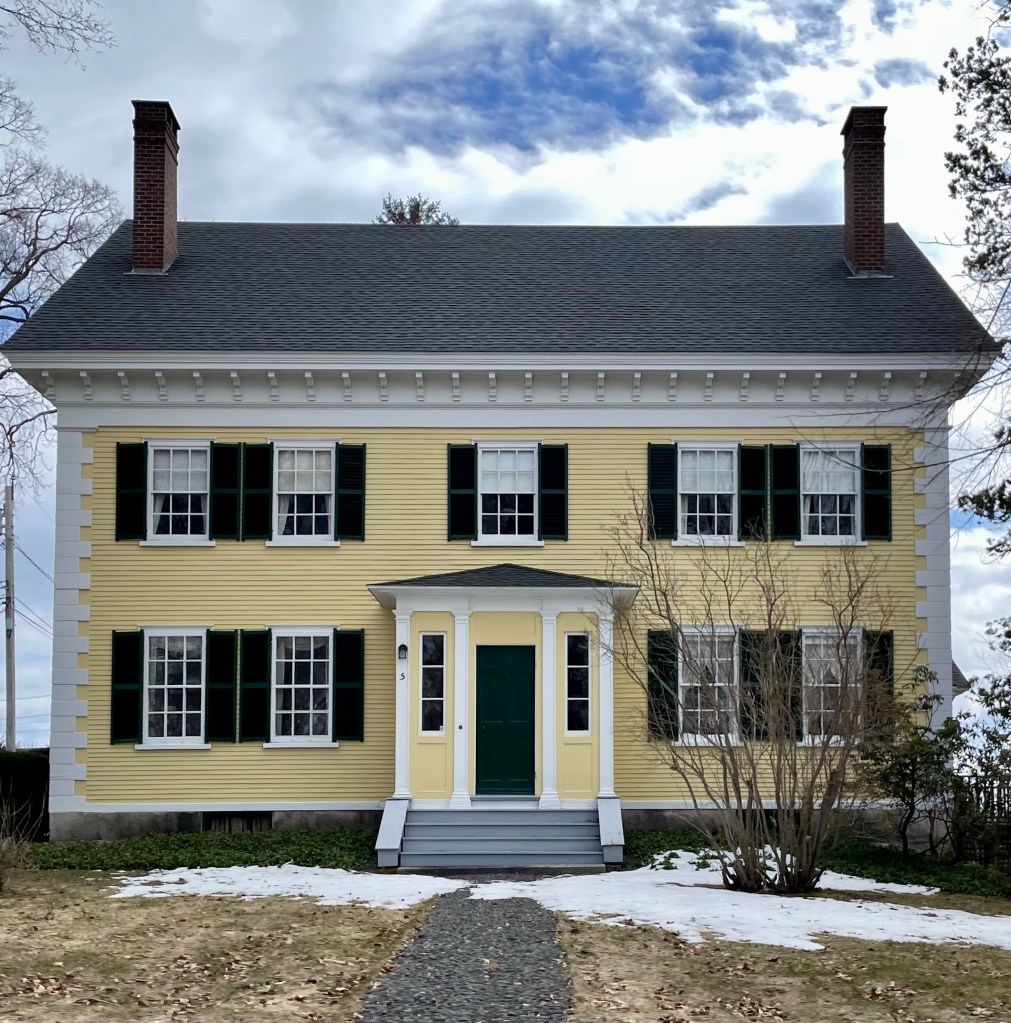
George Stevens House // 1814

George Stevens (1775-1852) was born in Andover, Massachusetts and settled in Blue Hill, Maine. He became a ship owner and merchant, making a name (and wealth) for himself in town and he showed an interest in education for the growing village. He erected this home in 1814 for his family, which seemingly employed Asher Benjamin’s house plans in the Federal style, popular builder’s guidebooks at the time. With his eyes towards education, George Stevens sat on the board of trustees for the Blue Hill Academy which flourished under the guardianship of the local Congregational Church and trustee president Rev. Jonathan Fisher. He chafed under Congregationalist dominance and wished for a non-denominational local academy. In 1832, he offered to give a thousand dollars and a piece of land to the Blue Hill Academy. His offer included this provision, “The institution shall be put on a liberal scale that all denominations shall have equal rights and privileges.” The Academy trustees said, “no.” As a result, George Stevens provided in his will that after his death and that of his wife this homestead, 150-acres of land, and a large portion of his personal property should be used to establish an academy, an “alternative” academy. In 1891 the Maine State Legislature incorporated George Stevens Academy, leading the “Old Academy” to cooperate with the
new institution, merging their boards and finally becoming a non-denominational academy. The school continues as a highly respected academic institution and retains the name of its founder, George Stevens.

Oliver Walker House // c.1809

The Oliver Walker House in Kennebunkport Village is one of the better examples that shows how overlapping architectural styles can work really well on an old house (when done right)! The original house was constructed around 1809 for Oliver Walker (1788-1851), a sea captain who later accepted the call and became a deacon for the South Congregational Church in Kennebunkport. Walker died in 1851 and the Federal style property was inherited by his only surviving child, daughter Susan, who had married Portland native, Captain John Lowell Little. Under their ownership, the traditionally designed Federal house was modernized with fashionable Italianate style modifications of the decorative brackets and an enclosed round arched window in the side gable. A later Colonial Revival projecting vestibule adds to the complex, yet pleasing design. I have a feeling the interiors of this house are just as spectacular as the exterior.