Peter Wanton Snow House // c.1830

This Greek Revival home with a one-story full-length porch was built in 1839 for Peter Wanton Snow, one of the unluckiest men in Providence. Born the son of a leading China trader and the son of a granddaughter of a former governor of Rhode Island, Peter W. Snow (1788-1843) was born into privilege and like many of such stature, could enter the family business with ease and make a lot of money. Peter first sailed for Canton (Guangzhou, China) with his father in 1803. Doubtless because of his father’s position and trading connections, young Snow became the partner of Edward Carrington who, within fewer than a dozen years, was to become one of the richest and best merchants dealing in Chinese goods in Rhode Island, if not in the entire country. Carrington wanted to retire and have Peter Snow take over his agency in China, but Peter did not seem to like it there and always wanted to go back home to the United States. He got the chance for a few years beginning in 1814, but upon returning home, he learned that his only son, Charles, had died a year earlier at the age of five years, and to compound his personal tragedy, Snow lost two baby daughters in the next three years. By 1816, he returned to China but never seemed to be able to get out of debt, while trying to provide for his last two remaining children. Tragedy struck again when his last living daughter died, while he was in China. Peter’s business partner and friend R. B. Forbes before letting Peter know the bad news wrote this.

Mr. Snow is now in as good health as he has been since his arrival in China, still he is weak in body, and a very little trouble or disappointment breaks him down and reduces him completely unable to do anything. Poor man, his countrymen here feel much sympathy for him, and fear the result of this news on him. This daughter has appeared to be the only thing which could induce Mr. Snow to make any exertion, and he often spoke of her with all the feelings of a Father who centered all his happiness, in this world, in making her comfortable and happy, and in the expectation of returning to America and of ending his days in her arms”

While in debt, he somehow had this home built in Providence, likely from assistance from family and colleagues. The land here was purchased by Peter’s wife Jeanette, and the home was likely built soon after. Peter died in 1843, virtually penniless.
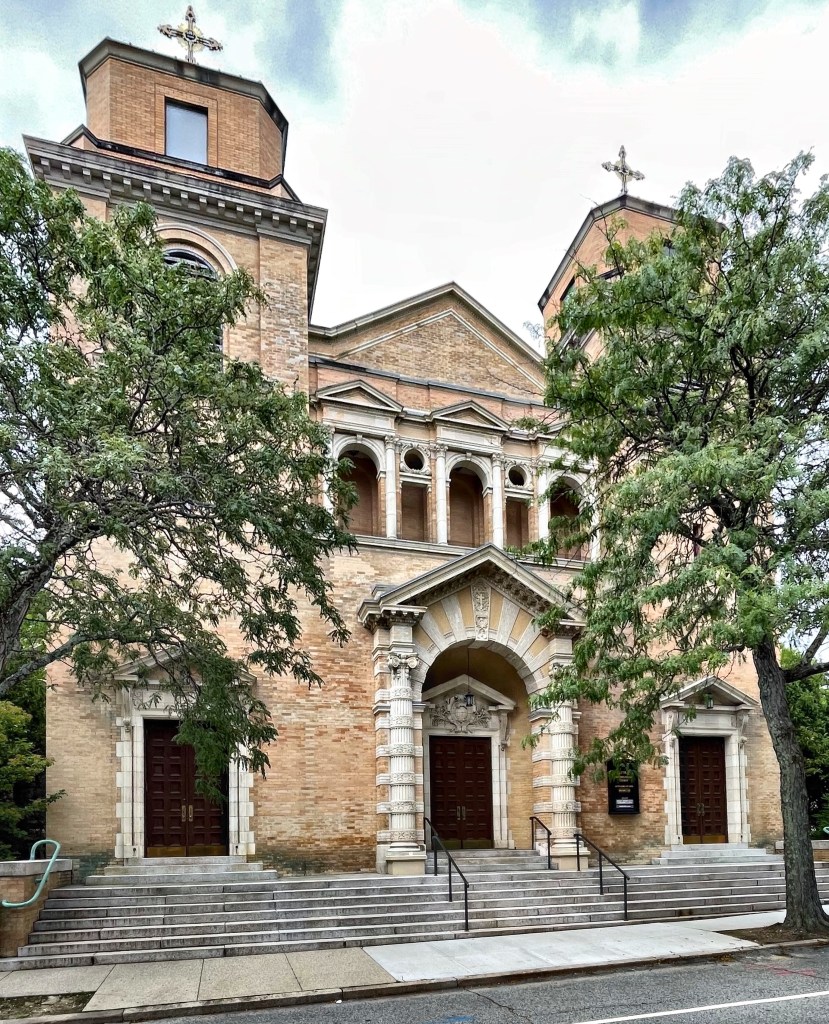
Central Congregational Church, Providence // 1893

One of the best examples of Renaissance Revival architecture in Rhode Island is the Central Congregational Church of Providence. Constructed between 1891-1893, this building was the new home to a growing congregation, which outgrew its original Thomas Tefft-designed building on Benefit Street (which has since been occupied by RISD). Famed architect Thomas Hastings of the firm Carrère and Hastings of New York City, was hired to furnish plans, and worked closely with Reverend Edward C. Moore to make sure the building was fitting of the site. The church is cross-gabled in form and is constructed of yellow brick with terracotta trimmings, evocative of Spanish and Italian Renaissance styles. The facade has a detailed central pavilion which is flanked by two towers. These towers were originally surmounted by elaborate belfries, but these were damaged by a hurricane in the mid 20th century and replaced by the present brick caps. The dome and vaulting is of tiles by Rafael Guastavino, it is the first dome that he constructed in the U.S., making this building even more significant.

Governor Henry Lippitt Mansion // 1865

North (secondary) facade

New England is lucky to have so many diverse house museums where architecture and history nerds like me can tour old houses and envision what it was like to live in that era. The Governor Henry Lippitt mansion in Providence stands out as one of the most significant Victorian-era homes in Rhode Island, and contains one of the best-preserved Victorian interiors in America. The mansion was likely designed by local architect Russell Warren, and modified by Henry Lippitt (1818-1891), heir to one of Rhode Island’s leading textile manufacturing families, for his wife Mary Ann Balch (1823-1889) and their six children who survived to adulthood. While Henry was a prominent businessman, his wife Mary may have been even busier. Mary owned and managed rental properties in Providence, including this mansion, giving her husband Henry life tenancy. She oversaw day-to-day running of the mansion, supervising the servants while teaching her daughter Jeanie, who became deaf at age four due to complications from scarlet fever, to read lips and continue to develop her speech. The Lippitt Mansion is an early, and high-style example of an Italianate Villa/ Renaissance Revival design, which moved away from the more prescribed forms of architecture towards the more eclectic, Victorian-era mode. The home features two main facades, with the smaller, west (main) facade featuring a central pavilion with ornate foliate frieze and Corinthian columns, and the north (side) facade – my favorite – with a more commanding presence with a bold porte-cochere. The home remained in the Lippitt family for 114 years, and was later acquired by Preserve Rhode Island, who opened it to the public as a museum in 1993.