Providence Market Hall // 1773

Located in Market Square between Downtown and College Hill in Providence, Rhode Island, the old Colonial Market House stands as one of the city’s oldest and most architecturally significant buildings. Constructed between 1773-1775, this Georgian-style structure originally served as a public market and meeting space. The building was originally two stories in height with an open arcade on the first story, it was used by vendors below and town officials above. The building was expanded in 1797 with a third floor, which housed the first Masonic Lodge in Rhode Island. The Market Hall was designed by local businessman, astronomer, and architect, Joseph Brown, who was also a brother of the founders and namesake of Brown University. Over the centuries, the Market House has played many civic roles. During the Revolutionary War, it was used for military purposes, and later became a hub of commercial and political activity in the growing city. It housed Providence’s first post office, and housed the Providence City Council in the decades before the completion of City Hall. In 1948, Mayor Dennis J. Roberts signed a deed to give the building to the Rhode Island School of Design, with the provision that the exterior of the building be maintained, an early preservation win! Architect John Hutchins Cady was hired to remodel the interior with classrooms and studios, and the Market House remains as a significant piece of the RISD campus. Its enduring presence on Market Square connects modern Providence to its colonial roots, embodying a rich legacy of adaptive reuse and historic preservation.

Rhode Island Hospital Trust Building // 1917

Located at the eastern edge of Downtown Providence, the Rhode Island Hospital Trust Building is significant as one of the city’s finest examples of the Beaux Arts style of architecture and as the headquarters of what was once the largest banking institution in the state of Rhode Island. The Rhode Island Hospital Trust incorporated in 1867 as the first trust company in New England. It owes its unique name to the fact that it was chartered by the board of trustees of Rhode Island Hospital, founded four years earlier, with the trust company established to help finance operations of the hospital. The original, purpose-built bank was constructed in 1891, and quickly outgrown as the institution grew exponentially into the early 20th century. In 1916, the trust hired the New York architectural firm of York & Sawyer to furnish plans for the present structure. Construction began in 1917, and after delays caused by WWI, the building finally opened in 1919. The 11-story U-shaped building was designed in an exaggerated form of Renaissance palazzo, with steel-framed construction that is faced with marble on the two lower levels and limestone elsewhere. After a series of mergers throughout the 20th century, the building was owned by FleetBoston, who donated this pristine building to the Rhode Island School of Design (RISD), which was renovated into a dormitory by RISD-alumni and architect Nader Tehrani of NADAAA Architects. It is today known as the Mandle Building.

Stephen O. Metcalf House // 1892

I am on a Colonial Revival style kick lately, so bear with me on this recent span of posts on houses in the style! This estate house is an earlier example in Providence, built in 1892 for Stephen Olney Metcalf (1857-1950) a multi-millionaire who was in business in woolen textiles and insurance before diversifying his portfolio further serving as President of the Providence Journal and Evening Bulletin. To make an architectural statement, Mr. Metcalf called the renowned Boston firm of Andrews, Jacques and Rantoul to design his new residence. The oversized Colonial Revival house is an excellent example of how Revival architecture tend to be a more free interpretation of their prototypes, being larger and having exaggerated features and proportions. In his will, Stephen O. Metcalf bequeathed this residence to the Rhode Island School of Design (RISD), an institution his mother helped found, and his daughter served as President. The mansion remains the RISD President’s House to this day.

Woods-Gerry House // 1860

There are always those houses that just stop you in your tracks… For my last post (for the time being) on Providence, I wanted to share this significant property, known as the Woods-Gerry House, perched atop College Hill. Owner Marshall Woods, who married into the Brown family and was active in the affairs of Brown University. Locally he was also involved on the building committee for St. Stephen’s Church where he was a factor in selecting renowned architect Richard Upjohn to design the church. He must have liked Upjohn so much (or got a good deal) that he hired Richard Upjohn to design his new home on Prospect Street. The exterior of the three-story brick building stands out amongst the other Italianate mansions built in the same decade nearby, but is elevated design-wise with a bowed centerpiece on its east elevation with the handsome new front entrance renovated in 1931 by then-owner, Senator Peter Gerry, who was a great-grandson of Elbridge Gerry, the fifth Vice President of the United States (who had given his name to the term gerrymandering). Today, this significant building is owned by the Rhode Island School of Design and houses the Woods Gerry Gallery. The grounds are also very well designed.

Francis Carpenter House // c.1857

I love a good Second Empire style house with a mansard roof, and luckily, New England is full of amazing examples. This house in Providence’s College Hill neighborhood dates to about 1857 and appears to have been built for Francis W. Carpenter, a successful businessman who would later serve as President of the Congdon & Carpenter Company, an iron and steel company which was founded in 1792. Carpenter did very well for himself and would later move out of this house and into a stunning Beaux Arts mansion further up the street (featured previously), designed by the premier architectural firm of Carrère and Hastings. The house is today owned by RISD, and appears to be used for residences.

Pardon Miller House // 1822

Pardon Miller, a watchmaker and silversmith in Providence had this Federal style home built in 1822 in Providence’s high-value College Hill neighborhood when he was in his 20s. The home and its neighbor were built at the same time, seemingly by the same builder as they share a lot of similarities in design and detailing. The house remained in the Miller Family until 1882, and it is now owned by the Rhode Island School of Design (RISD). The homes on the northern side of Angell Street, like this house, are largely built on a raised foundation with high retaining walls, which showcases the “hill” in College Hill.
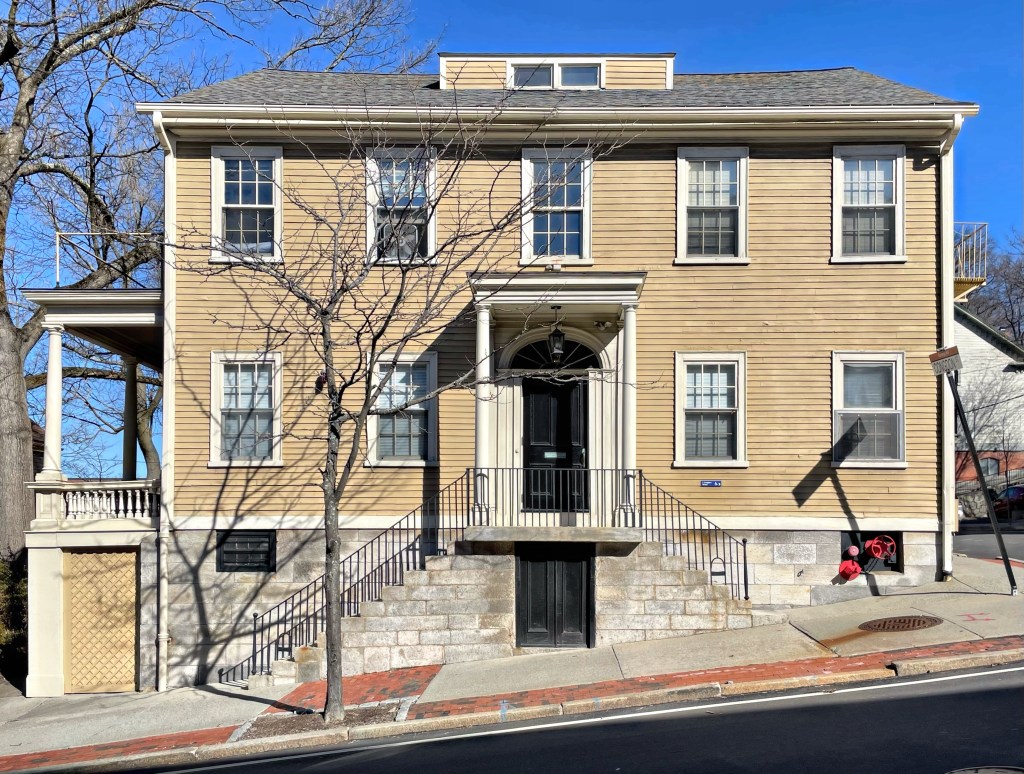
Jonathan Congdon House // 1818

Jonathan Congdon (1763-1862) worked in the hardware and iron business, following his father’s footsteps, eventually taking over the family business. Jonathan married Elizabeth Arnold and had at least nine children together. Two of their sons, Arnold and Welcome, too followed in the family business, as ironworkers and salesmen, with the new firm name, Jonathan Congdon & Sons. The company did well, and Jonathan replaced his c.1787 home on the lot (built at the time of his marriage) with the present structure. He also laid out a street on the side of the property, which was named Congdon Street. The home remained in the Congdon Family until 1937, when it was acquired by the Rhode Island School of Design (RISD).