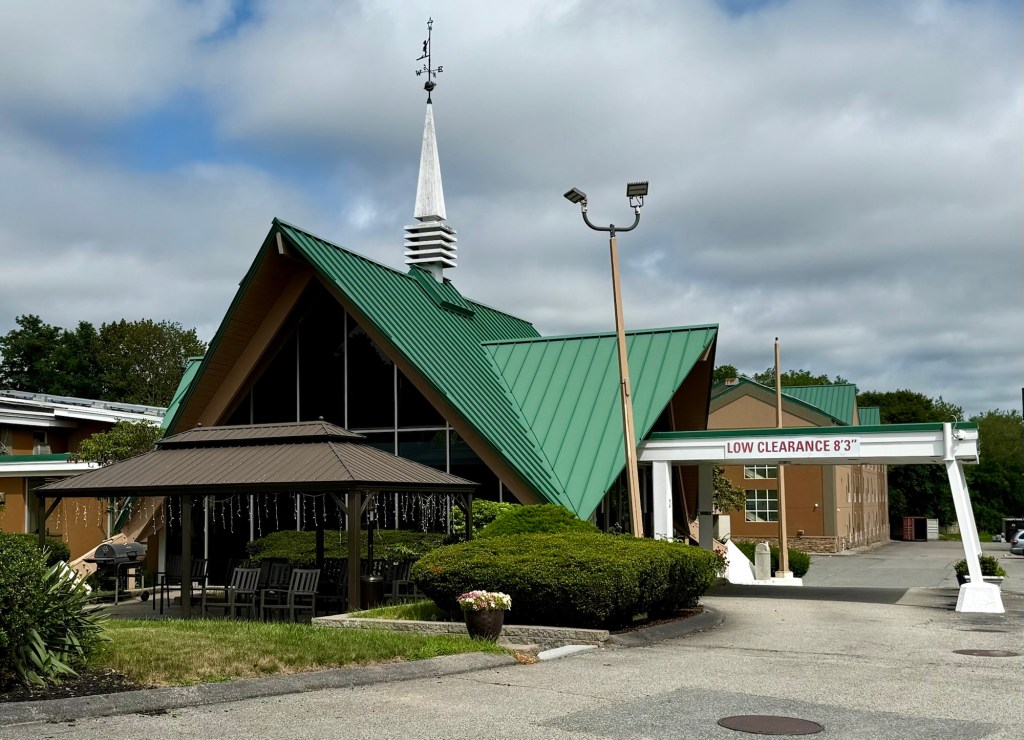
Former Howard Johnson’s Motor Lodge, Kingston // 1956

Howard Johnson’s (Hojo’s) traces its beginnings to the late 1920s when the Boston native Howard D. Johnson (1887-1972) opened a series of ice cream stands at various locations along the South Shore of Massachusetts. By 1940, there were more than 125 restaurants from Maine to Florida and by the late 1950s there were approximately 500 along the east coast. In 1954 the company expanded to motor lodges (motels), eventually opening over 500 across the United States. The growth of the motel tied closely with 1950s legislation that authorized Interstate highways connecting cities via automobile, increasing traffic all across the country. Howard Johnson’s adopted a policy of acquiring real estate directly off highway exit ramps and often the parcels were large enough to include a restaurant and motor lodge. Specifically, many Howard Johnson’s Motor Lodges featured prominent signage and bright orange roof, to help motorists identify the motel while speeding down the interstate. The Kingston location here opened in 1956 along Rt. 3, connecting Boston and points north, to Cape Cod. While it’s iconic name and orange roof do not remain, the unique Googie-esque form of the lobby with very 50s weathervane remain as an important vestige of 1950s America. 
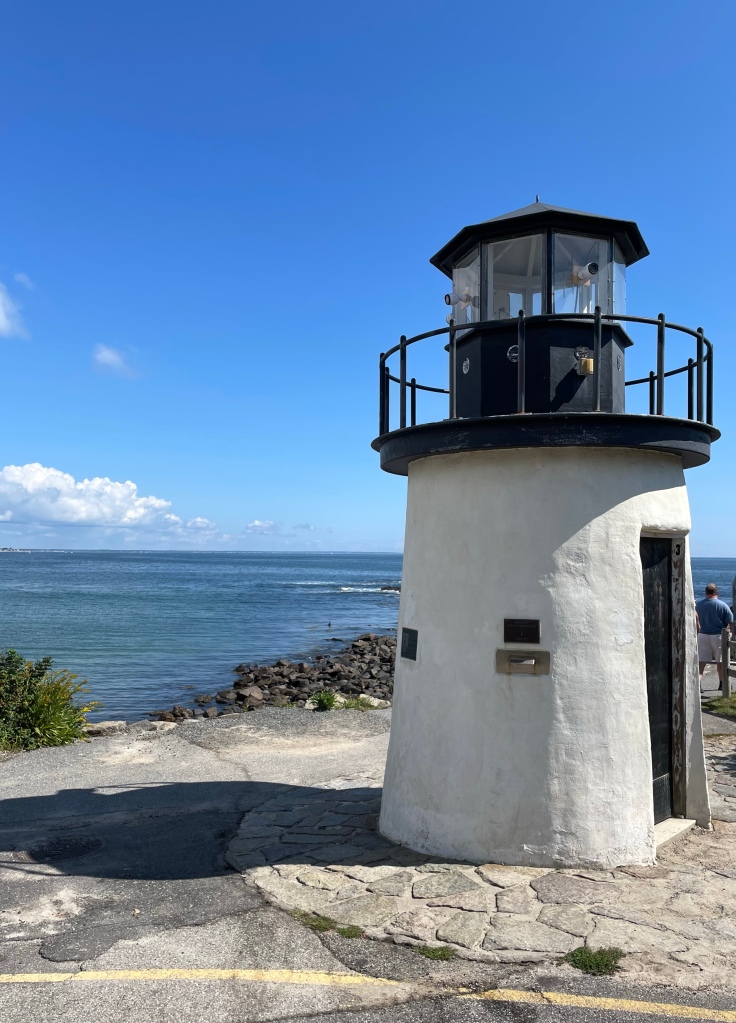
Lobster Point Lighthouse // 1948

When you walk along Ogunquit’s Marginal Way cliff walk, it is missing one thing, an iconic Maine lighthouse… or is it? This mini lighthouse on the route always has people lining up to snap a picture and its quirky roadside attraction appeal is undeniable. The original Lobster Point Lighthouse was constructed in 1948 by Winfield C. Littlefield of the local family who first settled in the town. The “lighthouse” was designed by Grover S. Perkins. Much like the real lighthouses on the coast, the original structure was badly beaten by the salt air and high winds and parts of the structure were replaced. Notably, in 1993, the top (lantern) was replaced with fiberglass. Additionally, in 2009 the structure was upgraded, all from donations. The iconic roadside lighthouse will continue to ‘light the way’ for the droves of tourists and locals alike who navigate Marginal Way.

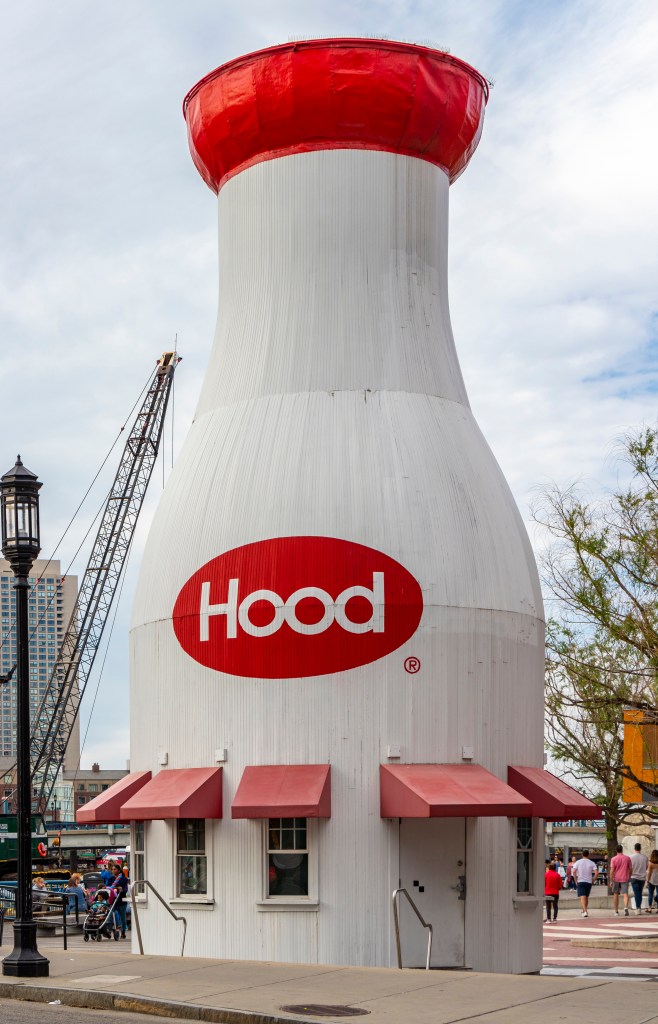
Hood Milk Bottle // 1934

Photo courtesy of Brandon Bartozek

Boston’s iconic Hood Milk Bottle has been an iconic fixture in the city’s built environment for decades, but do you know about the history behind it? The architectural oddity was born in 1933-4 in Taunton, Massachusetts, the brainchild of Arthur Gagner who created it as roadside attraction in which he could sell his homemade ice cream. The Milk Bottle beckoned to local families with its impressive size (the structure is 40 feet tall, 18 feet wide, weighs 15,000 pounds, and would hold 58,620 gallons of milk, if it were a real milk bottle)! As car ownership became commonplace, giant donuts, coffee pots, hot dogs, and other surreal shapes rose up on roadsides across the country, enticing motorists to pull over from the busy, new freeways. Gagner peddled sweet treats from his whimsical wooden stand for a decade before selling the building to the Sankey family, who also used it to sell ice cream. But by 1967, the bottle had been abandoned. In 1974, photographer Walker Evans took a Polaroid of the forlorn building, which brought Hood Milk, native to Charlestown, to the table. With a quote of $25,000 to repair it, Hood agreed to cover that cost if the Bottle could be renamed The Hood Milk Bottle, and the structure was to be located on City Hall Plaza, until the architect of the plaza called the Mayor’s Office stating their displeasure with that idea. They then contacted the newly relocated Boston Children’s Museum, who agreed to locate the bottle on their property. The Hood Milk Bottle was delivered to the Museum in 1977 from Quincy (where the repairs were made) on a barge with two fire boats steaming alongside, on a voyage the Hood Company dubbed the “Great Bottle Sail”, where it has remained to this day. It recently underwent a $350,000 renovation, restoring it to its former glory. So no crying over spilled milk!