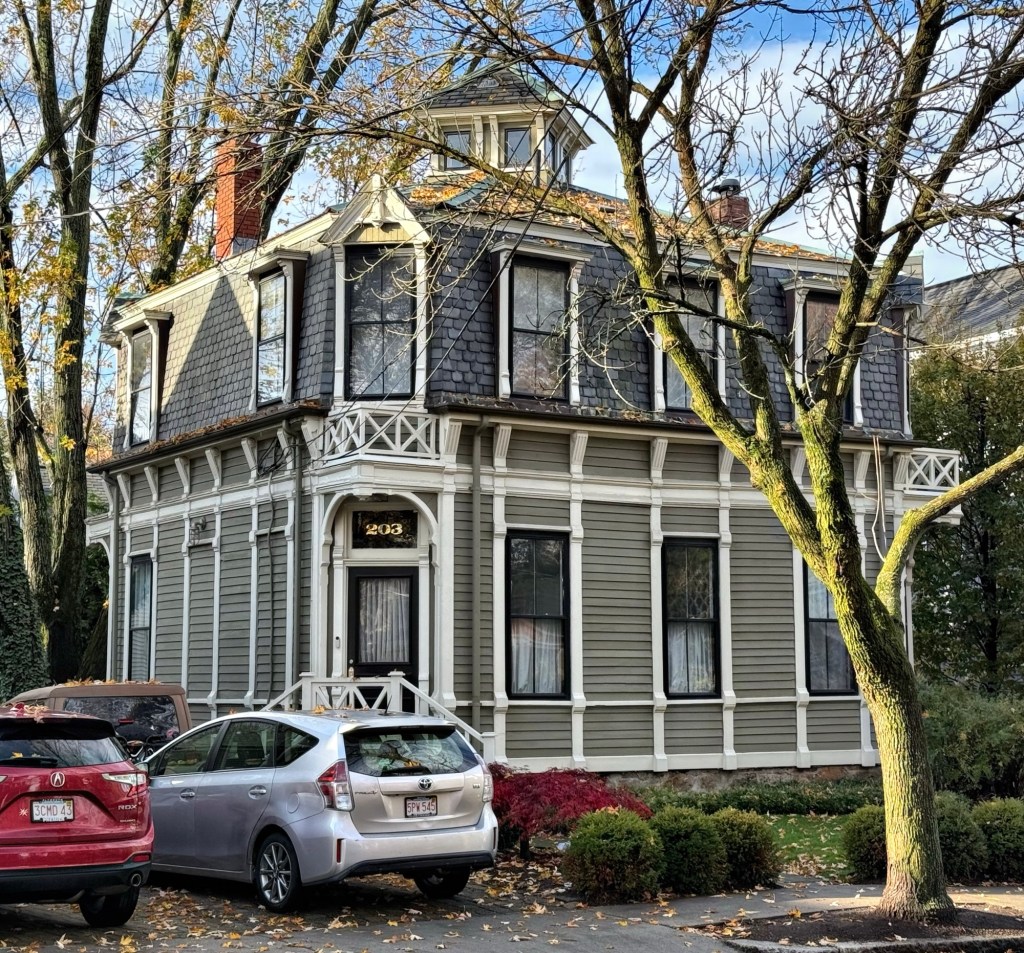
Toussaint House // 1879

In 1879, furniture-maker and amateur architect, Winand Toussaint (1826-1904), built this unique mansard roofed house at 203 Aspinwall Avenue in Brookline Village. Toussaint was born in Belgium, and immigrated to the United States about 1841, where he originally settled in Roxbury and operated a cabinetmaking business. Toussaint moved from Roxbury to Brookline about 1873, but lost his fortune in the Panic of 1874. After a few years, he found work and eventually purchased a house lot here, and designed and built this home in 1879. Winand was born into a family of architects and engineers in Europe with his grandfather being Jean Lambert Toussaint of Liege, an architect who reportedly built the first railway introduced in Belgium. He is said to have studied in France and Italy before working in furniture-making in the United States. He maintained a professional office from his Brookline house until his death in 1904. After his death, the family home was inherited by daughter, Emma Toussaint, who was unmarried and worked as a linguist and writer under the name “Portia”. The charming Toussaint House blends Second Empire and Stick styles with unique beveled corners, one of which contains the main entrance, and a belvedere at the crest of the mansard roof. Due to its unique architecture, the Toussaint House was individually listed in the National Register of Historic Places in 1985.
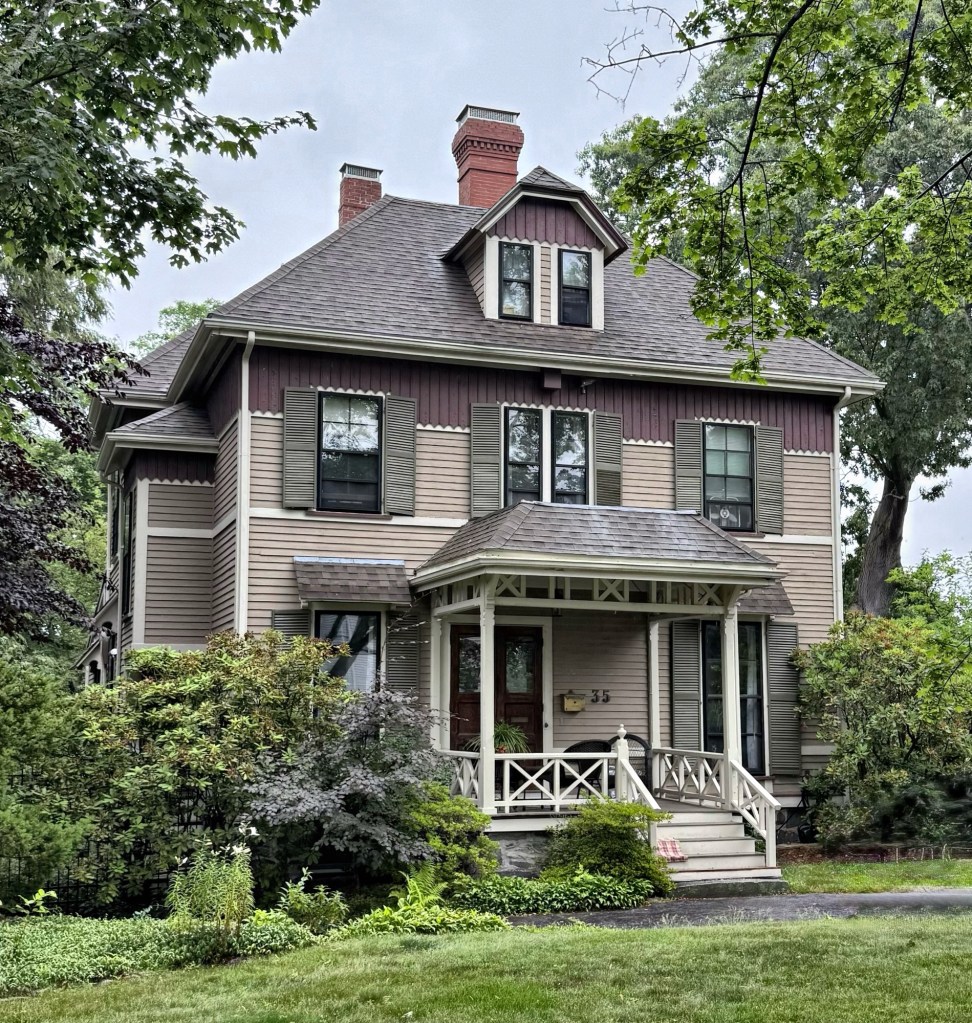
Mumford House // 1877

Set back behind a manicured lawn on the charming Alban Street in the Ashmont Hill neighborhood of Dorchester, this Victorian era residence was both a family home as well as a finishing school for young ladies. The house at 35 Alban Street was completed in 1877 for the Reverend Thomas James Mumford, pastor of the Third Church of Dorchester and anti-slavery advocate, who died the year his home was completed. His widow, Elizabeth Goodrich Warren Mumford (1834-1897) would inherit the home from her husband and for supplemental income to maintain the home, she opened the Mrs. Mumford’s Finishing School for Young Ladies, a school to educate and teach young girls manners and religion. Elizabeth Mumford would also publish books on how to conduct classes for Sunday School, Kindergarten, and the home. The Mumford House is a great example of a Stick style residence with less exuberance than some other examples. The picket frieze, applied stickwork on the siding, and more ornate porch are all typical of the style. 

Mudge Family Cottage // 1852

Edwin Mudge (1818-1890) was a major shoe manufacturer and a representative to the Massachusetts General Court. In 1844, he married Lydia Nichols Bryant, and in 1852, the couple hired Edwin’s brother, a carpenter, to build this house at 108 Centre Street in Danvers, Massachusetts. A son, Francis was born October 4, 1846, and his sister Lydianna was born March 20, 1853. Tragically, both brother and sister died in 1855 of what was described as “brain fever” or “dropsy in the head.” Frank, one month shy of 10 years of age, passed away on September 8, 1855, followed by little two-year-old Lydianna exactly one month later. They are buried together in the local cemetery and a portrait of them is in the Danvers Historical Society collections. Edwin and Lydia would have one other child, Sarah Mudge (1857-1938), who grew up to be a prominent citizen and one of the founders of the Danvers Historical Society. The formerly simple Greek Revival style cottage was “Victorianized” in the Stick/Eastlake style with the addition of delicate bargeboards, a hood over the new double-door entry with iron balustrade, and side dormers.