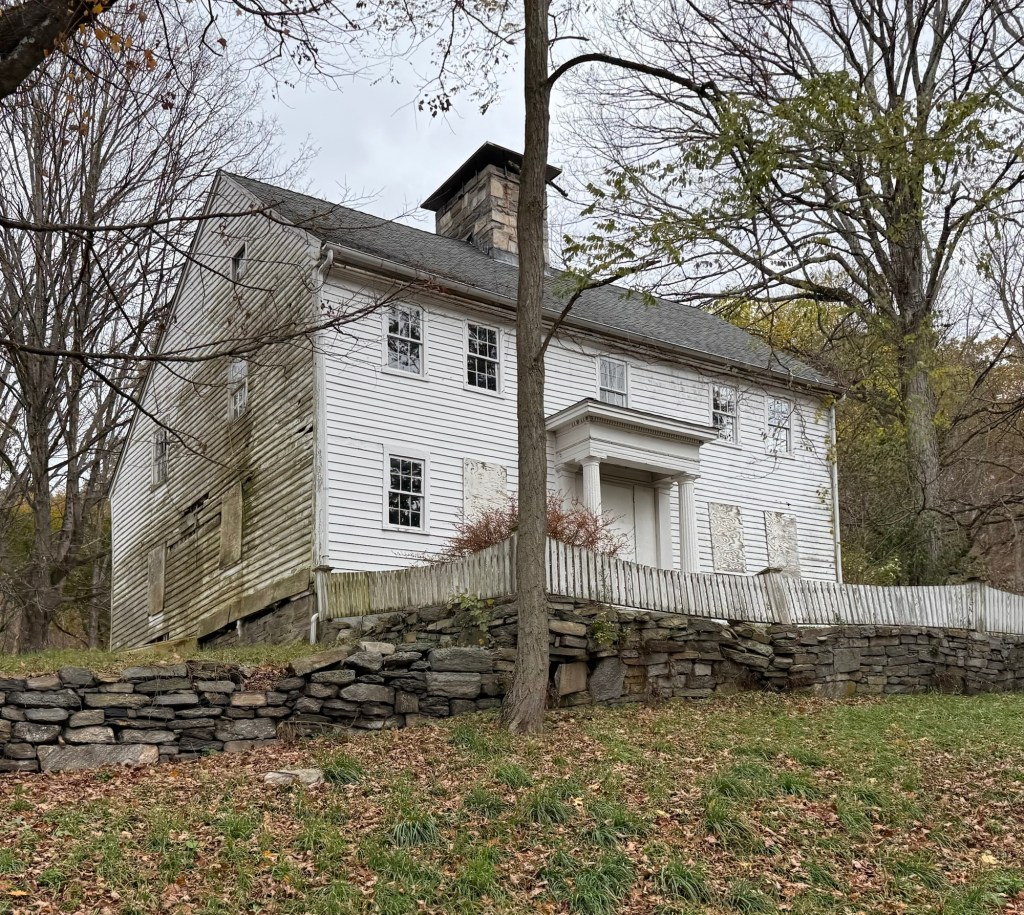
Smith-Curtiss House // c.1714

The Smith-Curtiss House, which is possibly the oldest extant building in Derby, Connecticut, has sat vacant and decaying for years and is owned by the State of Connecticut. Believed to have been built sometime between 1714 and 1740, this historic saltbox farmhouse at 411 Hawthorne Avenue is slowly decaying due to lack of maintenance and funding. Early ownership is difficult to determine, but by the 19th century, the property was owned by Ms. Alice E. Curtiss. The old estate was sold by Ms. Curtiss in 1913 to Frances Osborne Kellogg, a businesswoman, philanthropist and environmentalist, as part of her 350-acre dairy farm and land-conservation holdings. The Smith-Curtiss House was used as a residence for the herdsmen who ran the farm nearby. Before her death in 1956, Frances deeded the property to the state as a public park, and allowed her head herdsman life-occupancy of this house for the remainder of his life. The State of Connecticut assumed possession of this house in 1981. The building has suffered from deferred maintenance since this period, with the State attempting to lease the building to tenants. I hope that local and statewide preservation groups can mobilize to secure grants and funding to restore this important property.

Former Allerton Point Post Office // c.1890

By the end of the 19th century, various coastal developments on the elongated coastal town of Hull, Massachusetts, developed into established neighborhoods of cottages. As a result, new stores, schools, and post offices were built to accommodate the increase in population. William Henry Sylvester (1840-1923) a local resident, built this structure to serve as a store, professional offices, and post office. Like other buildings in the area constructed in the 1890s, the structure blends Queen Anne and Craftsman elements in a great composition. Sadly, the building has not been maintained and the windows are now boarded up, with the entire waterfront parcel selling in 2018. Plans to demolish the buildings on the site, including this charming structure were proposed to erect new townhomes, but they have not materialized. I’d love to see the site redeveloped with much-needed housing, but this structure should be incorporated in the development.

Tewksbury State Hospital, Superintendent’s Residence // 1894

Located adjacent to the Administration Building at the Tewksbury State Hospital, the Superintendent’s Residence, built in 1894, combines elements of the Craftsman and Colonial Revival styles wonderfully. The home is two-stories, and built of red brick laid in Flemish bond, capped with a slate hipped roof with exposed rafters. A massive uncovered porch wraps around the home and sits atop a rubblestone foundation. Like the adjacent Administration Building, the Superintendent’s Residence was also designed by Boston architect John A. Fox. From this residence, the massive almshouse and asylum would be run by the superintendent, who oversaw day to day activities and made sure everything was running smoothly. The house appears vacant now.