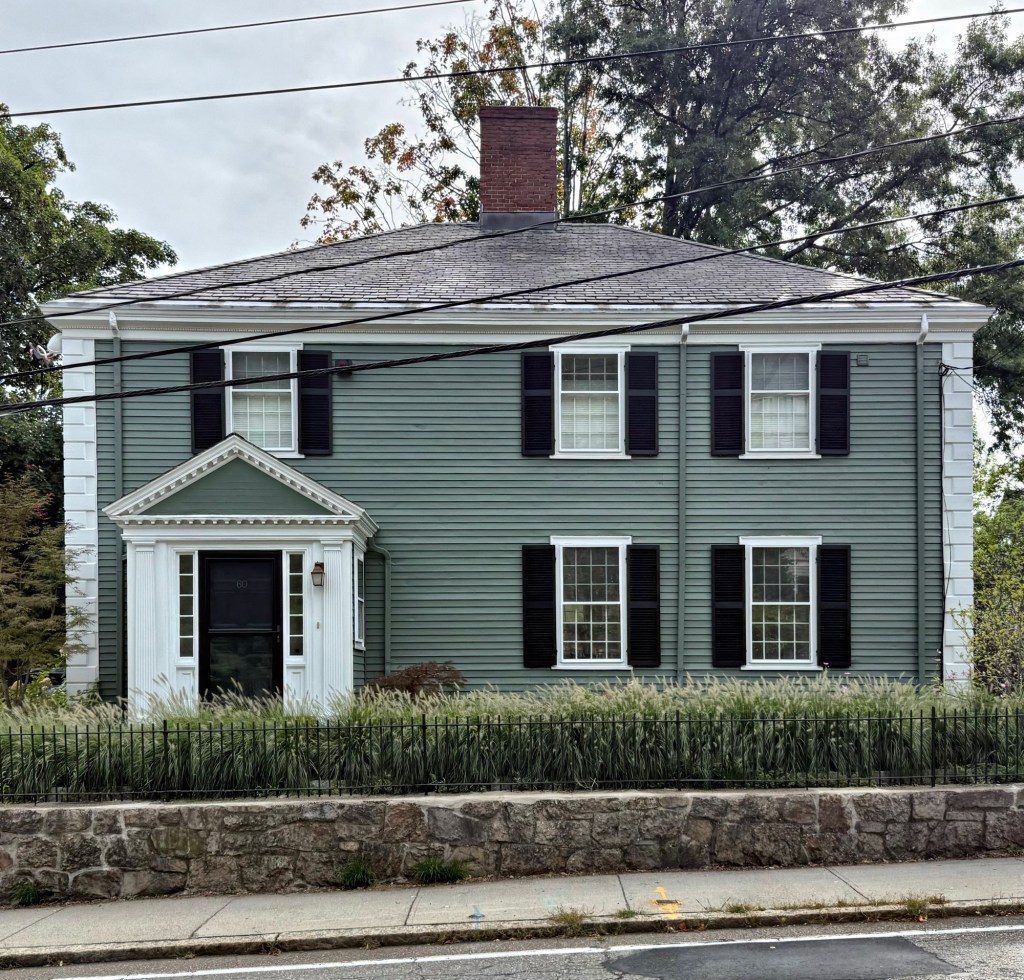
Built in 1928 as an accurate reproduction of an 18th-century residence the Codman-Gillet House at 60 High Street in Brookline is significant architecturally in the Colonial Revival style but also as a preserved house by the architectural firm of Howe, Manny and Almy. Lois Lilley Howe and Eleanor Manning were among the first women graduates of the M.I.T. School of Architecture, and the firm was joined in 1926 by Mary Almy. Their firm was the first all-woman architecture practice in Boston and the second in the U.S. Howe was the first woman elected a Fellow of the American Institute of Architects. The house was built for William Coombs Codman, a trustee of various real estate trusts, and was likely rented or sold for investment. The first long-time owner/occupants of the residence were Mr. and Mrs. Fernand Gillet and who both taught at the New England Conservatory of Music. Fernand was the principal oboist of the Boston Symphony Orchestra from 1925 to 1946. The Codman-Gillet House features many traditional Colonial Revival elements including: the corner quoining, window trim, a pedimented projecting entrance, and hipped roof with large central chimney.
 Buildings of New England
In the book I’m currently writing on Cambridge houses and their people, a format almost exactly like yours only longer, I distinguish between an earlier Colonial Revival in the 1880s-1900 and the later Neo-Colonial in the 1920-40s. They spring from the same Georgian/Federal models but their proportions are so different and sometimes their ornementation that I wanted to make a distinction. Just though you might like to know, and get your take on that.
Best,
Heli
LikeLiked by 1 person
Great! I would think that earlier Colonial Revival houses (1880s-WWI) are more grand in terms of proportions, detailing, and scale, while later Colonial Revival houses WWI-WWII, are less ornate and more traditional? Materials also may have impacted the later houses as Modernism began to seep into architecture for more streamlined facades? Though, there are definitely some traditionalists like with this house by Howe, Manning & Almy. What are your thoughts?
LikeLike
I am always struck by how rigid, non-imaginative and staid the Neo-Colonials are. Sometimes there’s an easiness in the design, but ususally I think of it as a strait-jacket. Well, that’s a bit too exagerated, but I’m sure you know what I mean. I think there was caution about being too playful with our “heritage.” Re the modern materials, that really changed when mid-century modern began, and probably not so much with the Neos. Also, there were fewer grand houses in the Neo period, less flurish, less playing around with the motifs.
Correct me if I’m wrong.
Heli
LikeLiked by 1 person
I agree with you! I think it is due to emergence of new materials, less sheer wealth, and changing tastes in architecture, all contributing to the Neo-Colonials being more streamlines and bland..
LikeLike