Card Memorial Chapel // 1898

Cemetery chapels are fairly uncommon, but always a must-see when exploring a new place. These small charming buildings help bridge the gap between life and death and are often adorned with a permanence not seen in our lifetimes. This is the Card Memorial Chapel in the Spring Brook Cemetery of Mansfield, Massachusetts. The chapel was erected in 1898 as a memorial to 31-year-old Mary Lewis Card, who died in 1896. Mary’s parents, Simon W. Card and Mary J. Card, founded S.W. Card Manufacturing Company in 1874. The Mansfield-based company did very well and manufactured tap and die tools locally, shipping them all over the country. Before her abrupt death, Mary Lewis Card was set to marry architect Charles Eastman, who is credited with designing the memorial to his late-fiance. The chapel borrows from the Romanesque and Victorian Gothic styles, and is constructed of red brick laid with a tinted mortar atop a foundation of Quincy granite. The various roof sections are sheathed in green slate. The building displays a cross plan with a central tower rising forty-two feet from the ground to the apex, topped by a steeply pitched pyramidal roof. The building was restored years ago and still looks great!

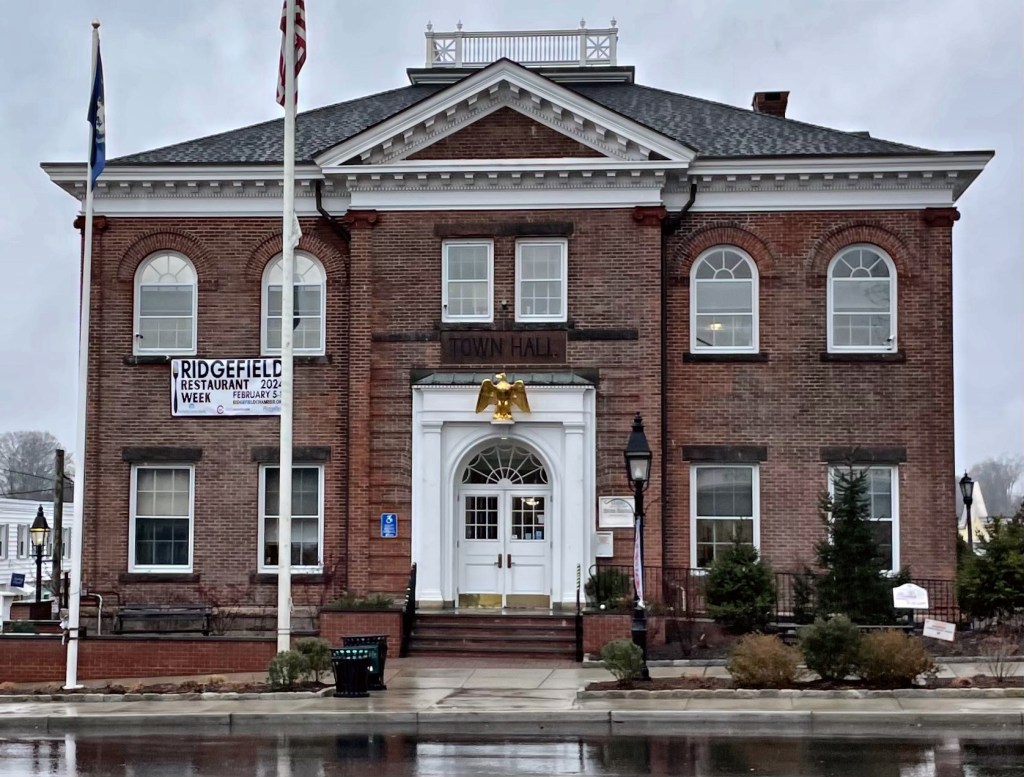
Ridgefield Town Hall // 1896

Ridgefield, Connecticut was settled in 1708 when 24 families from Long Island purchased land from Chief Catoonah of the Ramapo tribe. The Fundamental Orders adopted by Connecticut in 1639 directed would-be settlers, able to support a minister, to establish a settlement, build a Congregational church and farm the land. This is exactly what was done in Ridgefield, beginning in 1708. The original 24 proprietors received 7½-acre home lots drawn by lottery, with a 25th reserved for the minister. The lots were located up and down Main Street from a Common where a Meeting House was built. The town grew and for much of its three centuries, was primarily comprised of old farms. By the late 19th century, spurred by the connection of the railroad, Ridgefield was “discovered” by wealthy New York residents, who assembled large estates in town, a trend that has only picked up in the 21st century! Population growth and a large fire on the town’s Main Street in 1895 necessitated a new Town Hall building. The present Town Hall building was constructed in 1896 from plans by architect Philip Sunderland. Colonial Revival and Romanesque in style, the two-story brick building features a pedimented central bay also containing the entrance with fan light transom, round arched windows, brownstone trim, and narrow pilasters of brick. The building houses town offices today.

St. Denis Catholic Church // 1838

Believe it or not, this church in rural Whitefield, Maine is the second oldest Catholic Church in New England! As Irish and French Canadian families settled in this part of Maine in the early 19th century, Catholic churches were needed to provide worship space for those families. The church community of St. Denis began in 1818 when Father Dennis Patrick Ryan, an Irish immigrant serving at St. Patrick Church in Newcastle (the oldest Catholic Church in New England), moved to Whitefield to serve the influx of Irish Catholics and soon founded the church. Fr. Ryan oversaw the construction on a wood-frame structure built on this site. As more Catholic families settled here, a more permanent building was needed, and between 1833 and 1838, the main portion of the present brick church building was constructed around that original church. The tower was added in 1861, and the stained glass windows also date from later in the 19th century following the growth and prosperity of the church and its members. The St. Denis Parish House was constructed across the street in 1871 and is a lovely Romanesque style building.

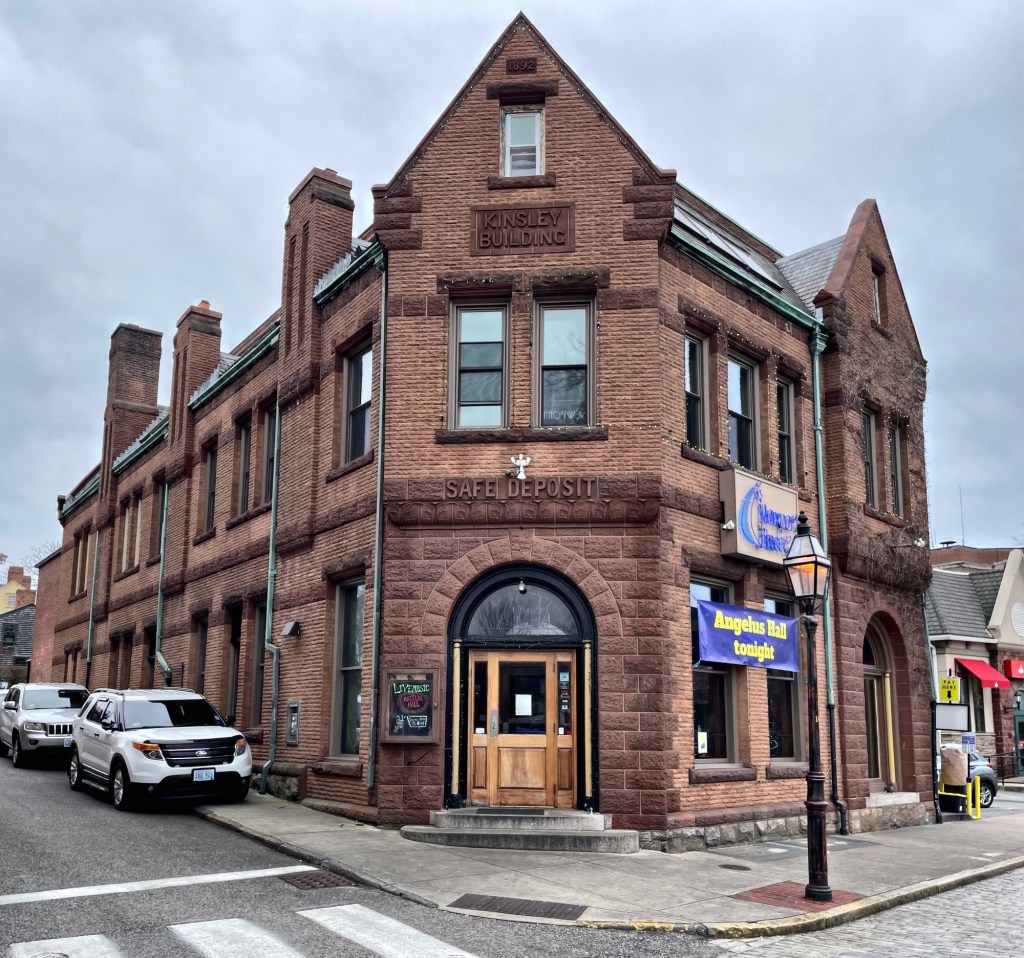
Kinsley Building // 1892

Established in May of 1854, the Aquidneck Bank begun with a capital of $100,000 with Rufus B. Kinsley as its president. The bank became the Aquidneck National Bank in 1865 and continued growing after the Civil War. The directors of the bank eventually left their former building (across Green Street) and moved into this building at Thames and Green Streets, which was built from 1892 to 1893 by local architect Dudley Newton. They named it after the banks founder, Rufus KinsThe Romanesque Revival style block is oriented to the corner and is built of brick and brownstone trim. Arched entrances are a nice Romanesque touch.

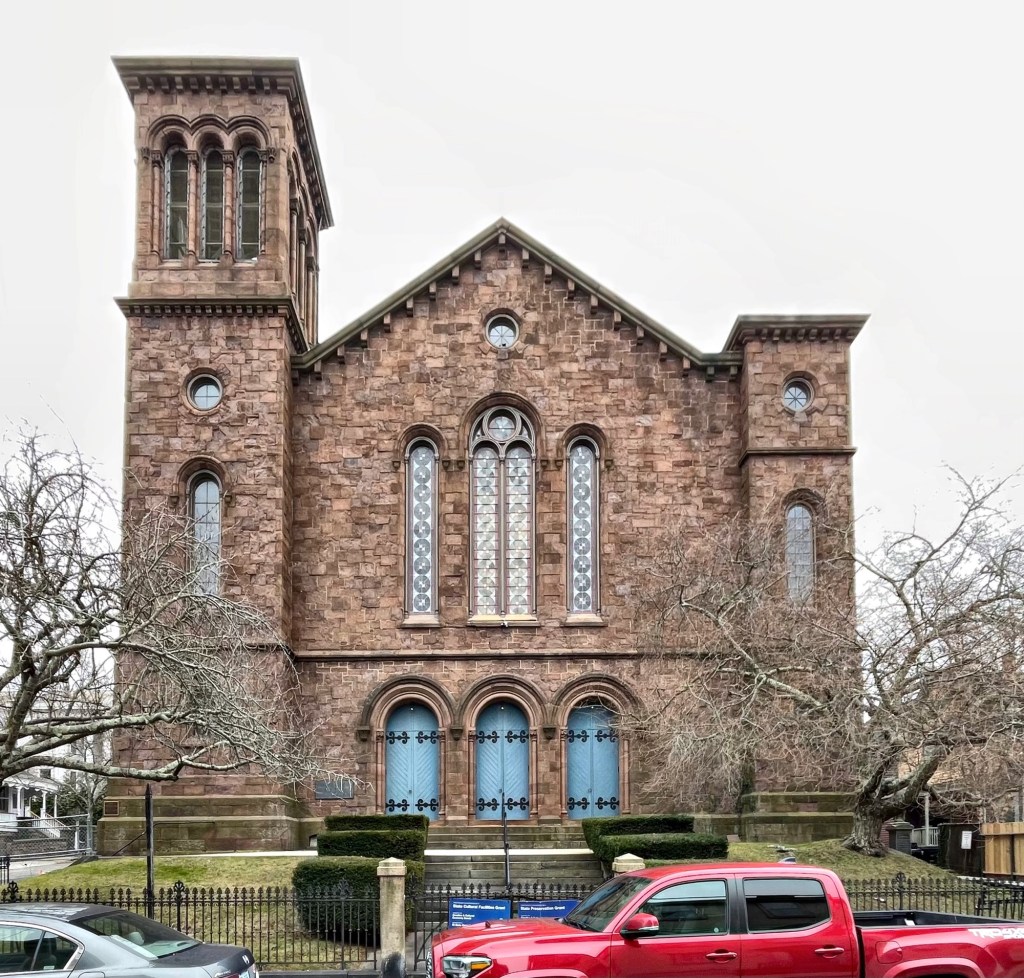
Newport Congregational Church // 1857

The Newport Congregational Church on Spring Street was built between 1855-1857 and serves the United First and Second Congregational parishes of Newport whose history began in the late 17th century. The building, designed by Joseph C. Wells a New York City architect, and redecorated on the interior in 1880 by John LaFarge, is an interesting and well-preserved example of the Romanesque Revival, brownstone churches of the mid 19th century. LaFarge had recently completed work on H. H. Richardson’s landmark Trinity Church, Boston, and sought to provide a more elaborate interior than he was able to in Boston. He produced twenty stained glass windows and a series of murals, which today, represent the only fully integrated ecclesiastical interior he produced. The congregation has shrunk in recent years and moved to nearby Middletown, but it’s vestry was committed to the preservation of La Farge’s work. The LaFarge Restoration Fund was established and since the 1990s, the nonprofit has spent $3 million on glass and mural restoration, architectural stabilization and systems upgrades for their former building. The building is used occasionally as an arts center.

Yale University – Warner House // 1887

Originally known as Cloister Hall, this ornate building on Hillhouse Avenue in New Haven, Connecticut is one of the most interesting I have seen. The building was constructed in 1887-8 as a residence hall for members of the Book and Snake, a secret society at Yale University. Architect H. Edwards Ficken designed the ornate brownstone Cloister which was completed in 1888. At the time, it was considered “one of the most picturesque buildings on the Yale campus.” The society added a matching rear addition in 1915, which is a heavier mass, but compliments the original structure. Yale University would eventually acquire the building after the society no longer needed a separate lodging house for members. Today, the building is called Warner House, and Yale does a great job at maintaining this beauty.

Yale University – Welch Hall // 1891

As Yale University continued to enclose its Old Yard with elongated dormitories in the second half of the 19th century, the proprietors began to experiment with slight deviations to the prototypical Victorian Gothic piles built in the previous decades. Following a financial gift from Pierce N. Welch, an 1862 graduate of Yale College, and his sisters in memory of their late father, Harmanus M. Welch, the college hired architect Bruce Price to furnish plans for the new dormitory. Welch Hall is built of Longmeadow Freestone, the building is more Romanesque in style with arched masonry openings, the rough hewn stone walls, and pointed dormers projecting through the eave lines.

Dorchester Mutual Fire Insurance Building // 1860

This is your sign to take a different route! When exploring a new town or neighborhood, I love to explore the obscure streets just as much as the iconic Main Streets as hidden treasures can always be found! This building in Dorchester’s Port Norfolk neighborhood was constructed in 1860 as the new home of the Dorchester Mutual Fire Insurance Company, which was incorporated in 1855. The company seemingly hired Dorchester-based architect Luther Briggs, who also laid out the streets for Port Norfolk and the Clam Point neighborhoods and designed many buildings in the area at the time. The high-style Italianate building features bold proportions, quoins, and cornice. While the former round-arched windows have since been enclosed and are traditional double-hung windows, they building still stands out! At the rear, Second Empire style rowhouses were built for private ownership. The building is now all condominiums following a renovation.

Freeport Street Power Station // 1896

The West End Street Railway was established in 1887 originally as an offshoot of a land development venture, but it rose to prominence when it merged several independent streetcar companies into a single organization. Over the next decade, it became the primary operator of public street transit within the Boston area! During this time, the company maintained one of the largest street railway systems in the world, the first unified streetcar system in the United States, and first electrified system in a major US city. Now, it’s the infamous MBTA. How far they fall… Power plants were needed all over the city to provide electrical power for the company’s street cars, this was the fourth (and final) power station built, and it powered the Dorchester, Neponset, Ashmont and Milton lines. The station was constructed in 1896 on the shores of Dorchester Bay, which allowed for coal to be delivered in barges to the plant. Old stone walls formerly lining the shore can be seen to this day. Landfilling in the second half of the 20th century and the construction of I-93 have since cut off the building from the shore. Eventually the building was sold off and today is home to Yale Appliance, good thing none of their products are coal powered!

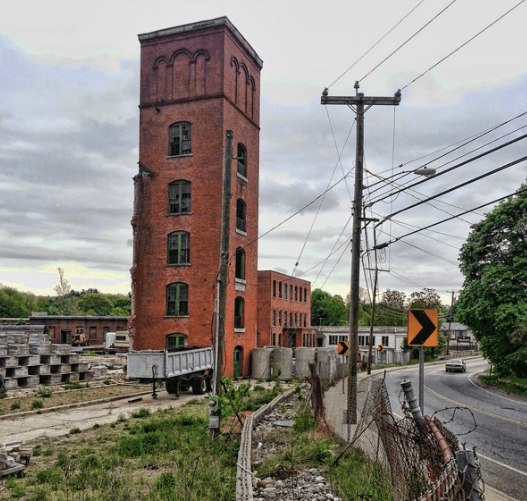
Putnam Nail Company Factory // 1860+

The Putnam Nail Company was founded in 1860 and located at the northern tip of the Port Norfolk neighborhood of Dorchester, Boston, Massachusetts. The company was founded by Silas Safford Putnam (1822-1895), who was the seventh of nine children by Israel Smith Putnam and Charlotte Safford of Hartford, NY. He moved to Boston and found work as Boston’s industrial growth took-off. He owned a curtain factory before patenting a process to manufacture wrought nails in the 1850s. After some time in Abington and Roxbury, he moved to Dorchester, purchasing large pieces of land and began building a manufacturing complex for his new Putnam Nail Company. The company made world-class horseshoe nails until it closed in the early 1900s. The property here was acquired by the George Lawley & Son Shipyard, who moved from their cramped City Point, South Boston shipyard to this newer yard. Already an established and respected New England manufacturer, the Lawley company had been building wooden ships in Massachusetts since 1866. The site was later the home to Seymour’s Ice Cream and was abandoned in the late 20th century. The large 1890s brick factory is now occupied by RISE, a development/construction management firm, with other buildings occupied by the Boston Winery and Boston Harbor Distillery.