Isabella Stewart Gardner Townhouse // 1860

152 Beacon (center) and 150 Beacon (right) demolished. Courtesy of Boston Athenaeum.

In 1860, David Stewart, a merchant from New York, built a townhouse on Beacon Street in Boston’s Back Bay neighborhood as a wedding present for his twenty year old daughter, Isabella Stewart, and her new husband, John (Jack) Lowell Gardner. The house was originally numbered 126 Beacon, but re-numbered as 152 Beacon ca. 1862 when homes were built on the south side of the street. The home was the city dwelling of the young couple, who also owned “Green Hill” in Brookline, and an estate on the North Shore. Isabella Stewart Gardner began amassing a large collection of art and their Back Bay home was insufficient to display it all. In 1880, John purchased the neighboring home at 150 Beacon from Andrew Robeson, a wealthy merchant from Fall River, who’s main home is now the headquarters of the Fall River Historical Society. Soon thereafter they combined the two houses, with the address of 152 Beacon, to provide greater space for the display of the growing art collection being assembled by Isabella. After her husband’s death in late 1898, Isabella Gardner pursued plans for a new home that would provide a suitable setting for her art collection. She purchased land in the Fenway and began construction on her mansion, Fenway Court, now the Isabella Stewart Gardner Museum. One year after completion of Fenway Court, the two townhomes were purchased by Eben Draper, who razed them for his mansion in 1904 (see last post).
Governor Draper Mansion // 1905

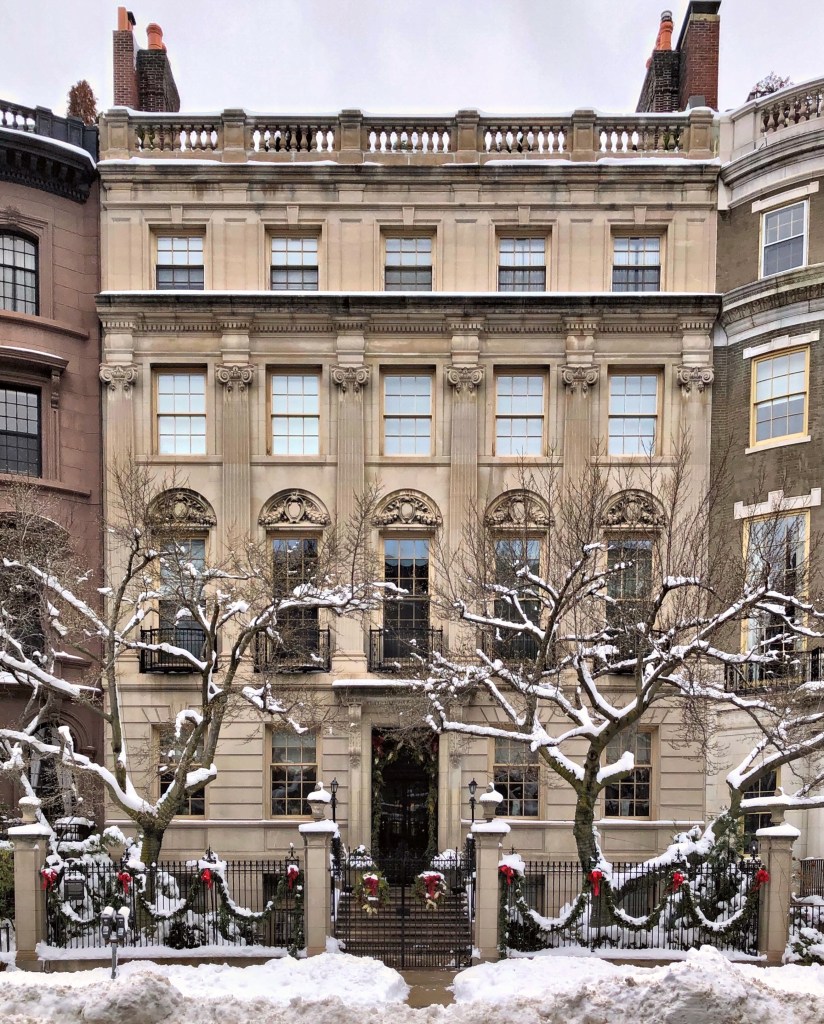
Adjacent to the Warren House (last post) on Beacon Street in Boston’s Back Bay neighborhood, this massive mansion is one of my favorites on the street. Built in 1905, and designed by architect Alexander Wadsworth Longfellow, Jr. an amazing local architect, and nephew of poet Henry Wadsworth Longfellow. The grand mansion was the home of Eben Sumner Draper and his wife, Nancy. Eben Draper was a manufacturer of cotton machinery in the Draper Corporation, founded by his father in Hopedale, MA. Draper graduated from MIT and entered his fathers business, which upon the time of his graduation, was the largest plant for manufacturing cotton machinery in the world. In 1905, Draper was nominated and elected as Lieutenant Governor of Massachusetts, the same year he had this mansion constructed. In 1908, Draper was elected Governor, and served two terms under the Republican Party, pushing a pro-business, and anti-reform agenda, a bill legalizing the merger of the Boston and Maine Railroad with the New York, New Haven and Hartford Railroad, signaling approval of what was seen as monopolistic business practices, something the Draper Corporation was known for in Hopedale. The former single-family home was converted to six condominium units in 2000. Fun fact: the Draper Mansion replaced the 1860 home David Stewart, a merchant from New York, built as a wedding present for his daughter, Isabella Stewart, and John (Jack) Lowell Gardner. Isabella would later create the beloved and iconic Isabella Stewart Gardner Museum. The couple purchased the adjacent townhome in 1880 to store their growing art collection.

Hollis Hunnewell House // 1870

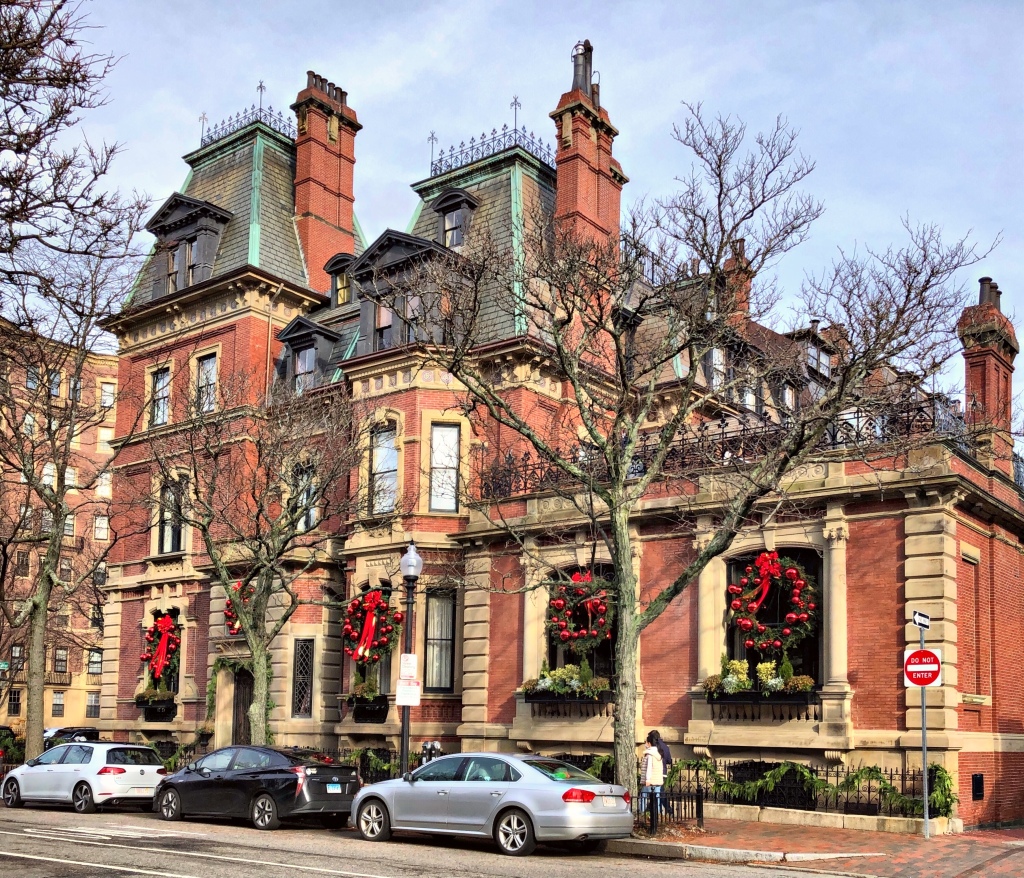
In 1870, when Boston’s new Back Bay neighborhood was being developed, Hollis Hunnewell and his wife Louisa, decided to erect a mansion to establish themselves in the burgeoning neighborhood. Hollis was the first son of Horatio Hollis Hunnewell, the businessman and railroad tycoon who made a fortune, eventually developing a family compound in nearby Wellesley. The couple hired esteemed architect Charles Brigham to design a home on the prominent corner lot that would live up to the Hunnewell name, and he did not disappoint. Just three years after the home was completed, they added a one-story addition, adjacent to the alley to quell a wind-tunnel effect that was occurring down the alley. In December, 1876, a fire broke out in the home, trapping maid Annie O’Hara at the top floor where she died. After the fire, the Hunnewell’s decided to renovate the home, adding the prominent corner tower with cresting. Hollis died in 1884, leaving his wife and two children alone in the home (along with the housekeepers, maids, and other help) until her death in 1890. The home is an excellent example of late Second Empire architecture in Boston, and it showcases the immense wealth some distinguished families had in the region in the 19th century. Today, the 13,000 square foot home is occupied as a single family home, assessed at over $17.5 million!

King House // 1880

Located at the corner of Commonwealth Avenue and Fairfield Street in the Back Bay neighborhood of Boston, this MASSIVE townhome exudes wealth and prestige. The home was built in 1880 as the home of iron and steel manufacturer George Parsons King and his wife, Sarah Williams (Lothrop) King. The home was designed by architect William Whitney Lewis and took over a year to build, even with numerous skilled craftsmen. The Kings lived in the Hotel Vendome two blocks away while this home was being built. The brownstone and brick Victorian Gothic townhouse has its main entrance on Fairfield Street within an arched vestibule. The home remained a single family home through numerous later owners until 1979 when it was converted to six condominium units, all still with plenty of space.

Massachusetts Normal Arts School // 1886-1967

The Massachusetts Normal Art School was one of the many Richardsonian Romanesque buildings constructed in the Back Bay, but it did not survive like so many others did. The building’s history goes back to the 1860s, when wealthy Bostonians petitioned for the Commonwealth of Massachusetts (State Government) to assist with the founding of new institutions to enhance the quality of life in the state. Due to this, the legislature funded three major institutions including the Massachusetts Institute of Technology (1860) and the Museum of Fine Arts (1870), and founded in 1873, the Massachusetts Normal Art School. The Normal Arts School was tasked with training future teachers for public schools and budding professional artists in the arts, with courses ranging from drawing to architecture. The Commonwealth of Massachusetts rented space in various buildings in Downtown Boston before they appropriated $85,000 and hired the firm of Hartwell & Richardson to design and oversee construction of the new school at the corner of Newbury and Exeter Streets. The Richardsonian Romanesque building was constructed of red brick and brown freestone, featured entrances on both street facades, and held gallery spaces inside for members of the public to view the work created at the school. The school outgrew the original building, which could comfortably fit just 100 students, and in 1929, a new building was constructed at Brookline and Longwood Avenues. Before moving one more time to its current location in 1983, the school was renamed to the Massachusetts College of Art and is best known as MassArt today. The original school in Back Bay was demolished in 1967 and was home to a surface parking lot before the existing building was constructed.

Porter House // 1906

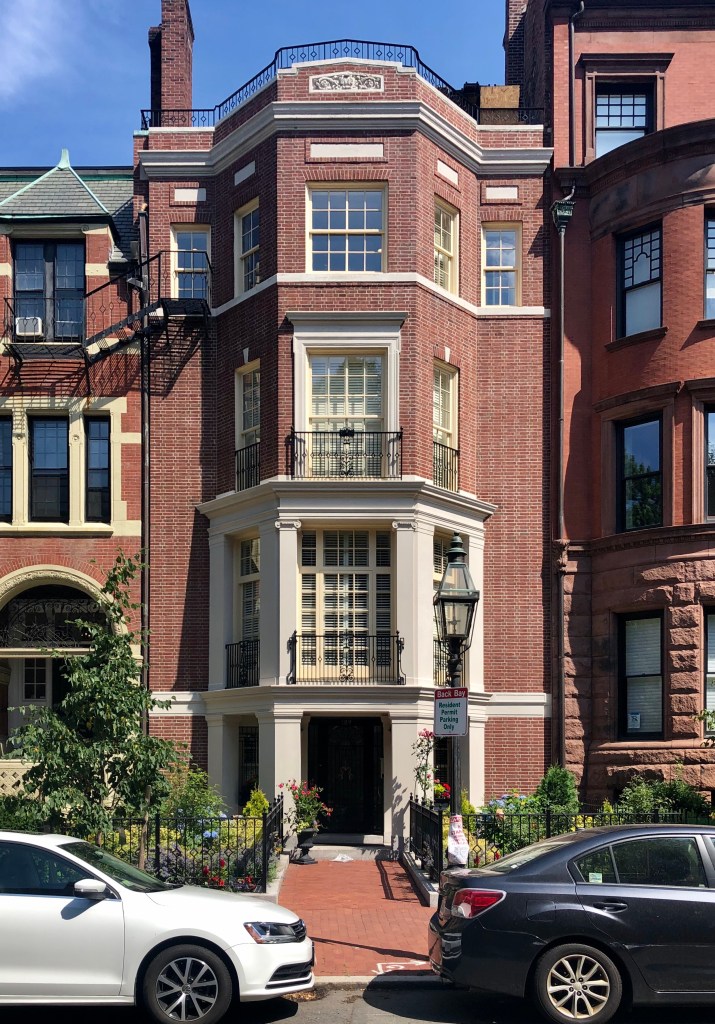
Built for “the best-known real estate operator in the city [Boston]”, this stunning townhouse, while narrow, packs a punch among the gorgeous homes on Marlborough Street in the Back Bay. This home was designed by the architectural firm of Winslow & Bigelow and built for Alexander Sylvanus Porter, Jr., and his wife Henrietta Goddard Wigglesworth. Mr. Porter was a partner of J.K. Porter & Co., auctioneers and real estate brokers. He was crucial for the development of many iconic buildings in Boston and New York, including the Touraine Hotel, the Boston Stock Exchange, the Brazer Building, and more. The townhome can be classified as Classical Revival with the symmetrical facade with central door, use of classical pilasters at the central bay, and decorative stone ornamentation on every floor.

Wheatland Rowhouses // 1874

This series of four rowhouses at 233-239 Marlborough Street were built together in 1874 for George Wheatland. Designed as two sets of symmetrical pairs, the four homes together contribute to the character of the Back Bay neighborhood while standing out for their use of materials and detailing. George Wheatland Jr. was a developer of over 100 properties in the Back Bay after the Civil War, and through his business partnerships and savvy land acquisitions and developments, became one of the wealthier residents of the neighborhood. Wheatland was born in Salem, MA and attended Harvard Law School before starting work as an attorney. Within a couple years, he was called to serve in the Civil War and fought for the Union Army, participating in the Siege of Port Hudson in Louisiana! When he returned, he used his legal knowledge and business connections to acquire and develop the filled, newly developable land in Back Bay. These four homes are constructed of brick with scored stucco on the main facade to resemble brownstone, which was more expensive. A large central oriel bay window is situated at each home with the fourth floors incorporated into a mansard roof with Stick style detailing at the dormers.