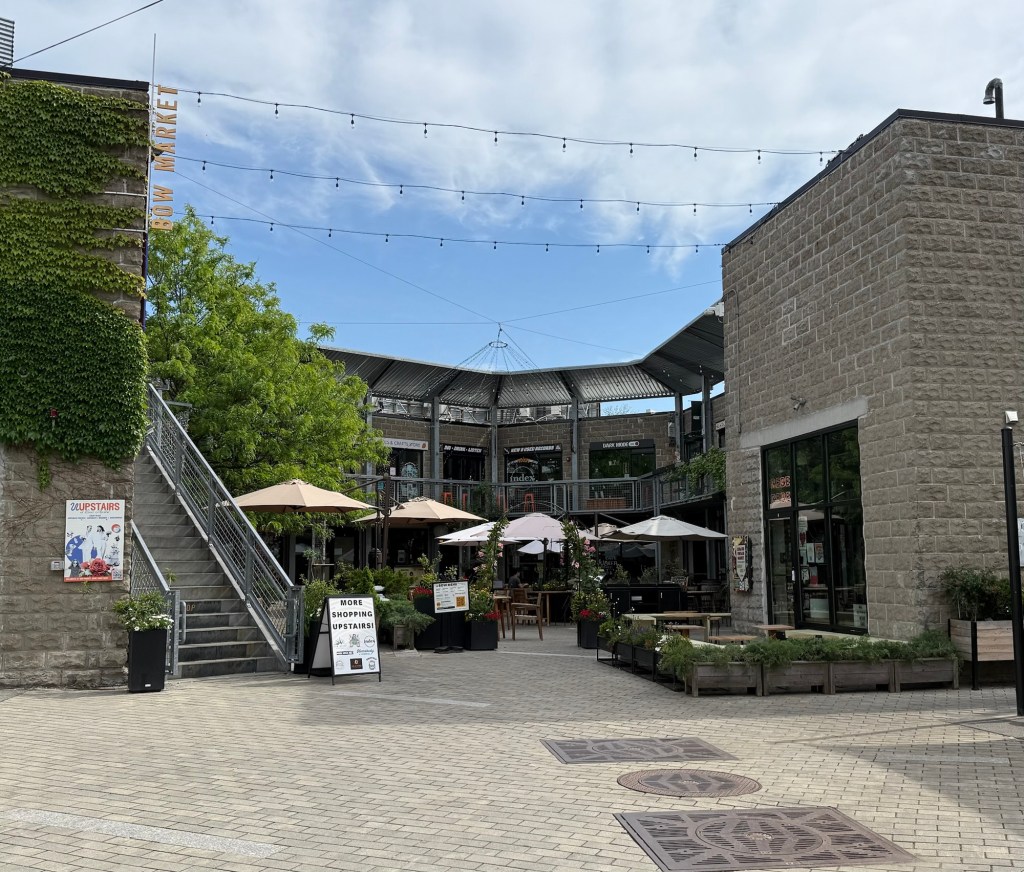
One of the best and most successful examples of adaptive reuse in the Boston area has to be Bow Market in Somerville’s Union Square commercial district. Tucked away behind buildings on the busy streets, a former concrete block storage facility was reimagined as a vibrant, European style marketplace of local vendors and businesses. The project was envisioned by business partners Matthew Boyes-Watson and Zach Baum, who worked with Matthew’s father, architect Mark Boyes-Watson, to renovate the storage building to create storefronts. The team worked with landscape architects, Merritt Chase, to make the public courtyard more enticing, which each micro-commercial space opening onto the landscaped communal courtyard. Design elements include seat walls constructed from recycled granite from the renovation of the Longfellow Bridge and reclaimed wooden beams from a ship building facility in Hingham. If you haven’t been to Bow Market yet, you must. This project is exactly what good urban planning and design is all about!
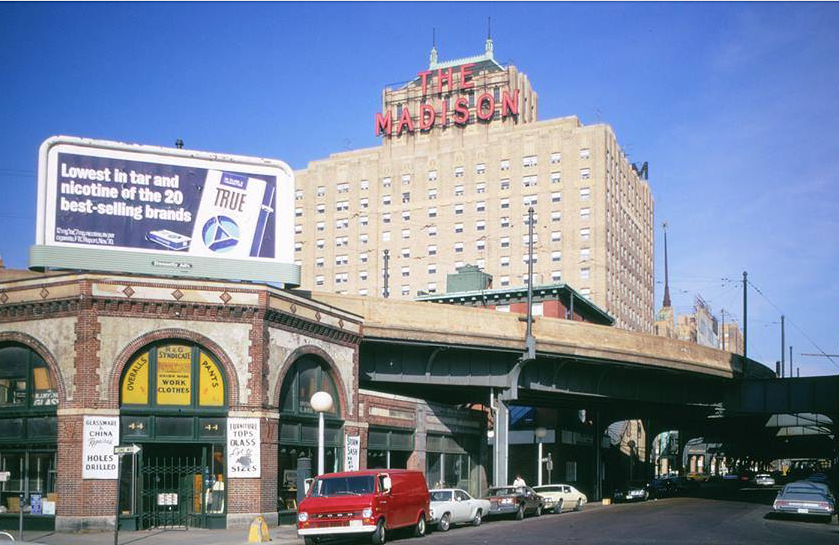
Built on the site of the former Boston & Lowell Train Station the Hotel Manger (later renamed the Madison Hotel in 1959) was part of the first redevelopment of North Station in Boston. When the Boston & Maine Railroad announced that plans had been finalized for the construction of a new North Station facility, which would include a sports arena, hotel, office building, and distributing terminal, Manger Hotels, a national hotel chain, and the Boston & Maine Railroad announced that the two parties had signed a contract for the construction of the hotel on the site with each party holding a 50% stock in the building. Designed by the architectural firm of Funk & Wilcox in the Art Deco style, the 17-story hotel was completed in 1930 and contained 500 rooms and at the time of its opening, the hotel was said to have had proportionately more marble than any other building in New England! As railroad traffic declined, the neighborhood surrounding North Station lost its importance as a commuter center and the hotel began to suffer financially, leading the hotel to close in 1976. Plans to convert the old hotel into elderly housing fell through, and in March 1983, the Boston Redevelopment Authority purchased the hotel and demolished it as part of their urban renewal plan for the area. The site is now occupied by the mundane Thomas P. O’Neill Jr. Federal Building.
In the second half of the 20th century, much of Downtown Boston and the Waterfront areas were blighted with decaying buildings. Seeing tax dollars flee to the suburbs, the City of Boston used Urban Renewal to demolish large areas to erect new neighborhoods and blocks to revitalize the city. Much of it was done with a heavy hand, evicting largely minority and immigrant residents and razing of traditionally walkable neighborhoods for more car-centric districts. The Waterfront was traditionally the economic hub of Boston, with large commercial wharf buildings jutting out into the harbor symbolizing the economy’s strong ties to maritime trade for centuries. Boston Properties was an early developer who saw the potential of the revitalized waterfront, and developed this hotel off Long Wharf. Architect, Araldo Cossutta, (who was originally picked 8th of 8 submissions in a design competition) was ultimately selected to design the hotel, which at first glance may look out of place. However, the building draws cues from the area, evoking the Quincy Market warehouses as well as the attributes of a modern ocean liner on its head. Relatively simple massing with rectilinear and semi-circular fenestration at the lower level rises to a complex series of stepped back balconies, which form a steep gabled roof. To me, its the right amount of recessiveness and boldness in Postmodernism.
Located across Arlington Street from the since demolished Shreve, Crump & Low building (last post), Heritage on the Garden stands overlooking the Boston Public Garden. Heritage on the Garden was a result of a redevelopment initiative known as the Park Plaza Project, one of the city’s many urban renewal projects of the 1960s and 1970s, where buildings, blocks, and sometimes neighborhoods were razed and redeveloped. As part of the city’s effort of dramatic urban renewal, the Park Plaza area was identified as a site for intensive new uses, including hotel and apartment towers ranging from thirty to fifty stories! The impact of these buildings on the Public Garden and Boston Common was considered unacceptable by many residents of the city, with citizen participation helped to require lower-height buildings which would front the iconic Public Garden. In the 1980s, nearly the entire block of Boylston Street between Arlington and Hadassah Way was razed for the erection of the new condominium building, developed by the Druker Company and designed by The Architects Collaborative (TAC). The project was one of the last of the iconic TAC firm, once led by Walter Gropius, who helped bring Modernism to the United States. The Post-Modern style building ranges from five- to twelve-stories tall and is constructed of brick with cast stone, a nod to the historic Boston architecture, but with modern forms and projections. I think it works quite well, but maybe that is because I wasn’t around to see what was there before…
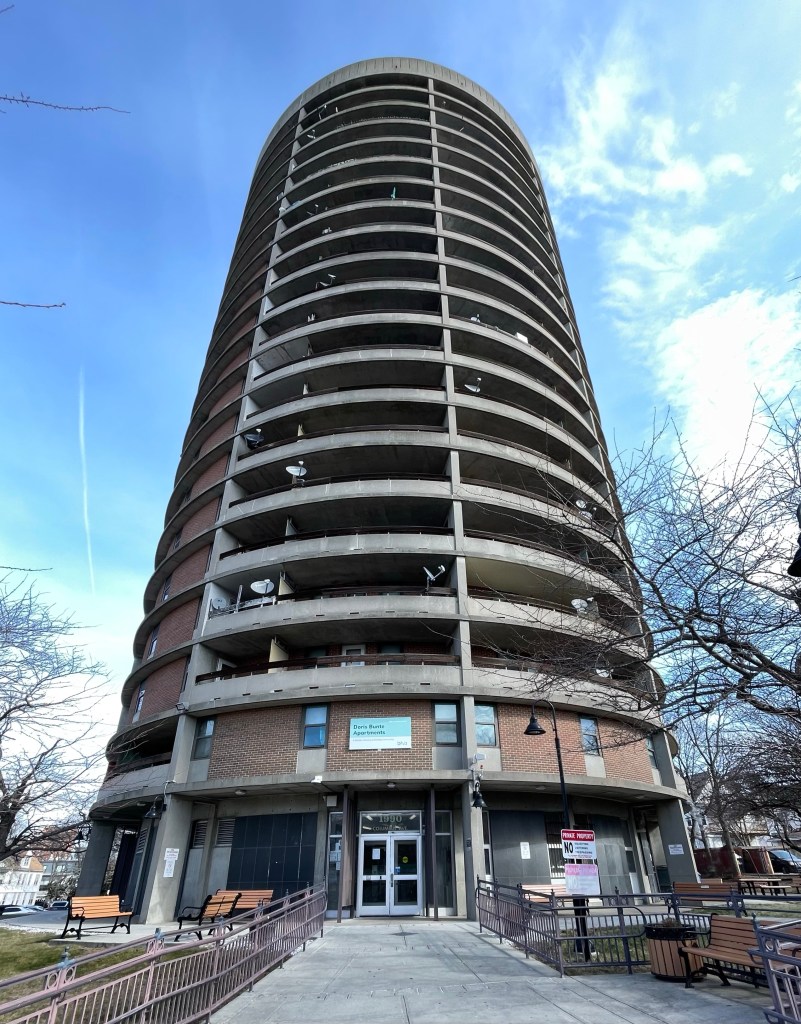
In the second half of the 20th century, parts of Boston saw disinvestment by private property owners as well as local and state government. With people leaving Boston for the suburbs, the hemorrhaging of tax revenue led urban planners to go big and institute ‘Urban Renewal‘ policies and planning to demolish what they believed to be substandard housing and invest in Modern apartments and car-oriented developments. The triangular shaped new community was as comprehensive as any urban renewal district in the region; indeed of the ten General Neighborhood Renewal Plans created by the BRA in 1961, Washington Park was the most self contained Urban Renewal District in the city. It included new police and fire stations, a courthouse, two public libraries, a shopping mall, a health center, elementary school and five garden style housing developments totaling almost 2000 apartments or townhouses. At its completion in 1975, $70.4 million had been invested to build the new community of which $31. 3 million came from the federal government. Part of this massive undertaking was the construction of elderly housing, which resulted in this 20-story cylindrical tower at the southernmost edge of the Urban Renewal area. The tower was constructed between 1967 and 1970 and was designed by Boston-based architectural firm Richmond & Goldberg, led by Isidor Richmond and Carney Goldberg. Apartments were “integrated” with with 70% Black and 30% White residents, all with private balconies and an emergency pull-chain system in kitchens and bedrooms for the elderly residents. As far as mid-century apartment towers go, this one is pretty interesting and unique. The building was renovated a few years ago and renamed the Doris Bunte Apartments. In 1969, Buntè was nominated to the Boston Housing Authority board, making her the first female public housing tenant to serve. In 1972, she was elected to the Massachusetts House of Representatives, becoming the first woman of color to serve in the Massachusetts legislature, and the first female to serve in the House leadership in 68 years. While there, Buntè helped found the Black Legislative Caucus and the Caucus of Women Legislators.
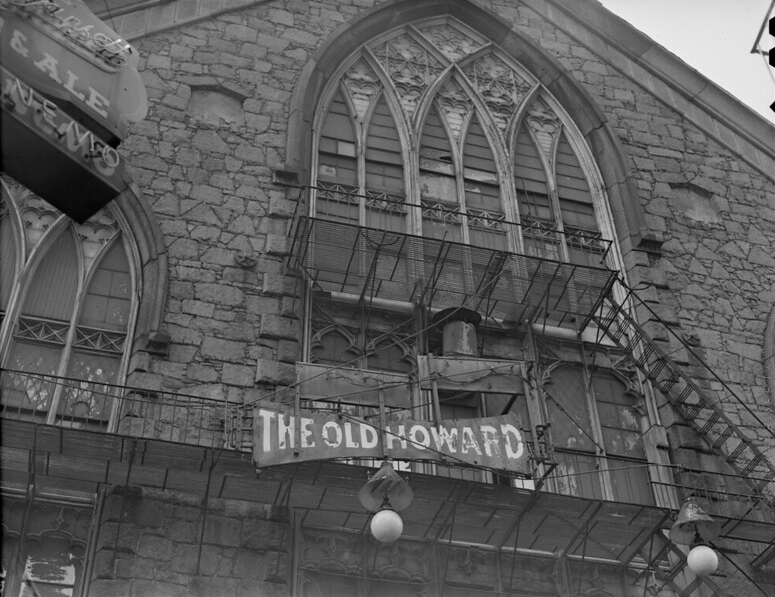
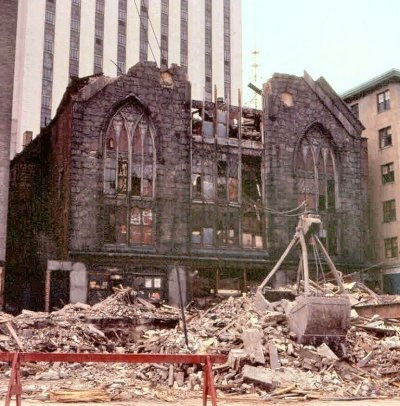
One of the more iconic theater buildings to ever stand in Boston was the Howard Athenaeum, later the Old Howard, which stood on the former Howard Street in Downtown Boston. The origins of the building begin in 1843, when a flimsy, tent was built to serve as a church for the small Millerite sect. The small but loyal congregation eventually abandoned the site following disappointment with the minister’s promise that the world would end in 1844. After Armageddon failed to materialize, the founder of the sect, William Miller, an ex-Deputy Sheriff from Poultney, Vermont, was discredited and the Millerites moved on. After running their former minister out of town, several church members (who had given up all their worldly possessions in preparation for their trip to heaven,) decided to recoup some of their losses by selling the property to Messers Boyd and Beard, who opened a theater here in 1845. A fire destroyed the structure, and it was replaced by a larger, fireproof building that same year. The new building was constructed in 1845 and was designed by architect Isaiah Rogers in the Gothic Revival style with massive granite blocks from Quincy.
The Howard Athenaeum saw many iconic performers and historical events in its 100 years. A young John Wilkes Booth, played Hamlet at the Howard before becoming famous for a more nefarious deed in Washington in 1865. Also, Sarah Parker Remond, a Black anti-slavery activist and lecturer with the American Anti-Slavery Society (and later a medical doctor), had bought a ticket through the mail for the Donizetti opera, Don Pasquale, but, upon arriving, refused to sit in a segregated section for the show. She was forcibly removed and pushed down a flight of stairs. She eventually won a desegregation lawsuit against the managers of the Howard Athenaeum and received $500 in a settlement.
The theater was quickly deemed obsolete and second-tier compared to more modern theatres built nearby. By the mid-20th century, the Old Howard was largely featuring burlesque shows. To keep bringing in audiences, the burlesque performances got more risqué with each year. As a result, the Boston vice squad made the Old Howard the object of their attention. The Boston Vice squad made a 16 mm film during one of their raids in 1953 and captured on film the performance by “Irma the Body”. This film footage resulted in an indecency hearing which eventually led to the closing of the Old Howard in 1953. A fire a few years later along with Urban Renewal led to the demolition of the Old Howard by 1962. Like the former Suffolk Savings Bank (featured previously), the present Center Plaza Building is on the site.
When elevated train service from Boston extended to Forest Hills in Jamaica Plain in 1909, the residents of the surrounding neighborhoods and points south were ecstatic to realize the chance to enjoy quicker transit to the city. The station, which opened in 1909, was an architectural landmark and engineering feat, as the new terminal was the largest structure of its kind and the most costly in the country at the time. The large station was made of steel and reinforced concrete, finished in copper at the elevated section, and took nearly two years of construction. City architect Edmund M. Wheelwright designed the station, and upon its opening, it was called “the chef-d’œuvre of rapid transit development in Boston”. Like with many cities all over the country, shifting transportation planning and priorities and shrinking investment necessitated the once grand station to suffer the fate of the wreckingball. As part of the Southwest Corridor project, this station was to be demolished, with a modern station constructed to service the MBTA trains on the Orange Line. Also, plans were developed for a 12-lane highway along the railroad right-of-way between Boston through Cambridge. The residents of the affected areas, including Jamaica Plain, Roxbury, South End, Back Bay, and Cambridge, protested against the destruction of their neighborhoods by the planned highway, and won! The old Forest Hills Station was a casualty of the proposal, but a lasting reminder for neighborhood planning and advocacy, preserving character and people over cars.



 Buildings of New England