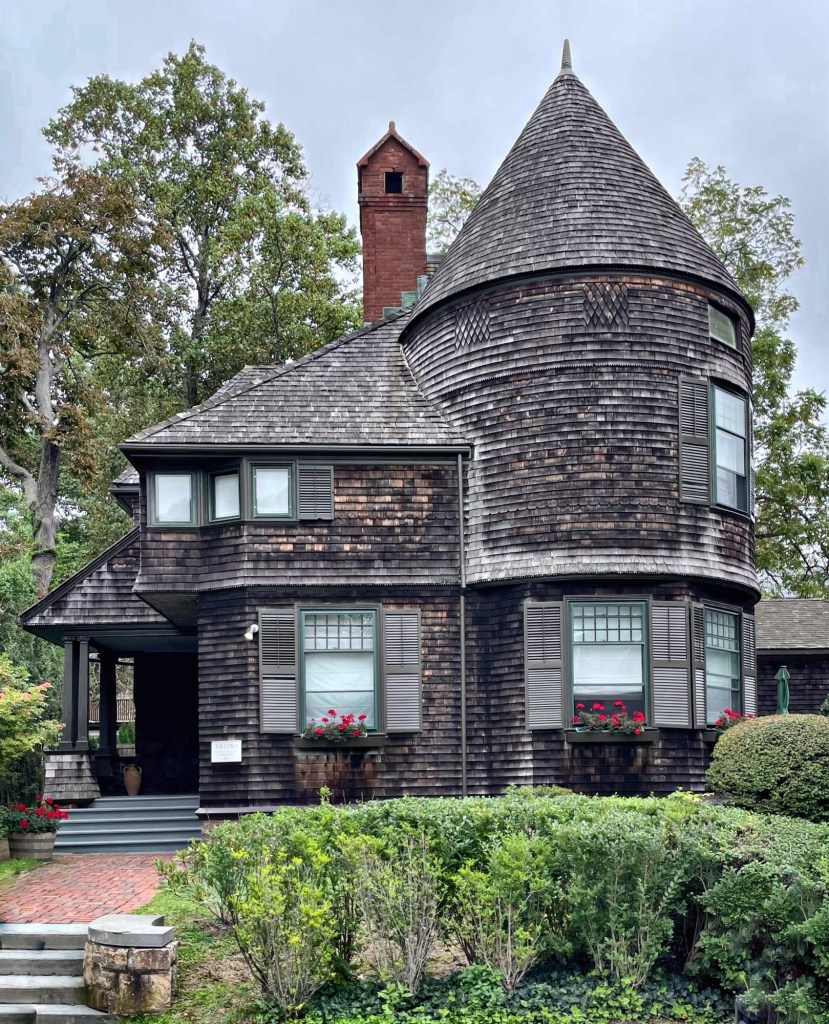
“Villino” was built in 1882 for $7,553, as a summer residence for Ms. Frances L. Skinner, a widow of the late Reverend Thomas Skinner. “Villino” was the work of the young firm of McKim, Mead & White, and it is one of the firm’s many Shingle style buildings, but one of the most compact. The asymmetrical 2½-story Shingle Style cottage sits atop a granite foundation with continuous shingles above. The entrance porch is tucked into the building mass on the side and its prominent tower with conical roof. The house is sited well into the landscape and unlike many other summer “cottages” the name Villino which is Italian for cottage, actually fits!
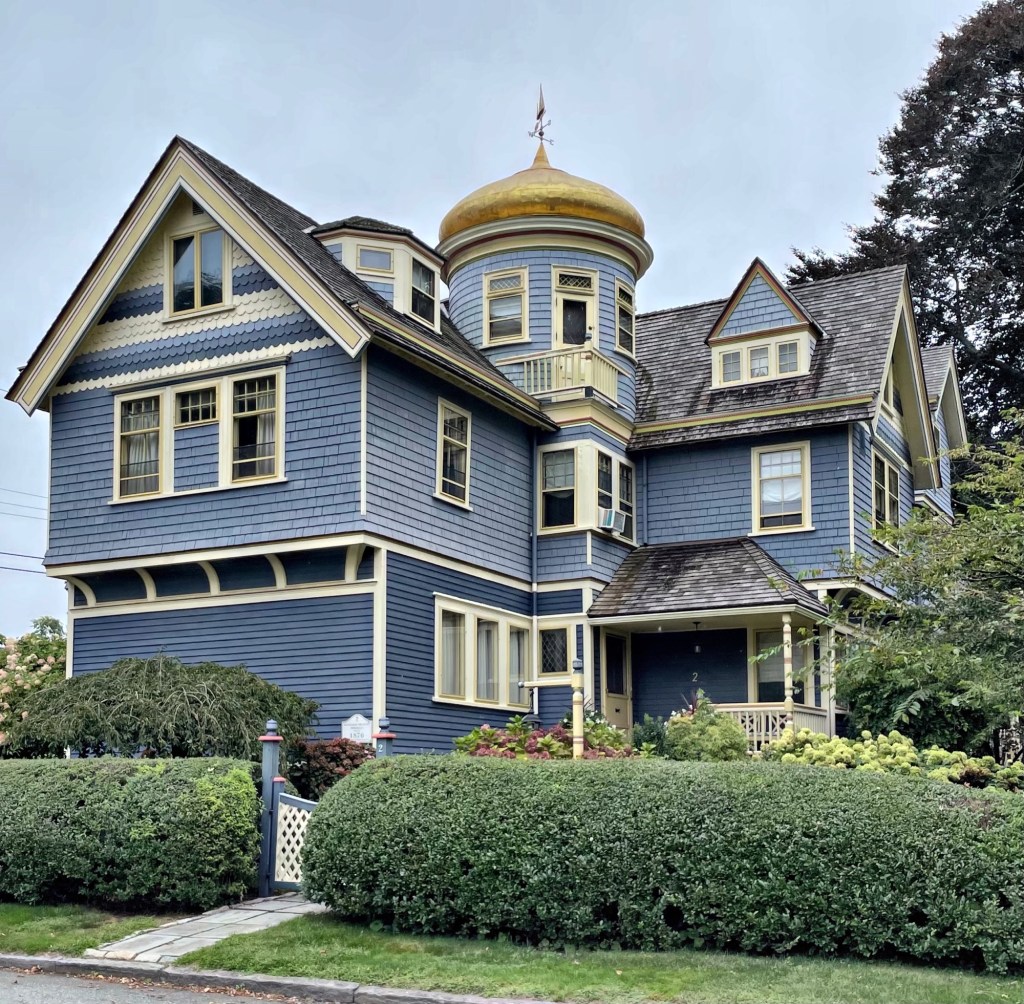
The Katherine Prescott Wormeley House is an eclectic and eye-catching Queen Anne architectural landmark on Red Cross Avenue in Newport, Rhode Island. Boston-based Katherine P. Wormeley (1830-1908), a native of England, served as a nurse for the Union Army during the Civil War and was one of the best-known translators of French literature into English. She built this double-house at a cost of $7,000 and rented another unit in the home for additional income. The Wormeley House is one of Charles Follen McKim’s early, independent works after working in the office of H. H. Richardson but before forming his own firm with William Rutherford Mead in 1877. Just years after she moved in, Ms. Wormeley in 1882, hired McKim, who was now under the firm, McKim, Mead & White to update and enlarge the home. By 1893, Wormeley had moved to New Hampshire and sold the house to Elizabeth Cabot Hayden and Dr. David Hyslop Hayden. The golden onion dome roof at the tower is a real treat!
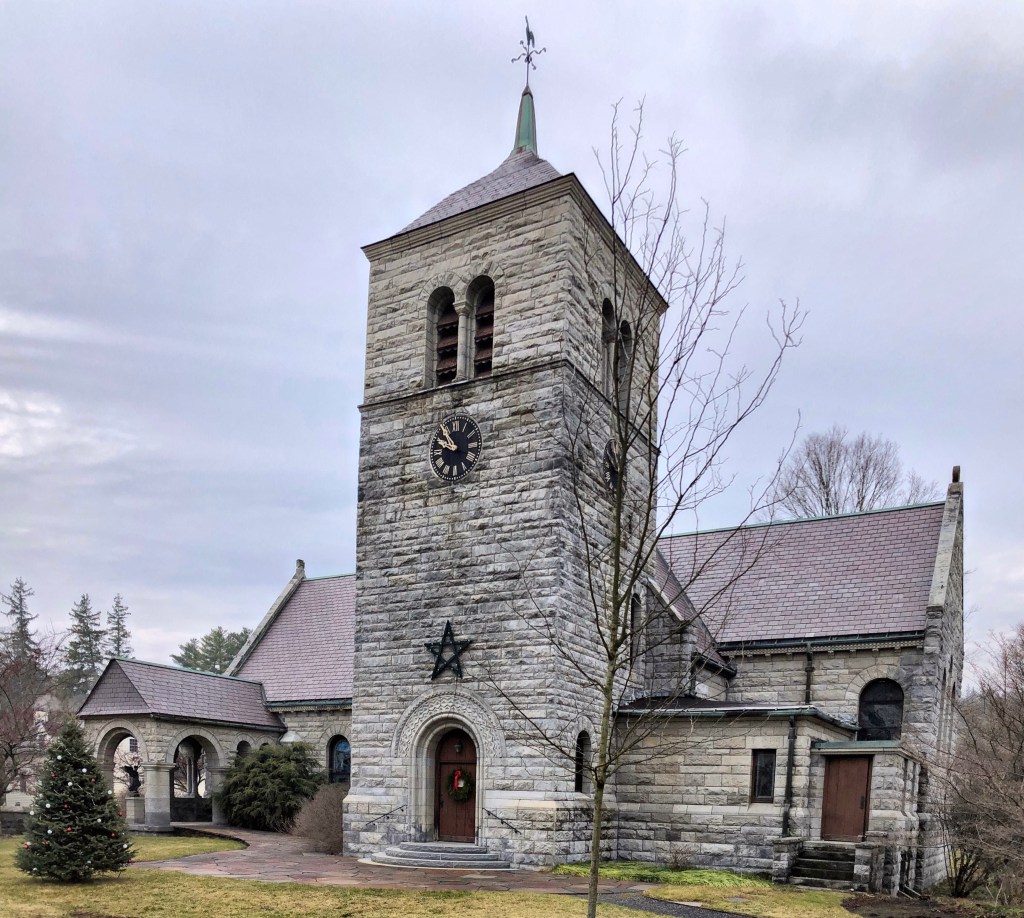
Located on the idyllic Main Street in Stockbridge, MA in the Berkshires, this stone church marks the emergence of the once sleepy town into a summer retreat for wealthy citizens, escaping the cities in the late 19th century. This building is Charles Follen McKim’s first church design, a building reflecting his early training in the office of H. H. Richardson with the use of Romanesque detailing, though with a hint of Norman design. St. Paul’s Church is constructed of gray Berkshire granite with stained glass windows by John La Farge. The church replaced an older wooden church building designed by Richard Upjohn in the Gothic Revival style. The church was almost entirely funded by Charles Butler, a New York lawyer who wanted to honor his late wife Susan Ridley Sedgwick Butler, a descendant of Theodore Sedgwick, whose home I featured not long ago.
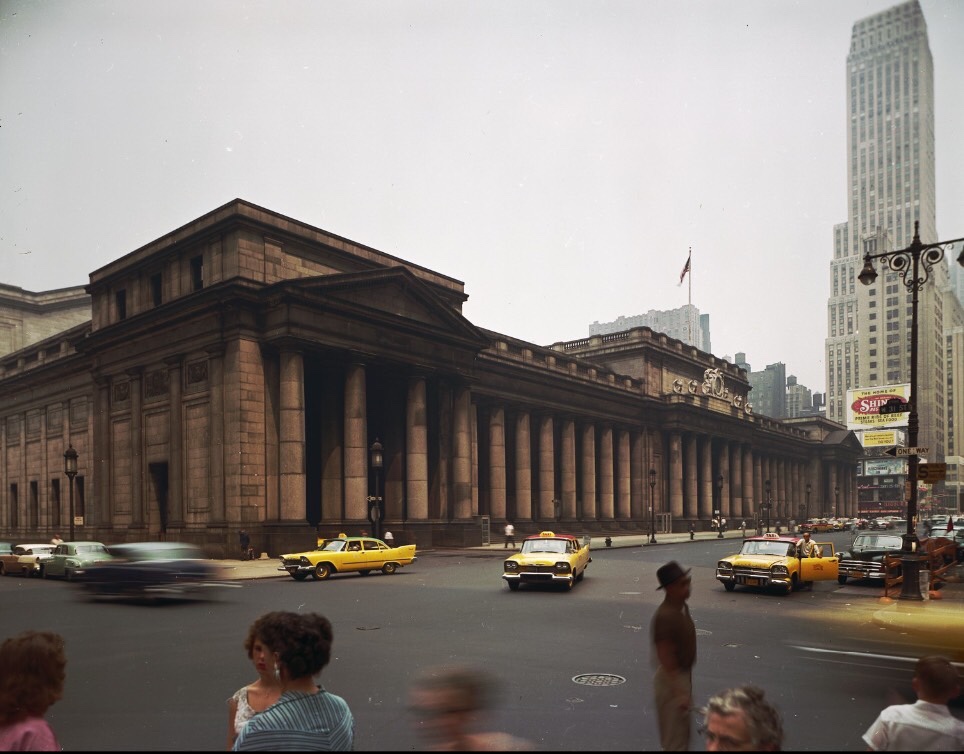
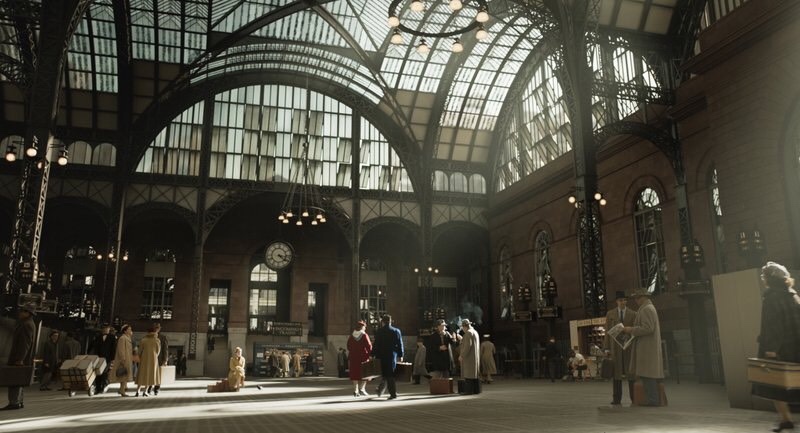
Pennsylvania Station in Manhattan was opened in 1910, and its sheer scale immediately evoked a sense of awe. At the time it was completed, it was the largest building ever built occupying two entire city blocks, and boasted the biggest waiting room in history. Over 500 buildings were demolished for the station to make way for the Charles McKim-designed station, an icon in the Beaux-Arts style. The structure had“nine acres of travertine and granite, 84 Doric columns, a vaulted concourse of extravagant, weighty grandeur, classical splendor modeled after royal Roman baths, rich detail in solid stone, and an architectural quality in precious materials that set the stamp of excellence on a city.” Sadly, being one of the most beloved architectural gems in the city did not constitute its maintenance nor preservation.
In 1961, after numerous plans for redevelopment, air-rights were sold on the building and in 1963, Penn Station was razed. The former grand station was replaced by Madison Square Garden and Pennsylvania Plaza, an office skyscraper, all with a modernized station below. When the building was destroyed, art historian Vincent Scully famously said, “One entered the city like a god. One scuttles in now like a rat.” In 1965, two years after Penn Station’s demolition commenced, the city passed a landmarks preservation act, thereby creating the New York City Landmarks Preservation Commission. Additionally, Grand Central Station was proposed to be demolished later in the decade, but was saved thanks to preservation efforts.
 Buildings of New England