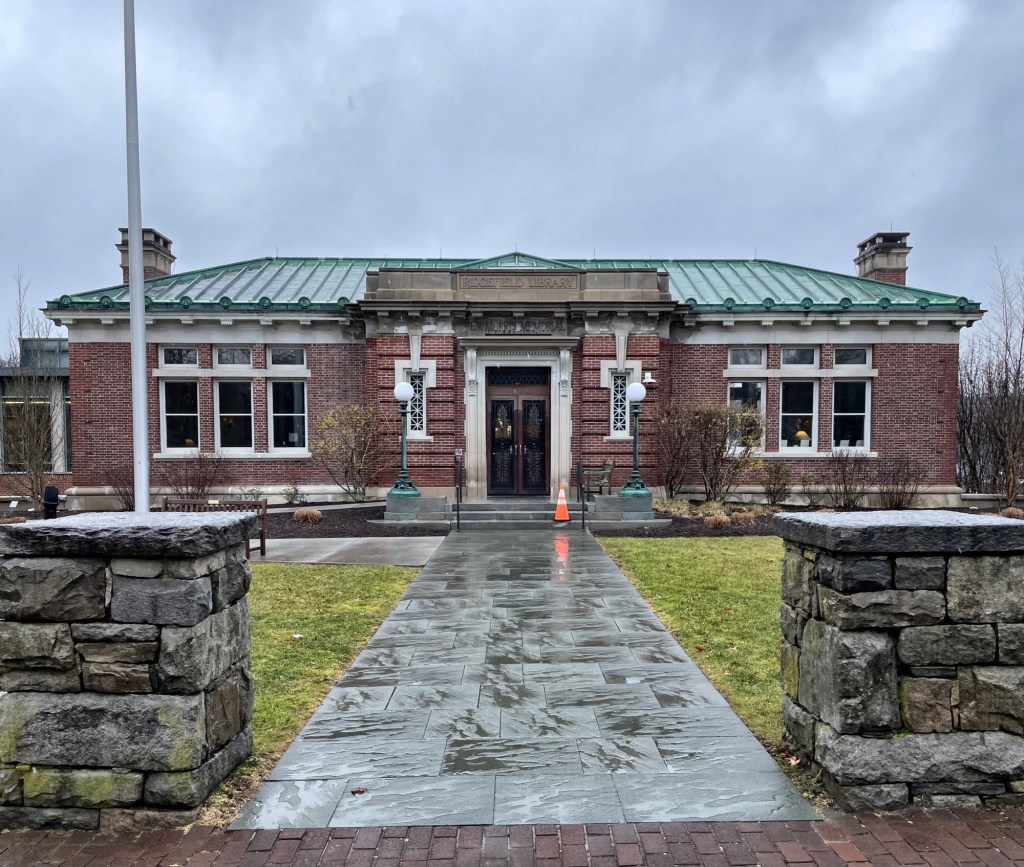
The Ridgefield Public Library is an intriguing Beaux Arts style building from the turn of the 20th century. Built in 1901, the brick structure replaced the Smith Tavern, a 1798 frame structure built by Amos Smith right on Main Street. In 1900 the Smith Family sold the property to James N. Morris who had this library built in memory of his wife, Elizabeth, donating it to the town. Architect Raleigh G. Gildersleeve is credited with the design which is comprised of a one-story building constructed of brick with cast stone trim details and ironwork at the door. The library was given later additions, which are recessive in location and detailing to let the original building shine, as it should!
One of the biggest architectural losses in New Haven was the 1957 demolition of the Town-Sheffield Mansion, formerly on Hillhouse Avenue. The mansion was built around 1836 by esteemed American architect and civil engineer Ithiel Town (1784-1844) as his own home on Hillhouse Avenue in the Greek Revival style; here he kept what was then an extraordinary architectural library, which was said to have been larger than any other personal collection anywhere at the time, including that of Sir John Soane in London. After Town’s death, the house was bought by Joseph Earl Sheffield in 1859, benefactor of the Sheffield Scientific School at Yale, and modified by local architect, Henry Austin in the Italianate Villa style. Alterations included two large asymmetrical towers, a new porch, and symmetrical side wings with large bay windows. After Sheffield’s death in 1889, the building was used for laboratory space for the school. Although the house was one of Austin’s most important works, it was demolished in 1957 by Yale to make way for Dunham Laboratory.
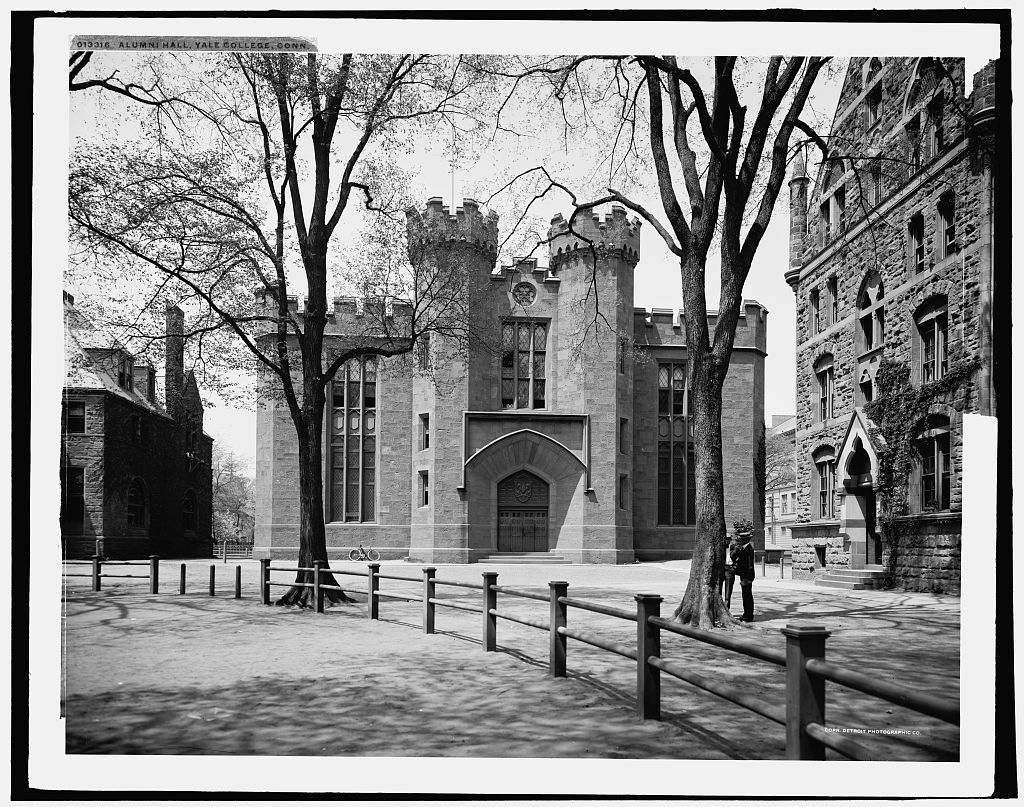
Alumni Hall at Yale was designed and built between 1851-1853, at the northwest corner of Yale’s Old Campus. Its was designed by Gothic specialist architect Alexander Jackson Davis, who completed Dwight Hall (the Old Library) a some years prior. The building had a large, open floorplan on the first floor for large gatherings as well as the entrance examinations, along with the biennial examinations that every student had to take at the end of his sophomore and senior years. As the building turned 50 years old, the campus around it was already looking very different. Shifting priorities for dormitory space in the yard necessitated its demolition for Wright Hall (next post). Alumni Hall was razed in 1911, but its two crenelated towers were salvaged when the building was demolished. They were incorporated into Weir Hall which has been incorporated into Jonathan Edwards College, one of Yale’s residential colleges.
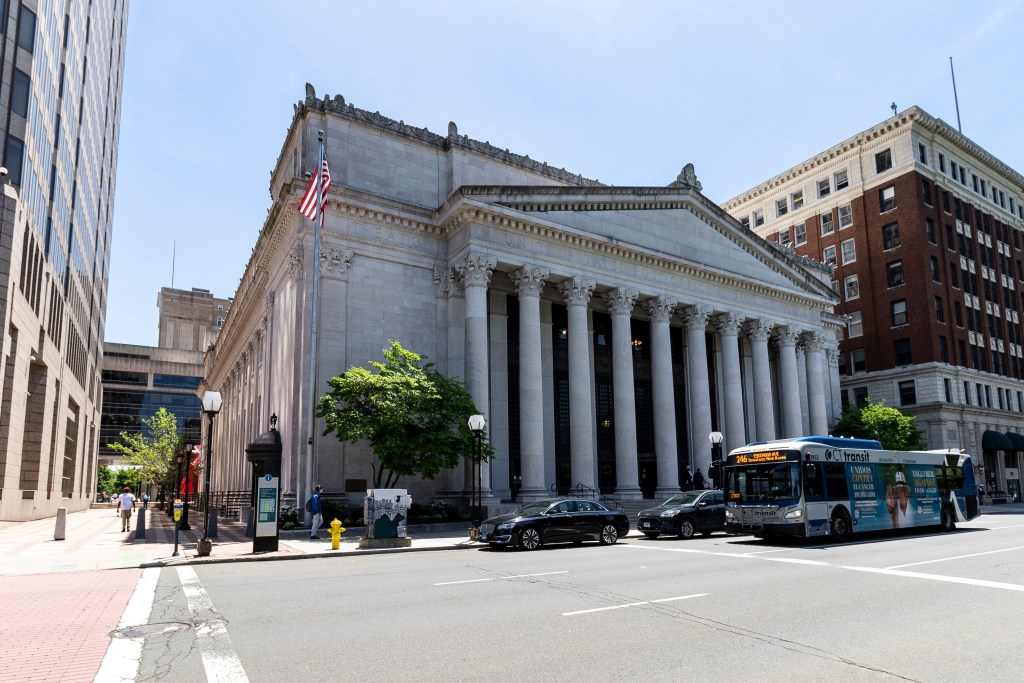
The monumental Richard C. Lee U.S. Courthouse is located on the west side of the Town Green in New Haven, Connecticut, a stone’s throw from the New Haven City Hall. The building is an excellent example of Classical Revival architecture. The building originally served both as a courthouse and post office, although the post office moved to another location in 1979. James Gamble Rogers designed the building, which was constructed between 1913 and 1919. Rogers was also the architect for structures at Yale University, his alma mater (more on some of those later). The building was the last to be designed under the auspices of the Tarsney Act (1890-1912), which allowed the Treasury Department to hire private architects rather than use only designers employed by the federal government. Classical architecture was commonly seen in federal building design during the early twentieth century because officials believed it conveyed the dignity of the federal government. The New Haven courthouse displays several hallmarks of the style, including the colossal portico and pediment with columns capped by Corinthian capitals. The courthouse was slated for demolition in the 1960s as part of an urban renewal plan. However, a coalition of federal judges and local historic preservationists rallied to save it. In 1998, the building was renamed to honor Richard C. Lee, a former New Haven mayor who was a pivotal figure in the building’s preservation as well as the city’s revitalization.
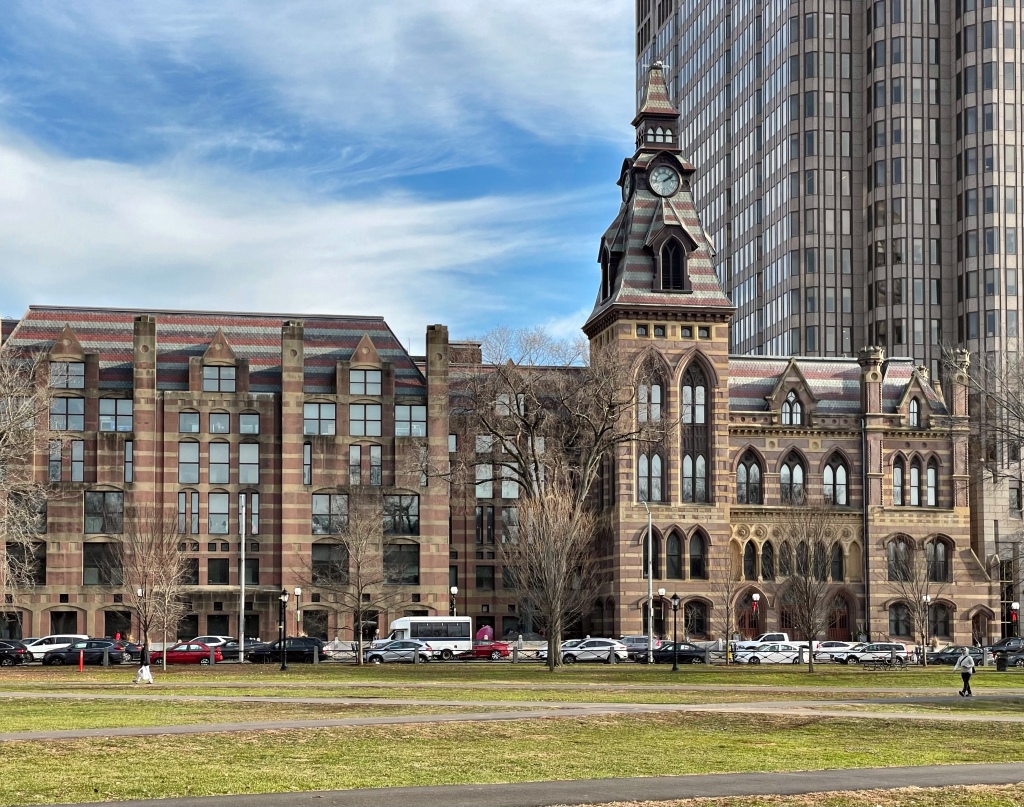
Less than four centuries ago the area which is now New Haven, Connecticut, was the home of a small tribe of Native Americans, the Quinnipiac. White settlers arrived by 1638 and made a deal with the local sachem (leader) to protect the native Quinnipiac from raiding bands of Pequots and Mohawks in return of purchasing some of the tribe’s land by the Puritans. By 1640 a complete government had been established and the settlement, originally called Quinnipiac, was renamed Newhaven (later New Haven). The town plan was based on a grid of nine squares. In accordance with old English custom, the central square, now the Green, was designated a public common. By 1718, in response to a large donation from East India Company merchant Elihu Yale, an early college relocated from Old Saybrook to New Haven, and its name was changed to Yale College. The city grew exponentially with industry, education, and commerce, becoming one of the wealthiest and diverse cities in the state. As the city grew after the Civil War, a new City Hall was built. The New Haven City Hall was constructed in 1861-2 and was designed by local architect Henry Austin. To the left of City Hall and set back further from the street was the old Courthouse (1871-3) designed by David R. Brown (1831-1910). Together the buildings provide a united facade marking the first phase of the High Victorian Gothic Style in America. By the 1980s, plans for a new Government Center were discussed following decades of deferred maintenance and a decaying building. Luckily, cooler heads prevailed, and the facades of the building were preserved with a modern structure constructed behind to house city offices, from plans by local architect Herbert S. Newman. The Victorian Gothic and Post-Modern building stands proudly today, anchoring the east end of the Town Green.
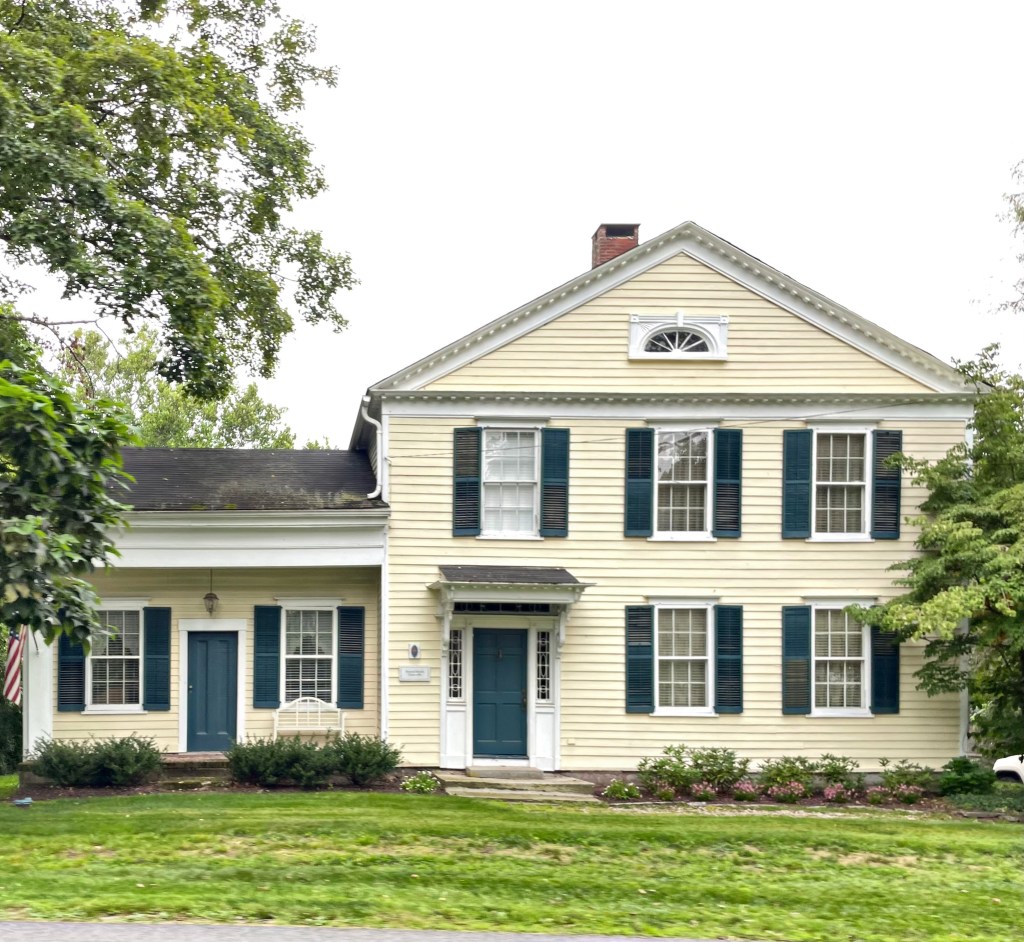
This transitional Federal-Greek Revival style house sits on the main street in South Britain, Southbury, Connecticut. The based on the style, the house was likely built around 1829 for Samuel Smith (1804-1856) who married Caroline Curtiss that year. Federal elements include the entry at the gable end, a pedimented facade embellished with modillions, and a doorway with sidelights and a leaded transom. Some moldings, the six-over-six windows and the simplicity of design are Greek Revival. It is one of the best preserved old houses in this part of Southbury.
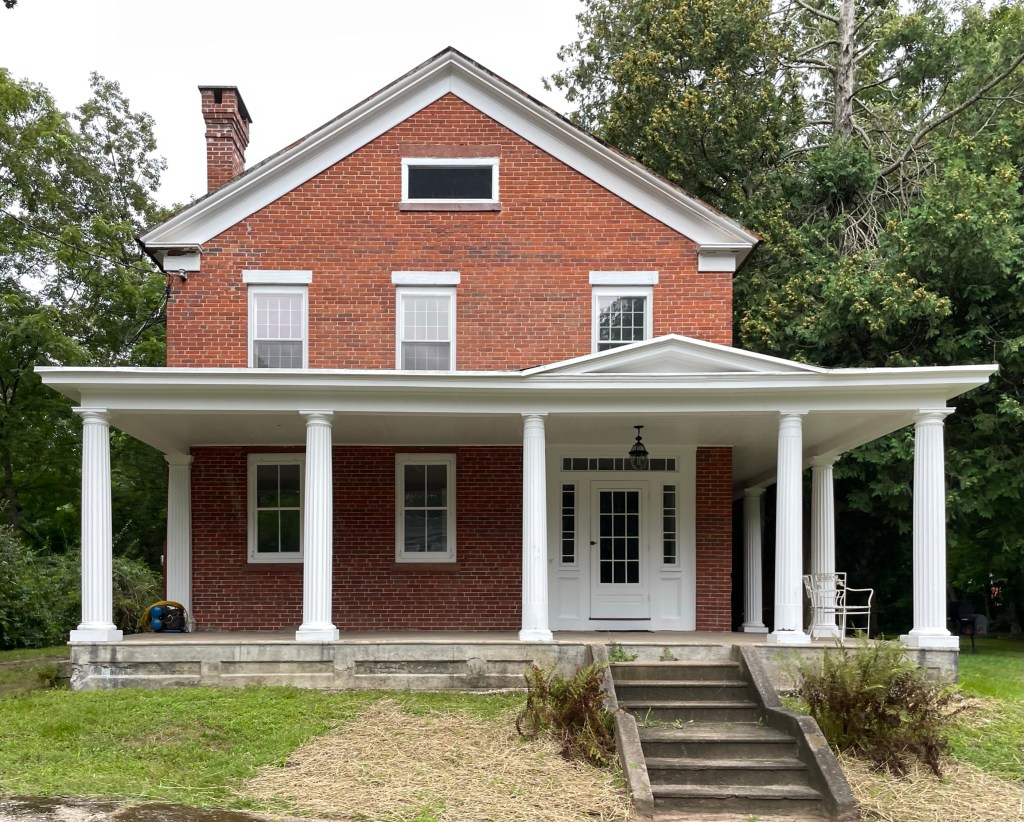
Located a stone’s throw from the Judson Manville House (last post) another uncommon brick Greek Revival style house in South Britain, Connecticut, this house stands out for its outstanding proportions and well-preserved exterior. This residence was built around 1830 for Benjamin Downs on the site of his family’s old property. The simple lines, portico at the entry supported by Ionic columns, and the window in the gable are all typical of the period.
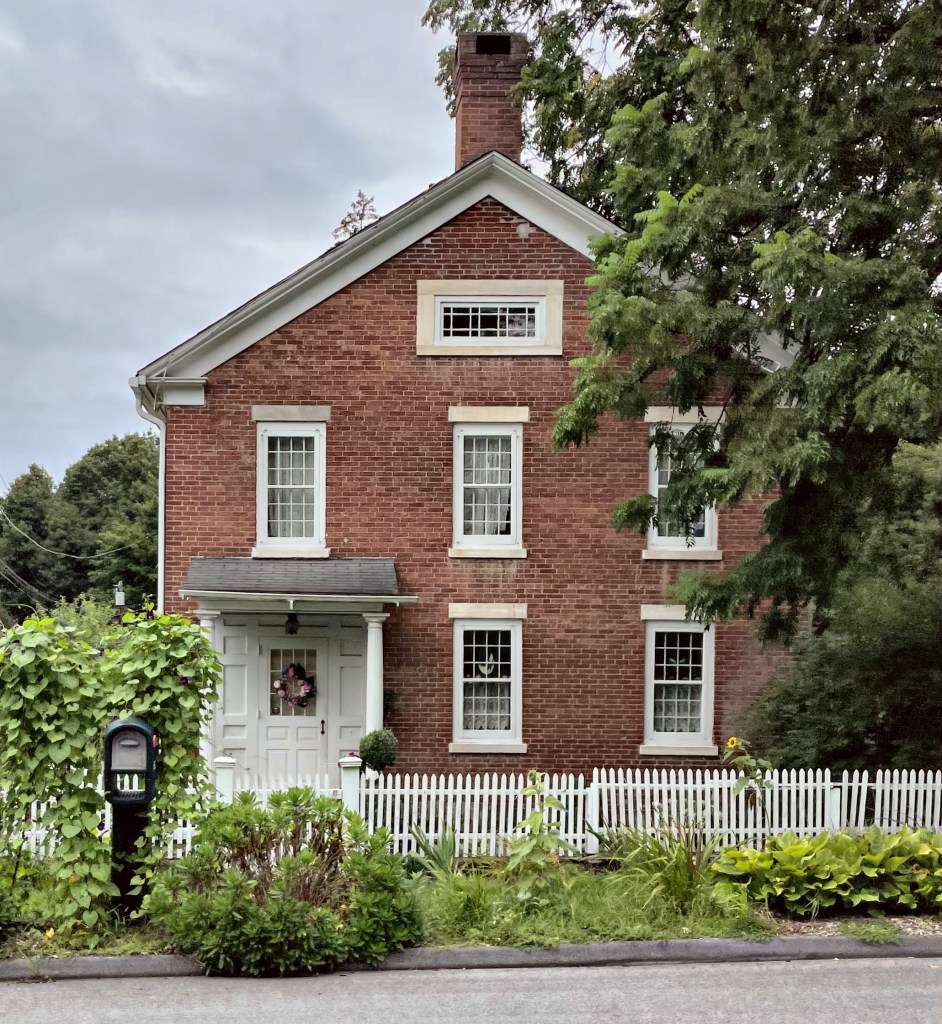
Greek Revival style houses in brick are amazing to find “in the wild”, when I stumble upon them! This example is located in the South Britain village of Southbury, Connecticut. The brick house was built for Judson Manville in 1835 and it was constructed of locally manufactured bricks. Judson operated a hat manufacture next door to this property and it clearly made him some money. The property was eventually acquired by the Hawkins Company at the turn of the 20th century and it was operated as the company offices. It was during this time that the 20th century wrap-around porch was added. It is now a private residence.
The Southbury Training School occupies about 1,500 acres of land in Southbury, Connecticut comprised of two major sections: a self-sustaining 400-acre institutional campus and its contiguous 1,100-acre farm complex. Planning for the Southbury Training School began in 1935 at the height of the Great Depression. The State needed to provide housing and services for 1,200 residents on the waiting list for the Mansfield Training School, the state’s only facility for the mentally handicapped at that time. Site planning and development were the responsibility of architect Edwin A. Salmon, later Chairman of the NYC Planning Commission, along with A. F. Brinckerhoff, who was hired as the landscape architect. Two buildings of the nearly 100 that comprise the campus stood out to me the most, they are the Roselle School and the Administration Building. Both structures were built in 1940 and are hallmark examples of inter-war Colonial Revival style buildings for institutional use. Both structures have large cupolas at the roof and symmetrical facades with applied wood ornament over the brick. The Roselle School has a recessed entry and the Administration Building is notable for its hipped roof and pilastered façade. In recent decades, the State of Connecticut has been under-funding the complex, leading to lawsuits and concerns statewide. The state has been moving residents and patients to other facilities, likely in order to sell-off or redevelop the campus in the future. This is one to watch out for!
Formerly known as “Churaevka,” the community known today as Russian Village in Southbury, Connecticut, was established in 1925 as an artistic community for Russians who fled to America after the Russian Revolution of 1917. The village was created by two Russian writers, Count Ilya Tolstoy, the son of Leo Tolstoy (the author of War and Peace and Anna Karenina), and the famous Siberian novelist George Grebenstchikoff. Although Tolstoy was first to discover the area while visiting his translator in Southbury, it was Grebenstchikoff who dreamed of establishing a cultural center and planned to create a rural community of cottages where Russian writers, artists, musicians and scientists could live and flourish statestide. The village was named after a mythical Siberian village mentioned in the works of Grebenstchikoff and the centerpiece is this chapel, St. Sergius Chapel, which was built in 1932-33 from plans by Nicholas Roerich. The small square-plan chapel was likely built of stone gathered from the neighborhood.



 Buildings of New England