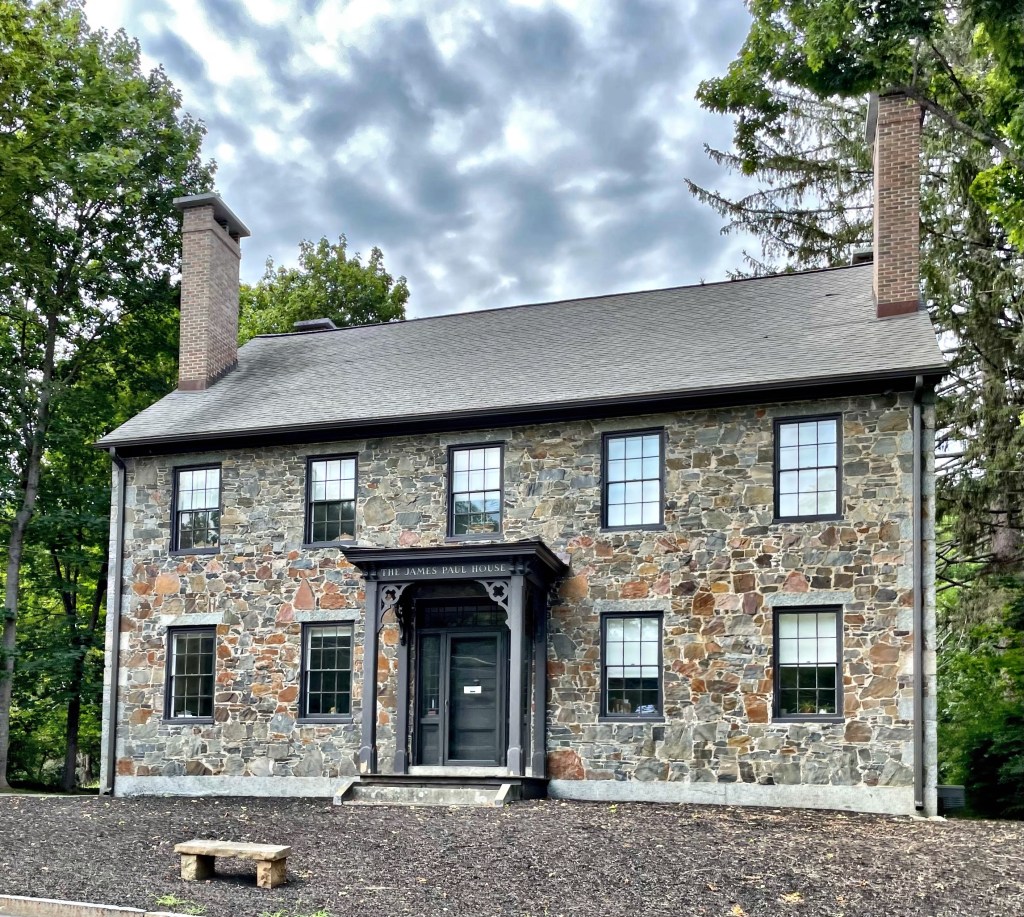
The James Paul House in Durham, NH, stands out as a rare example of stone construction in town. The house was built between 1830 and 1840, and is transitional Federal/Greek Revival in style. It has four tall chimneys (two on each slope of the roof), granite lintels over the windows, and granite quoins at the corners which together, create an elegant composition. Tragically, James Paul died unexpectedly when removing the staging on this house, he was never able to live in this beauty. The home was occupied by two reverends of a local church.
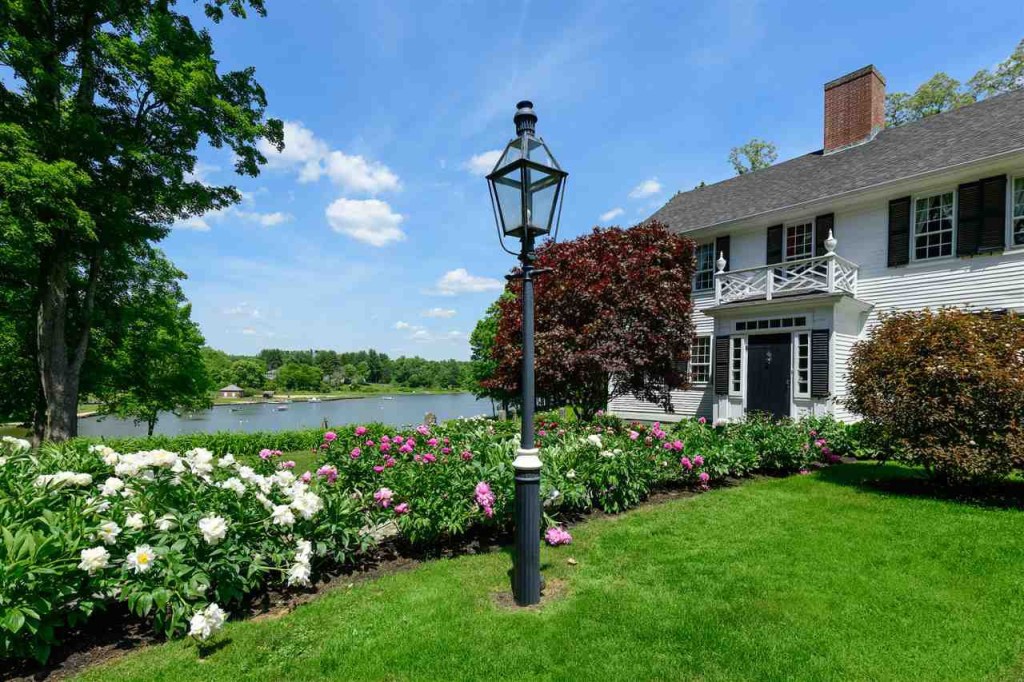
John Sullivan was born in nearby Somersworth, and studied law. He settled in Durham to practice law in 1763, and purchased this house in 1763 (it was built in 1740 by Reverend Hugh Adams). It served as his home for the rest of his life, and is buried in the family cemetery nearby. Sullivan was a vocal opponent of British rule in the colonies, and was elected to the First Continental Congress in 1774. In December of that year he led a raid on Fort William and Mary in which the colonial militia seized munitions stored there. He was appointed a brigadier general in the Continental Army in 1775, and served through the American Revolutionary War. He participated in the Siege of Boston, and was captured by the British in the 1776 Battle of Long Island. After being exchanged, he served in the Battle of Trenton, the Philadelphia campaign of 1777, the failed attempt to recapture Newport, Rhode Island, and the 1779 Sullivan Expedition, in which the Iroquois, who had largely sided with the British, were driven from upstate New York. Sullivan’s actions and barbed personality made him enemies in Congress, and he resigned from the army late in 1779. He returned to New Hampshire, where he served as Attorney General 1782-86, and as President (the office now known as Governor) 1787-89. He chaired the state convention that ratified the United States Constitution. His home was designated a National Historic Landmark in 1972, the most prestigious designation (more than listing on National Register of Historic Places). I encourage everyone to read his Wikipedia page, he was a fascinating and polarizing early Revolutionary, that I personally did not know about until researching.
Durham, New Hampshire, sits beside Great Bay at the mouth of the Oyster River, an ideal location for settlement, like the Western Abenaki and their ancestors who’ve lived in the region for an estimated 11,000 years. By 1633, English colonists were spread along the tidal shores of the Oyster River, and brought non-native livestock aboard their ships, “thousands of cattle, swine, sheep, and horses,” requiring them to clear acres merely for pasture. Formerly un-molested fields, carefully cultivated across centuries, were trampled and their crops destroyed. Due to this, violence between the native people and colonizers erupted, and livestock were frequently killed. The Abenaki saw them as a direct threat to their food supply. The Oyster River Plantation (as it was originally named by colonizers), was so named Durham in 1732 when it was incorporated, after County Durham in England.
Built in 1825 by Joseph Coe, local merchant and shipbuilder, this brick building was constructed as a prominent corner store with two stories of windows for commercial use and a top floor apartment. The brick structure is an excellent example of Federal style architecture in the Great Bay area of New Hampshire, and its location at the end of Main Street, where it converges with Dover and Newmarket roads, historic routes to the town’s neighbors, provided a lot of traffic of potential customers.After years of meeting in taverns and schoolhouses, the town selectmen voted in 1840 to purchase Coe’s Store for use as a town hall. They purchased the building, later opening the top two floors into one large meeting space. The town outgrew the building and relocated across the street, and since 1961, the building has been occupied by the Durham Historic Association and Museum.