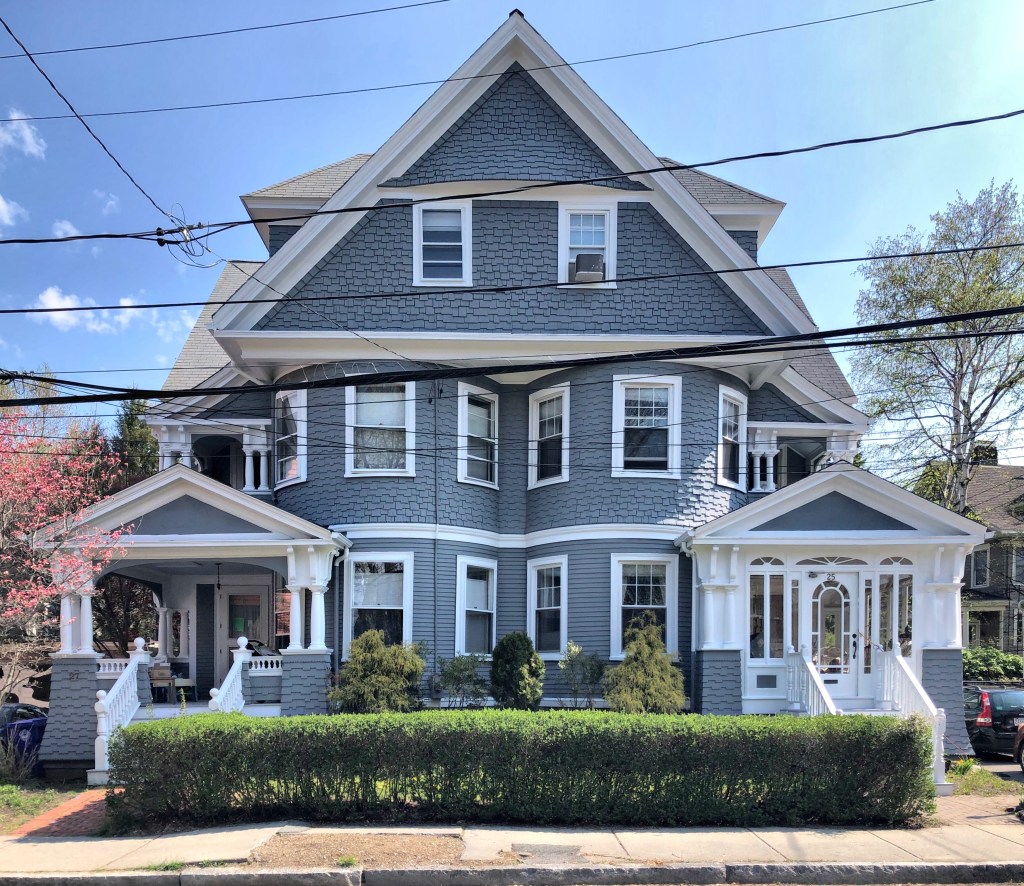
Johnston-Sullivan House // c.1894

One of the more exuberant and ornate homes in Roxbury’s Washington Park neighborhood is this charmer on Howland Street. The eclectic house was built in around 1894 for Ellen S. Johnston from plans by local architect Timothy Edward Sheehan and stands out for its preserved exterior in a neighborhood where many homes are covered in later siding, obscuring the ornate details underneath. Details include: swag and garland applied ornament, two bays at the facade (one polygonal and one rounded), a Colonial Revival style porch, and central rounded dormer. Wow!

Stephen S. Albro House // 1876

Stephen Stedman Albro (1817-1895) was born in Newport, Rhode Island, the son of James and Rhoda Albro. After attending local schools, he entered into a mason’s trade, eventually starting his own contracting business. He split his time as a contractor and as a Deacon of a local Baptist Church. He was engaged in local politics, serving as a alderman for Newport and even was a director of the National Exchange Bank in Newport for some years. He built this home on Green Street after his marriage to his second wife, Emma, possibly designing and constructing the house himself. The Albro House is a stunning example of a late-Italianate style dwelling with later Queen Anne/Colonial Revival embellishments. This is a special house!

John Reed House // c.1840

The John Reed House at 37 Orange Street in Nashua, New Hampshire is a testament that houses can be updated over time with thoughtful renovations, and still be pretty darn amazing! The house was originally constructed in 1840 in the then-popular Greek Revival architecture style. Within a decade, to ‘keep up with the Jones”, the house was “modernized” with Italianate style detailing, including the brackets at the eaves and the large, square cupola with round arched windows and shutters. Decades, later, Queen Anne/Colonial Revival changes were made, with the full-length front porch with turned, fluted posts, enlarged windows, and an oversized front door. The house today blends these very different styles very well and adds to the house’s significance.

Arthur Jones Double House // 1896

As Brookline Village developed in the mid-late 19th century, house lots were scarce. Demand for housing saw the demolition of a number of older 1840s Greek and Gothic Revival style cottages for multi-unit dwellings as duplexes and three-deckers which surged in popularity in the Village from the late 1890s to the 1910s when three-deckers were effectively banned in Brookline. In 1896-1897, Arthur R. Jones had large double houses built here and nextdoor, which were rented out to families. Newton architect Henry McLean designed these double houses as pairs of attached single-family dwellings separated by a brick party wall blending both Queen Anne and Colonial Revival styles under one roof. The homes show what housing was available to middle-class residents of the Boston area, a price-point that is unattainable to most in the area today. Though, it is great to see these old homes lovingly preserved so well by their owners!

Henry Thatcher Fowler House // 1903

Henry Thatcher Fowler (1867-1948) was born in Fishkill, New York, on March 4, 1867. He graduated from Yale in 1890 and received his Ph.D., also at Yale, in 1896. After stints teaching at Yale, Norwich Academy, and Knox College, Professor Fowler came to Brown and was hired as Professor of Biblical Literature and History; he was chairman of that department until 1932. Soon after arriving to Providence to accept his professorship at Brown, Henry and wife, Harriett, hired the local architectural firm of Martin & Hall to design a new home for them a few blocks away from his work. The house blends Tudor and Shingle styles with the ogee entrance at the porch, flared shingled overhangs on each floor, and a prominent gable facing the street.