Ancient Landmark Building // 1887

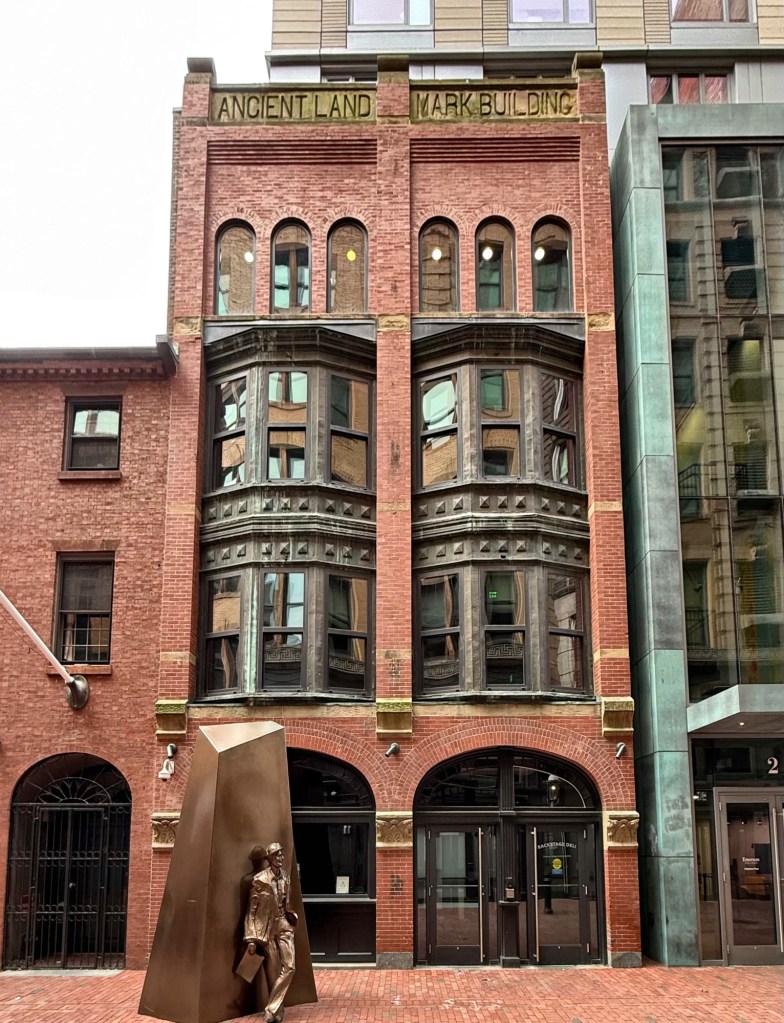
Tucked away on Boylston Place, a dead-end pedestrian way off the bustling Boylston Street in Boston, you will find a collection of 19th century buildings that have miraculously survived over a century of growth, urban renewal, and rebirth. This is the Ancient Landmark Building, constructed in 1887 as a IOOF Lodge. The Independent Order of Odd Fellows (IOOF) is a non-political, non-sectarian international fraternal order established in the United States 1819. The four-story Ancient Landmark Building blends Queen Anne and Romanesque Revival styles effectively with its two arched openings, arched windows in the top floor and two-story metal projecting bays. In the 1970s, the building was listed as “substandard” by the infamous Boston Redevelopment Authority, and luckily did not get demolished as part of its Urban Renewal push. The property was eventually acquired by Emerson College, a great steward for historic buildings and cultural institutions, who restored the building and built a new dormitory above and alongside the Ancient Landmark Building. The project preserves the important streetscape of Boylston Place, while providing needed dormitories for the school.
Little Building // 1917

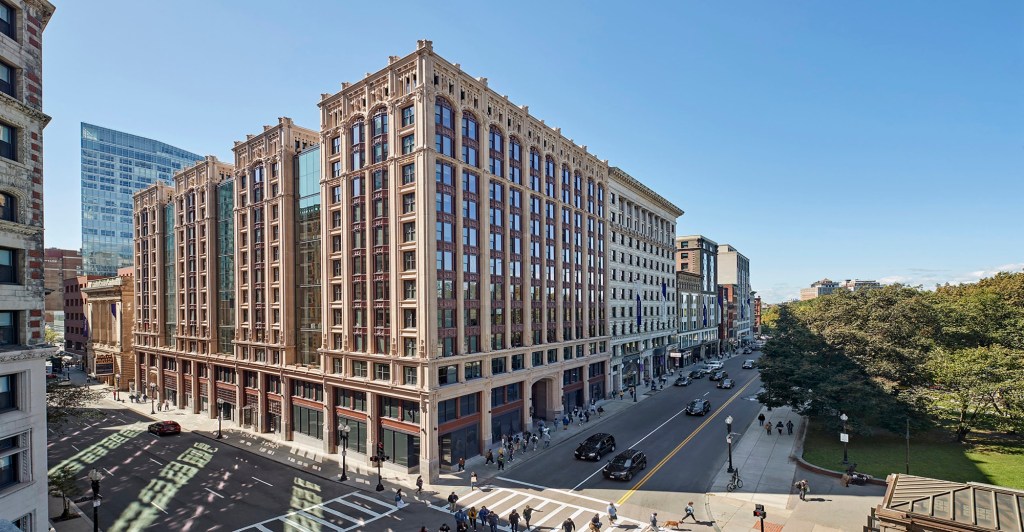
The Little Building sits prominently at the busy corner of Boylston and Tremont streets overlooking the Boston Common. Like the Colonial Theater next door, the Little Building was designed by architect Clarence Blackall and named after its developer and owner, John Mason Little. Blackall designed the Little Building in the Neo-Gothic style with a steel frame and a two-story Tudor-arched entrance on Boylston Street. The original facade was granite and cast stone, and the floors were made from reinforced concrete. The building replaced the Hotel Pelham which occupied the site since the 1850s. After being completed in 1917, the Little Building was considered significant enough that it was featured in American Architect and Building News, highlighting many architectural details inside and out. The Little Building was advertised as a “City Under One Roof” with 600 offices, dozens of shops, a post office, restaurants, and connections to the nearby subway and theaters. Emerson College purchased the Little Building in March 1994 for $5 million and converted the building to dormitories. After years of deteriorating masonry, Emerson College hired Elkus Manfredi Architects to oversee a full renovation of the building, including a sweeping facade restoration and the insertion of three glazed elevations between street-facing light wells. The “new” Little Building is a splendid re-imagining of a historic building, showing how old buildings can be renovated to meet contemporary uses through well intentioned design and care.

Colonial Theater Building // 1899

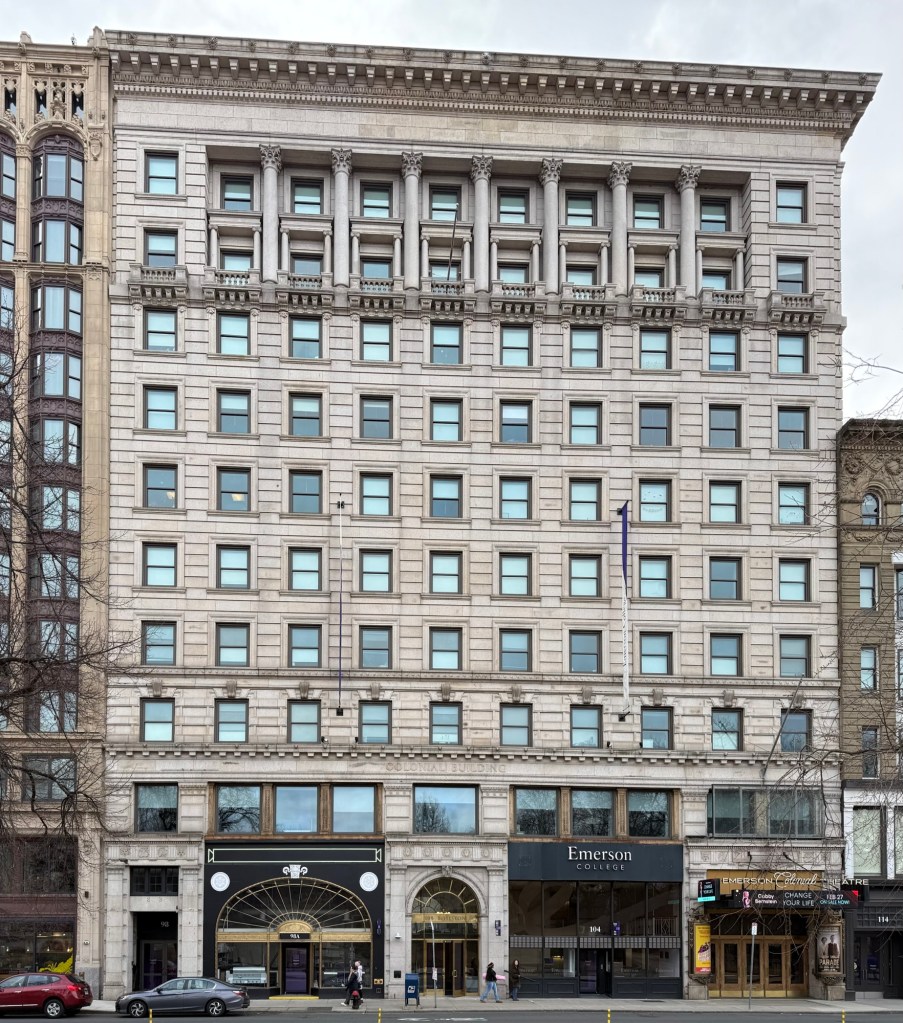
One of my favorite buildings on Boylston Street in Boston is the ten-story Colonial Theater Building, a landmark Classical Revival style structure of stone. Built in 1899, the Colonial Theater replaced the original Boston Public Library building (1855) which was demolished by 1898, and relocated to Copley Square. The Colonial Theater was designed by famed theater architect, Clarence Blackall and is said to be the oldest, intact theater in Boston. The theatre first opened its doors for a performance of Ben-Hur on December 20, 1900 with a sold out show. Ben-Hur operated with a cast and crew of 350 people and featured eight live horses on stage in full gallop during the chariot race scene, with the play being so mechanically and technically extraordinary it was featured on the cover of Scientific American. While cheekily named the Colonial Theater, the interior theater spaces were anything but. The spaces originally contained murals and Baroque style finishes, many of which remain today. Beyond the 1,700-seat theater, the building contained between 250-300 professional offices. The building is owned by Emerson College, who underwent a massive restoration project of the building with Elkus Manfredi architects. Allowing the oldest Boston theater to shine again!

Walker Building // 1891

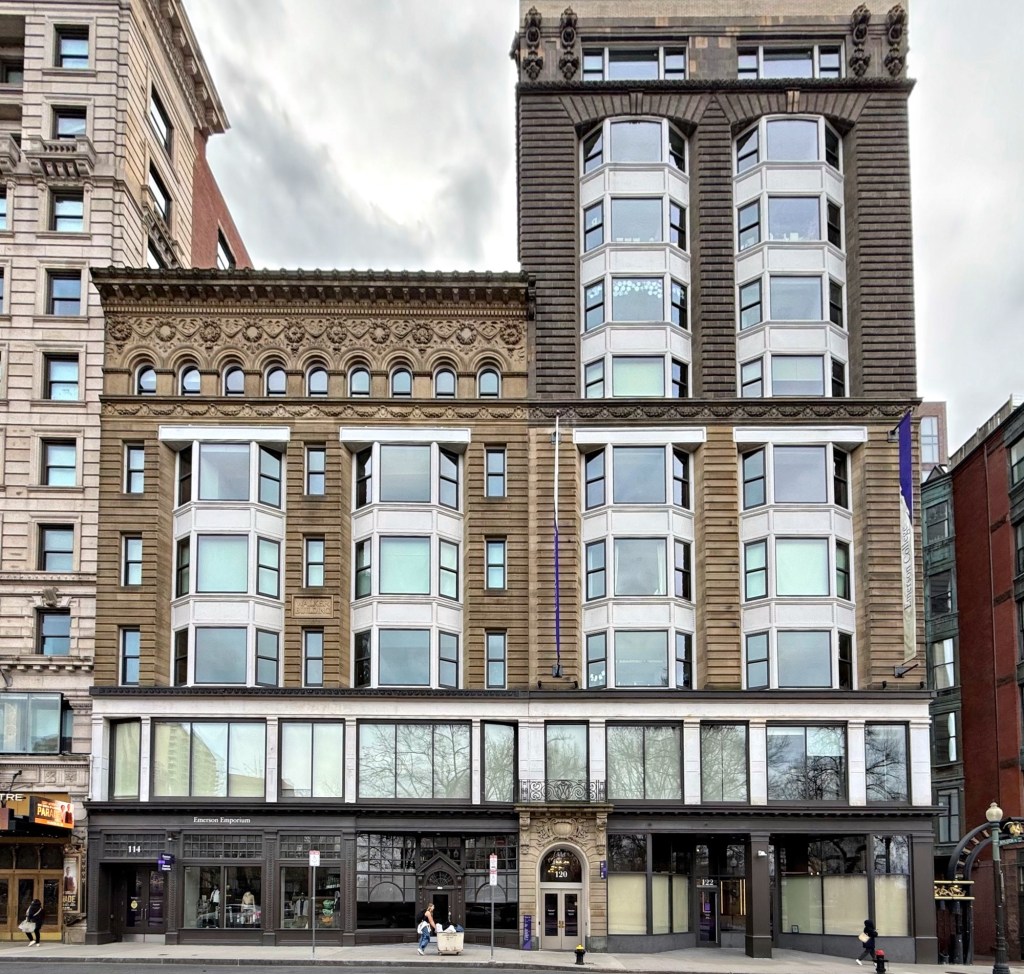
On Boylston Street overlooking the Boston Common, this historic building with two distinct parts is not photographed as much as some of its neighbors, but it is an important visual reminder of the period of growth and development in the city in the late 19th and early 20th centuries. This is the Walker Building, an early office building that was constructed beginning in 1891 in two phases by owner Joseph W. Walker. Mr. Walker hired the architectural firm of Winslow & Wetherell to design the building, which was finished in the Romanesque Revival style with a notable cornice with nine-bay arcade of arched windows and ornate wreath and swag motifs. A major tenant in the building was the Boston office of the S. S. White Dental Manufacturing Company, the largest dental manufacturing company in the world. Less than a decade after the six-story Walker Building opened, Joseph Walker purchased and razed the parcels nextdoor and again hired the same firm (at this time renamed Winslow & Bigelow), to expand the Walker Building, building a ten-story addition in a similar style. The second Walker building housed piano company showrooms and offices along with professional offices of numerous architects and professionals. The Walker Building is now owned by Emerson College, and is used as classrooms, computer labs, and study spots for students with the dining center and bookstore in the former retail spaces.